

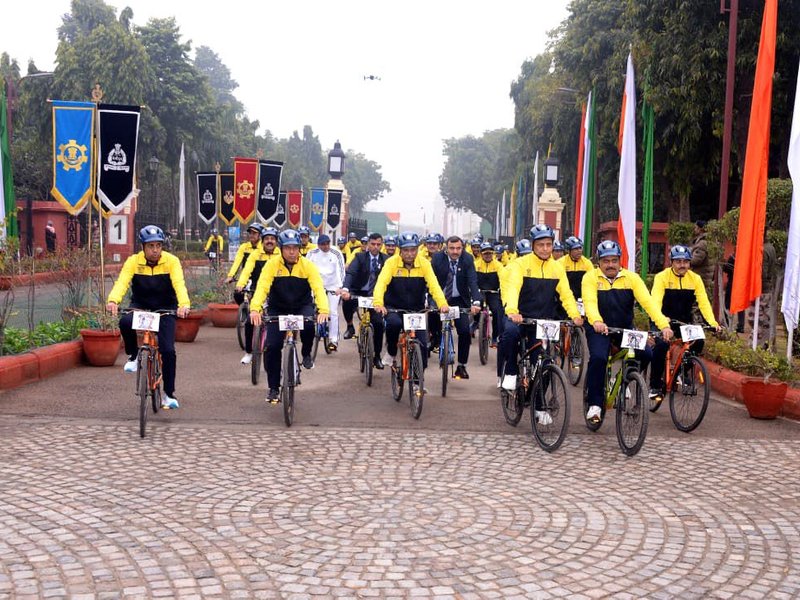
NEW DELHI, Feb 22: The 25- day- long Central Industrial Security Force’s ‘Vande Mataram Coastal Cyclothon 2026’ concluded on Sunday at Kochi in Kerala, after covering 6,553 kilometres of India’s eastern and western coastlines.
The journey of the CISF personnel had started on January 28, which was virtually flagged off from New Delhi by Minister of State for Home Affairs Nityanand Rai, and had culminated in a nationwide movement. The cyclothon reached out to the people living along the coasts, uniting the communities, youth, women, fishermen, sister security agencies, industry stakeholders and civil society under one theme that is “Surakshit Tat, Samridh Bharat” (Secure Coasts, Prosperous India).
DG CISF Praveer Ranjan said that, “What we are witnessing through this Cyclothon is the emergence of a confident, aware and inspired coastal India. When young girls see women in uniform leading from the front, when students cycle alongside our personnel, security becomes an aspiration. This initiative is about turning awareness into action and citizens into partners in national security,” he added.
The valedictory ceremony was attended by Bandi Sanjay Kumar, Minister of State for Home Affairs, and DG CISF along with senior officer from Central Armed Police Force.
Traversing nine states and two union Territories, the Cyclothon connected historic ports, bustling industrial hubs, fishing villages and tourist beaches.
This initiative also contributes to strengthening coastal security by establishing better coordination with the coastal communities, which are very important.
With over 250 ports handling nearly 95 per cent of the country’s trade, securing the coasts is inseparable from economic prosperity and energy resilience.
From Lakhpat Fort in Gujarat to Bakkhali in West Bengal, through Mumbai’s Gateway of India, Goa’s iconic shores, Karnataka’s New Mangalore Port, Odisha’s historic coastal belts, Andhra’s fishing harbours and Tamil Nadu’s southern maritime stretches, the initiative of the CISF spread more awareness about threats such as narcotics trafficking, arms smuggling and infiltration amongst the coastal population, reinforcing the need for community vigilance as the first line of defence.
The CISF cyclists halted overnight at the important 52 coastal villages shortlisted by the force , lived among the residents, shared meals, participated in local cultural programmes, and held open dialogues with fishermen, elders, youth groups and women’s self-help collectives.
These interactions were not just symbolic, but strategic and sincere conversations about livelihood challenges, environmental concerns, maritime risks and developmental aspirations.
Notably, CISF’s 47 coastal units, which are strategically located near the coastline, will be spearhead this long-term engagement drive to ensure continuity beyond the cyclothon event, and work on transforming awareness into sustained partnership.
It is noteworthy that 50 per cent women personnel participated in the cycling contingent, which clearly stood out as a powerful symbol of change.
Young girls cycled alongside the CISF teams, and asked questions about training and careers, and expressed interest in serving the county wearing a uniform.
Interestingly, the families in the places along the coasts openly acknowledged the motivational impact of seeing women lead such an initiative.
(UNI)
 Follow our WhatsApp channel
