

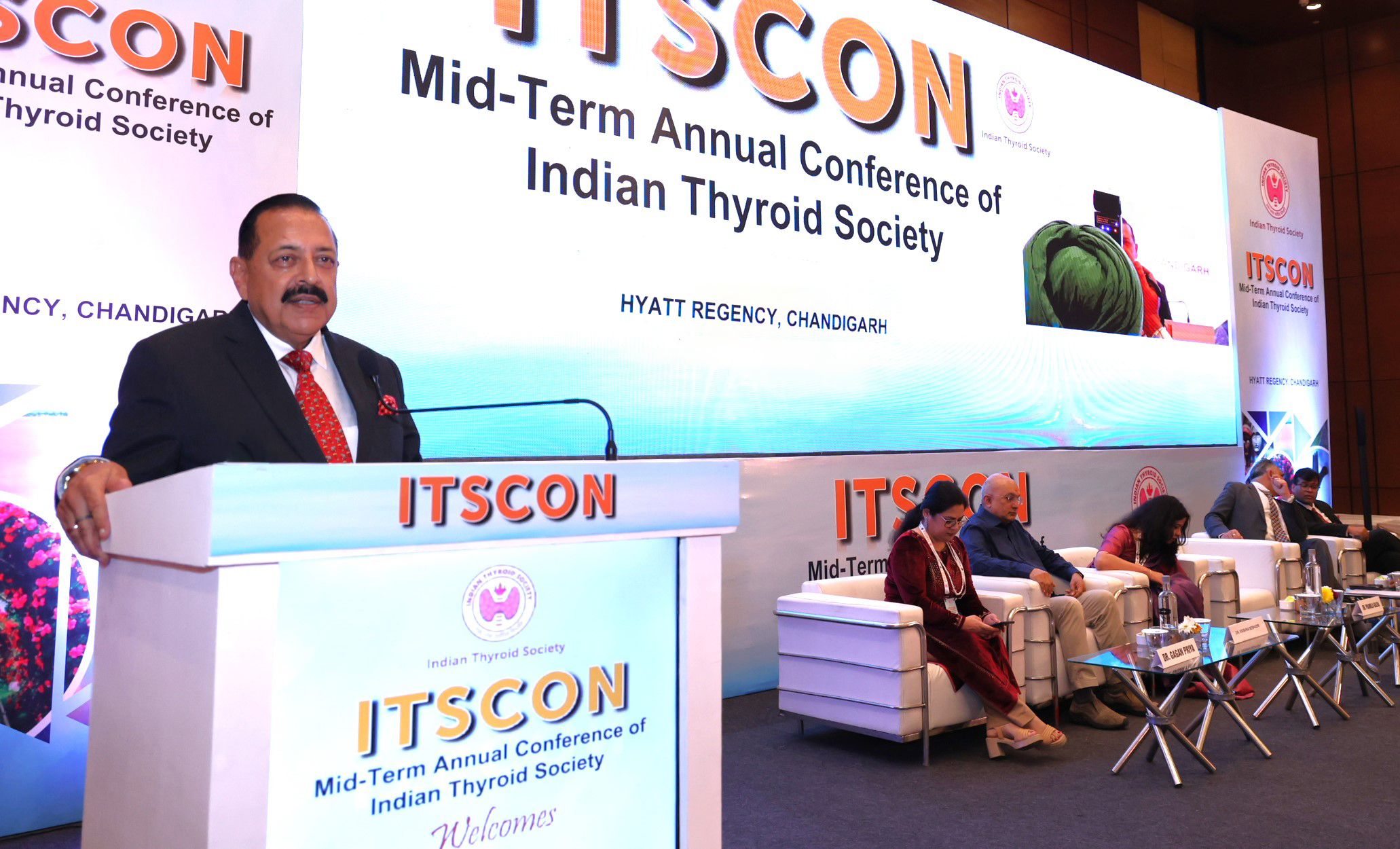
CHANDIGARH, Feb 9 : Union Minister of State (Independent Charge) for Science & Technology, Earth Sciences, and MoS PMO, Personnel, Public Grievances, Pensions, Atomic Energy and Space, Dr. Jitendra Singh today said that the Modi Govt’s reforms over the past decade promise to propel India as a global hub for affordable therapeutics and diagnostics.
Delivering the inaugural address at the “Indian Thyroid Society” Conference, the Minister who is also a Professor of Medicine, said that thyroid disorders must be viewed not merely as clinical conditions but as a national concern linked to human productivity, demographic strength, and the broader task of nation building.
Addressing leading endocrinologists and medical experts, the Minister said that undiagnosed and untreated thyroid conditions, particularly hypothyroidism, impact energy levels, workforce efficiency, and long-term national output, especially in a country where over 70 percent of the population is below 40 years of age.
Dr. Jitendra Singh was addressing the inaugural session of the Mid-Term Annual Conference of the Indian Thyroid Society (ITS) held at Chandigarh. The conference saw the participation of eminent endocrinologists, senior faculty members, nuclear medicine specialists, surgeons, and researchers from premier medical institutions across the country. Appreciating the organisers for choosing Chandigarh as the venue, he described the city as an important academic and research centre in North India with strong institutional presence contributing to medical science.
Referring to the estimated 42 million Indians living with thyroid disorders, Dr. Jitendra Singh said that the scale of the challenge demands proportionate research attention and public health response. He stated that hypothyroidism affects nearly 11 percent of the adult population, with a substantial number remaining undiagnosed or untreated. He drew attention to the serious implications of undetected hypothyroidism during pregnancy, which can lead to congenital hypothyroidism and irreversible neurodevelopmental consequences in children if not addressed through timely screening and intervention.
The Minister observed that while diseases such as diabetes and obesity often receive significant focus, thyroid disorders remain relatively under-recognised despite their widespread prevalence. He called for stronger multidisciplinary coordination across life sciences, medical sciences, and allied sectors to address thyroid disorders in a comprehensive manner. He said that medical issues of this magnitude cannot be left to a single domain and require wider societal awareness and institutional collaboration.
Placing the discussion in the context of the Government’s scientific reforms over the past decade, the Minister said sustained efforts have been made to dismantle silo-based functioning and promote synergy among research institutions, academia, industry, and technology developers. He emphasised that innovation must move beyond laboratory research to market-linked application, and that industry participation from the early stages of research strengthens sustainability and impact.
Referring to recent Union Budget announcements, he spoke about the Biopharma Shakti Mission with a substantial financial allocation aimed at boosting indigenous development of drugs and medical instruments. He cited India’s progress in biotechnology, including the development of the country’s first indigenously developed antibiotic effective against resistant infections, successful gene therapy trials for haemophilia, and the rollout of the DNA vaccine during the COVID-19 pandemic. These achievements, he said, reflect India’s growing capability in cost-effective therapeutics and diagnostics.
Dr. Jitendra Singh also spoke about the establishment of the Anusandhan National Research Foundation (ANRF) and the ₹1-lakh-crore Research Development and Innovation framework to strengthen the research ecosystem with participation from private and philanthropic sectors. He noted the rapid growth of India’s startup ecosystem, the increase in patent filings by Indian residents, and the rise in high-impact scientific publications as indicators of a transformed scientific landscape.
Calling doctors “true nation builders,” the Minister said that every timely diagnosis, early neonatal screening, and effective treatment contributes directly to shaping India’s future human capital. He urged the Indian Thyroid Society and the wider medical fraternity to intensify awareness, research collaboration, and early detection strategies so that thyroid health becomes an integral part of the national development discourse.
Dr. Jitendra Singh concluded by expressing confidence that with collective resolve, scientific integration and forward-looking collaboration, India can effectively address the growing burden of non-communicable diseases, including thyroid disorders, while strengthening its journey towards a resilient and self-reliant future.
 Follow our WhatsApp channel
