

Piotr Opaliński
Relations between Pakistan and Taliban-ruled Afghanistan are currently among the most unstable elements of South Asia’s security architecture. Increasing border incidents, escalating political tensions, and growing activity of extremist groups indicate that the Islamabad-Kabul conflict has transcended the framework of incidental crises and taken on the character of a chronic regional threat. The beginning of 2026 confirmed this trend, bringing further militarization of the border, continued trade blockades, and a deepening diplomatic impasse.
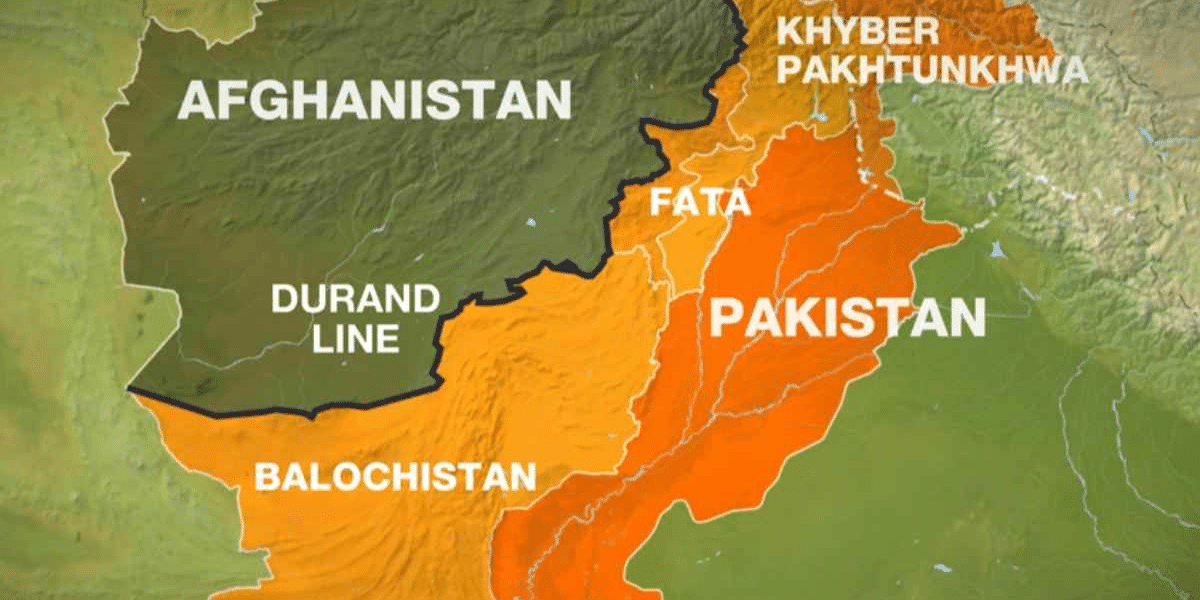
The consequences of the crisis extend beyond bilateral relations, affecting the interests of China, Iran, Russia, India, and Central Asian states, as well as the security of regional trade routes. Its axis is defined by the Durand Line – the border drawn in the 19th century between Afghanistan and British India, and since 1947, Pakistan. It divides ethnically Pashtun lands and has never been formally recognised by Afghan governments, thus failing to serve a stabilising function. It has become a permanent arena of political, military, and narrative rivalry, where state, tribal, and ideological interests intersect, as well as Islamabad’s strategic aspirations and the Taliban’s need to consolidate power.
Islamabad treats securing the border not only as an element of protecting internal security but also as an instrument for managing escalation with Kabul, particularly in the context of the growing activity of the Pakistani Taliban movement (Tehrik-i-Taliban Pakistan – TTP). In turn, the Afghan Taliban are using the dispute with Pakistan to strengthen their internal legitimacy and social mobilisation, although their ability to effectively control the border remains limited by the fragmentation of the power apparatus and the autonomy of local tribal structures.
Military escalation and narrative rivalry
Armed clashes regularly occur along the border, particularly in Chaman, Spin Boldak, Kurram, and Angoor Adda regions. Tensions stem from three overlapping factors: Kabul’s questioning of the border’s legitimacy, tightening of Pakistani control, and use of these areas by the TTP as an operational base.
The border has also become an arena for narrative rivalry. Kabul portrays Pakistan’s actions as an attempt to impose a colonial order, while Islamabad interprets the Taliban’s stance as indirectly tolerating terrorist threats. The escalation was deepened by Pakistani airstrikes in Paktika and Khost provinces after the Peshawar attack in November 2025, as well as subsequent ground and air operations in Afghanistan, resulting in losses among TTP fighters, civilian casualties, and the temporary closure of border crossings.
Economic Pressure, Deportations, Demographic Dimension
In 2024–2025, the crisis also encompassed economic and demographic dimensions. Pakistan introduced restrictive visa regulations, transit restrictions, and mass deportations of Afghans without valid identity documents – over 1.5 million people. For Islamabad, this was part of a strategy of conditionality and deterrence, justified by security concerns and the activities of the TTP (Tehrik-i-Taliban Pakistan). Beginning 2026, the pressure continued, and the prolonged closure of the main border crossings – Torkham and Spin Boldak – paralyzed legal trade. Afghanistan’s losses reached hundreds of millions of dollars, and rising food and fuel prices deepened the humanitarian crisis. Pakistan experienced a decline in transit revenues and increasing social tensions in the border provinces.
Internal Conditions in Pakistan & Afghanistan
Islamabad’s pressure on Kabul is not solely a reaction to external threats. It’s also part of a broader strategy of internal stabilisation, often implemented at the expense of regional relations. Pakistan’s policy is conditioned by the economic crisis, civil-military tensions, and the dominant role of the army in defining security priorities. The escalation of actions at the border and the tough policy towards migrants serve to consolidate power in the centre and create political justification for extraordinary security measures. These actions are also used in internal disputes with the opposition (Imran Khan’s PTI) and the authorities of the Khyber Pakhtunkhwa province.
Erosion of Communication Channels &Activation of TTP
The most persistent source of the crisis remains the activity of the TTP and Kabul’s limited ability to neutralize it. The TTP operates in a decentralized, tribal environment, often beyond the real reach of the state apparatus. Between 2023 and 2025, the group evolved from a loose coalition into a more coordinated cross-border network, focusing on military targets and testing Pakistan’s deterrence capabilities.
In December 2025, TTP leadership council, the Rahbari Shura, approved a new administrative and operational structure for 2026. This includes, among other things: establishment of two new management zones, so-called shadow provinces – the Western Zone (Balochistan) and the Central Zone, each with its own military commander-in-chief. New units were also brought under TTP control, including the Kashmir province, and Gilgit was divided.
ISKP Factor in Regional Instability
Parallel to the threats generated by TTP, the regional landscape of instability is complicated by the presence of an actor with ambitions extending beyond the Pakistani-Afghan dimension – the Islamic State Khorasan Province (ISKP). Although its operational capabilities are limited, the group maintains a flexible, cellular mode of operation, enabling it to adapt to military pressure and exploit gaps in border control.
The rivalry between ISKP and the Afghan Taliban is both ideological and operational. ISKP challenges the religious legitimacy of the Islamic Emirate, accusing the Taliban of nationalism, political pragmatism, and deviation from the doctrine of global jihad, which facilitates the recruitment of radicalized fighters.
Regional Dimension & Adjustment of External Actors’ Approaches
The protracted Pakistani-Afghan crisis is prompting regional and global actors to revise their previous assumptions regarding Afghanistan. China is making infrastructure investments contingent on the actual level of security, treating stability as a condition for the successful implementation of projects; Iran is developing alternative logistical routes, reducing Afghanistan’s dependence on Pakistan; India maintains working contacts with the Taliban and supports humanitarian and infrastructure projects as an instrument to limit the influence of Pakistan and China. Its involvement in the Chabahar port is formally strategic but limited by US pressure. India is suspending full-scale investments, making them dependent on the predictability of the Taliban’s policies and Washington’s stance. Russia is offering mediation, framing the crisis in terms of Central Asian security.
These actions indicate a fragmentation of external approaches and a shift from declarative stabilization to conditional, selective pragmatism towards Kabul. The effectiveness of mediation remains low due to the asymmetry of expectations of the parties and the limited influence of the mediators. From the perspective of the EU and Poland, maintaining dialogue channels provides important signals for planning humanitarian activities, monitoring migration pressure, and analyzing cross-border risks.
Development of the Situation
Four scenarios are possible in the next two years. One, continuation of controlled escalation – maintaining pressure at the border, deportations, limited goods and passenger transit; Two, Multilateral mediation – temporary freezing of escalation with the support of Qatar, Turkey, China, Russia, and selective involvement of the US; implementation of monitoring and crisis communication mechanisms; Three, Technical de-escalation – limiting TTP activity through operational and intelligence actions, without full normalization of bilateral relations and four, regionalization of the crisis – involvement of external actors, further fragmentation of trade routes, and deepening of cross-border instability.
Indeed, the Pakistani-Afghan confrontation is structural and long-term. The lack of credible dialogue formats and effective escalation control mechanisms means that the Pakistani-Afghan border remains one of the most unstable areas in South and Central Asia. Any international mediation will be hampered by asymmetrical expectations and limited capacity to enforce agreements. The risks are systemic and extend beyond the regional dimension, indirectly affecting the security of the wider Eurasian region.—INFA
 Follow our WhatsApp channel
