

Ashok Ogra
ashokogra@gmail.com
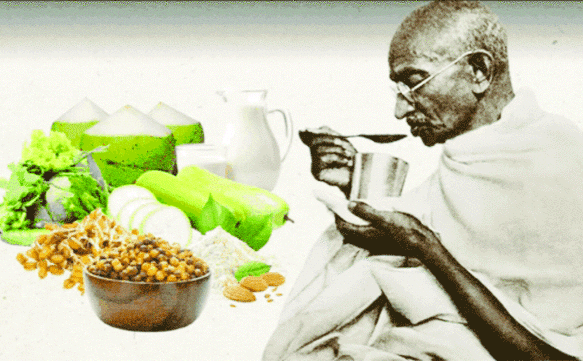
As the nation observed January 30 as Martyrs Day, it was also a moment to reflect on Mahatma Gandhi simple food habits and the discipline that shaped his life.
Historians estimate that Gandhi walked about 79,000 km-roughly equal to circling the earth twice over 35 years. This translates to nearly 18 km every single day. He believed that this simple daily routine played a crucial role in keeping him physically fit and mentally alert.
Fasting was another major part of his life. He fasted on 17 occasions, sometimes for political reasons, sometimes for moral or spiritual discipline. His longest fast lasted 21 days, during which he consumed only water and a little lime juice. These fasts were also a way to cleanse the body and cultivate discipline.
Interestingly, Gandhi’s experiments with food were as interesting as his fasts. He tried almost everything: non-vegetarian food, eggs, vegetarian diets, vegan experiments, and even raw food. He wrote about these experiences in ‘Harijan’ and ‘Young India’, the journals he edited.
During the Champaran Satyagraha (1917), Batak Mian worked as a cook for a British indigo planter named Erwin. According to various accounts, Erwin wanted the cook to mix poison into milk intended for Mahatma Gandhi. Batak Mian refused to follow the order and thereby helped avert the danger.
Before leaving for London in 1888 to study law, he promised his mother that he would avoid meat and liquor. He kept that promise throughout his stay in England-though he often remained hungry because vegetarian food was hard to find at that time. He even gave up spices and survived mostly on boiled or raw foods.
In London, one day he noticed a book displayed in a vegetarian restaurant window: Henry Salt’s ‘Plea for Vegetarianism.’ He read it completely and later said it had a profound impact on his thinking.
Before reading Salt’s book, Gandhi said he was a vegetarian merely by custom and tradition. After reading it, he became a vegetarian by choice. Inspired by this new belief, he even founded a local branch of the Vegetarian Society in his neighbourhood, and argued for vegetarianism vigorously.
During his visit to Buckingham Palace in 1930, Gandhi had tea and goat’s milk with King George V; they discussed diet, and both chose a simple vegetarian luncheon together.
His support for vegetarianism was not only on health grounds. It was also moral. He believed: “Man was not born a carnivorous animal, but born to live on fruits and herbs that the earth grows.”
In books such as Diet and Diet Reforms, The Moral Basis of Vegetarianism and Key to Health, Gandhi described his constant experiments with diet, trying to balance energy, health and a life of simplicity. For him, eating was tied to self-control, not indulgence.
Gandhi took a vow not to drink cow’s milk after learning about the cruelty inflicted on cows. But his health deteriorated and he needed some form of animal protein. Suspicious of pulses because he felt they caused gas, he had few other options. On Kasturba’s suggestion, he finally agreed to drink goat’s milk-arguing that when he took the vow, he was not thinking of goats.
Milk, in his view, was essential for vegetarians since it remained one of the few sources of animal protein for them.
Cereals, Gandhi believed, were key to making India healthy-wheat, rice, bajri, jowar and so on. Since all cereals supply starch, he suggested consuming only one type at a time. He called wheat “the king among cereals”.
Proteins were, of course, essential. Gandhi believed pulses were needed-especially locally grown varieties. Yet, he felt that people who led sedentary lives and consumed sufficient milk did not need pulses. This view will sound unusual to many today, but it shows how deeply he thought about the needs of different lifestyles.
He was ahead of his time in warning against over-polished rice or too finely-refined wheat flour. He preferred hand-pounded brown rice and suggested using flour exactly as it comes from the grinding stone, without sieving. The outer layer of the grain, he said, contains precious salts, vitamins and roughage. Removing it is harmful. Today’s modern nutrition science fully agrees with him.
Modern nutritionists often recommend a mix-millets plus wheat or rice-for complex carbohydrates. But Gandhiji stressed moderation in all carbohydrate-rich foods.
On fats and oils, he believed they were necessary for the body, but should be consumed in moderation. He had a special place for ghee, even saying that if ghee is available, oil becomes unnecessary. Oils, he felt, were harder to digest and less nourishing. He recommended one and a half ounces of ghee per person daily, and said those who cannot afford ghee should consume enough oil to meet their body’s fat requirements.
From his reading, he concluded that sweet oil (vegetable oil), groundnut oil, and coconut oil were preferable. But he strongly opposed vanaspati (hydrogenated vegetable oil), which he believed was unhealthy and was also widely used to adulterate ghee during those days.
Writing in ‘Harijan’ (February 1, 1935), Gandhi praised jaggery. He wrote, “Gur is any day superior to refined sugar in food value.” He feared villagers were abandoning traditional jaggery-making and warned that children would lose an important nutritional food item. He advised avoiding sweets as much as possible.
On eggs, contrary to what many believe today, Gandhi never clearly called them vegetarian. He simply argued that sterile eggs-which never develop into chicks-should not be considered flesh foods. “Therefore, anyone who can take milk,” he reasoned, “should have no objection to taking sterile eggs.”
He discouraged onion and garlic but encouraged vegetables, fruits, curd and leafy greens. Today, when lifestyle diseases have become widespread, terms like “low oil, low salt, low sugar, farm fresh, and local food” dominate our health conversations. Gandhi had been saying all this nearly a century ago.
Food, for him, was also a way to bring people together. He often asked: Why shouldn’t a Gujarati be able to cook dishes that a Tamilian or Bengali enjoys? Why restrict diets to regions? Rich people will always have special dishes. What matters is creating simple, every day, nutritious food that everyone can access. For him, such common dishes helped unite people across caste, class and region.
Cleanliness and regular bowel movement were almost an obsession with him. Whether in Tolstoy Farm or Indian ashrams, he insisted on personal hygiene, sanitation and discipline. He said, “Everyone should be his own scavenger.” When we speak today about Swachh Bharat or Swasth Bharat, we are echoing his ideas.
He encouraged people around him to experiment with their diets and avoid blindly copying others. He always stressed making food choices that caused the least harm to plants and animals. Reading Gandhi’s letters is fascinating-he could move instantly from writing to a Viceroy or a senior political leader to advising an ashram follower on what to eat at dinner.
He believed in minimalism in diet, as in everything else. Food, in his view, was energy and medicine-and should be taken in minimum quantity, only as required to keep the body fit for work. He repeatedly warned against overeating or eating simply to satisfy taste buds.
While travelling abroad, he kept to his diet but remained courteous, even passing wine glasses along a table without drinking. Even Barack Obama once remarked that he would have liked to dine with Gandhi, joking that it would be “a really small meal” because Gandhi did not eat much.
He encouraged people around him to experiment with their diets and avoid blindly copying others. Reading Gandhi’s letters is fascinating-he could move instantly from writing to a Viceroy or a senior political leader to advising an ashram follower on what to eat at dinner.
In an age of processed food, excess sugar, sedentary lifestyles and rising lifestyle diseases, his simple principles-walk more, eat simple, eat local, stay clean, experiment thoughtfully, and respect all living beings-offer timeless guidance.
As we remember the Mahatma, it helps to recall that his message was not just about politics. It was also about how we live, what we eat, how we walk, and how we care for our health and surroundings. His simple food habits are still a quiet but powerful part of his legacy.
(The author works for the reputed Apeejay Education, New Delhi.)
 Follow our WhatsApp channel
