

Dr. Banarsi Lal
kvkreasi@gmail.com
Union Territory Jammu and Kashmir is endowed with different agro-climatic conditions and topography. There is enormous scope for strengthening various commercial horticultural activities to enhance the income of the farmers. Horticultural sector contributes immensely to strengthen the financial condition of J&K. This is a core sector of Jammu and Kashmir agriculture and about 4.5 lakh families are engaged in it. Around 20 per cent area of the UT is under horticultural crops. Horticultural sector contributes around 5000 crores to the annual income of Jammu and Kashmir. Among the horticultural crops in the UT apple occupies the predominant position constituting around 45 per cent of the total area under fruit crops. Horticultural activities major thrust is given in hilly areas. The fruit crops grown in this UT are almonds, walnuts, pears, cherries and apricots in temperate areas and mango, citrus, litchi, ber, papaya, guava etc. in subtropical areas. Saffron cultivation in Jammu and Kashmir is unique in the world. The annual production of Saffron in J&K ranges from 10 to 20 tonnes. The J&K government has made strenuous efforts to increase horticultural crops production. SKUAST-J& SKUAST-K has made great efforts to introduce new interventions in horticultural sector in J&K. Incentives are given to the horticultural crops growers by the departments of the UT to develop orchards in Kandi and hilly areas. Subsidy to the extent of 50% of fruit plants and inputs used by the farmer are provided. It has been observed that around 40 lakh tones of fruits are exported annually from J&K.
Horticultural sector contributes significantly to the economic and ecological development, employment generation, export and nutritional requirement of the people of UT. Horticultural crops are adapted to a wide range of climatic conditions, produce higher biomass per unit area as compared to field crops, are more remunerative for replacing subsistence farming and thus may aid in alleviating poverty in difficult agro- ecosystems as rain fed, dry land and hilly areas OF J&K. There is also great potential to improve wastelands for productive use in the UT. These crops require lesser irrigation and provide higher employment opportunities round the year. Increase in demand for horticultural produce due to great health awareness, rising income, export demand and increasing population poses the challenge for further increasing the production and productivity of horticultural crops. The issue of climate change and climate variations has resulted in more uncertainties and risks in this already high capital intensive system. This has resulted in further aggravating the constraints on horticulture production system. The major challenges before us is to have sustainability, higher levels of production, competitiveness to stay in market, regular production, land, water and more importantly threat of climate change. In order to meet the above challenges, we need innovations for improving horticultural crops production in new era.
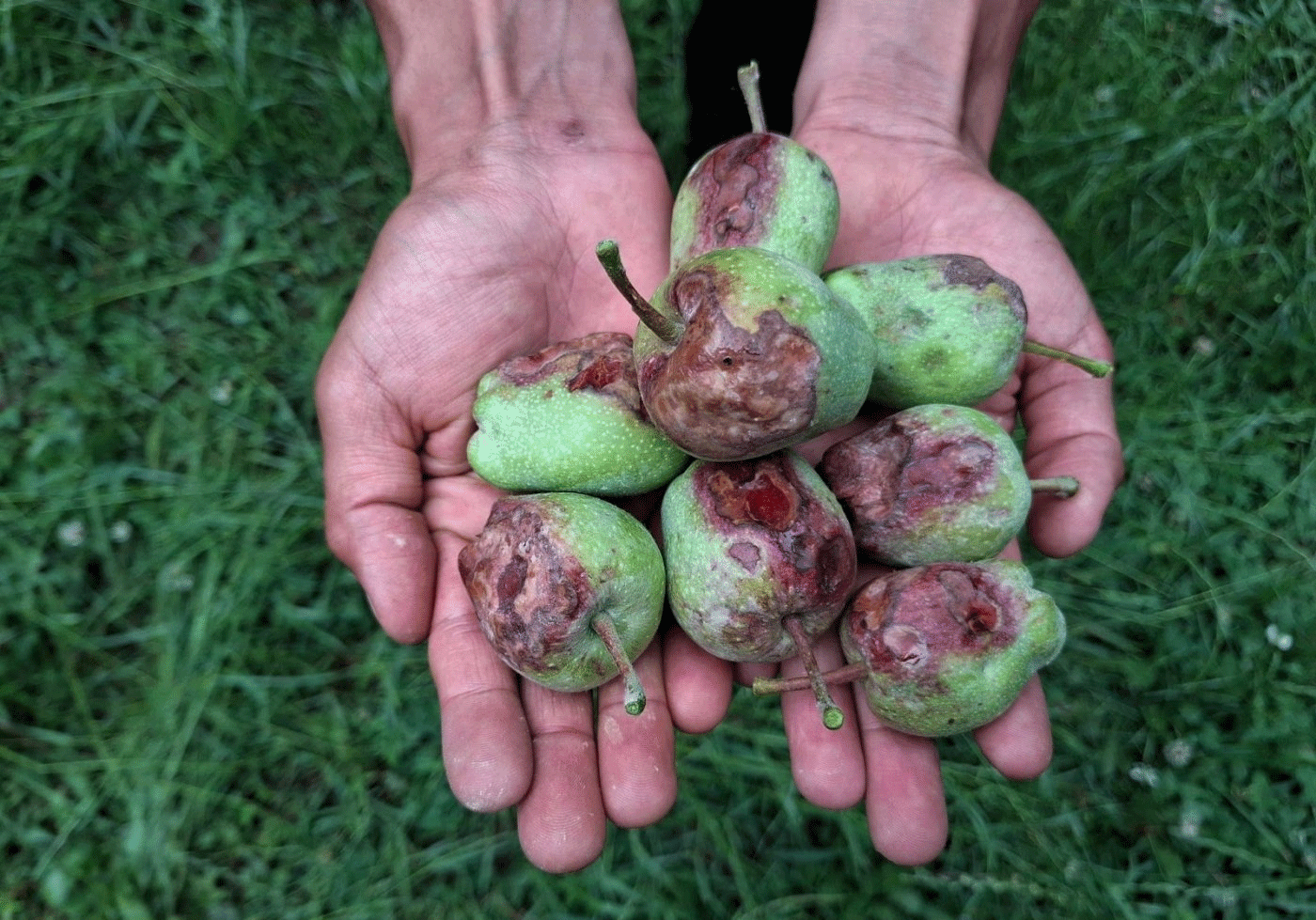
Global warming is having an impact on agricultural productivity;this has implications for food security.Horticultural crops have been impacted by the high temperatures Kashmir and moderate temperature in Jammu.The harsh weather has a negative impact on these blossoming crops.he earth’s climate makes small adjustments so as to maintain a firm balance between the energy reaching earth surface and energy reflected out of it. Even a small rise in temperature could mean substantial changes in cloud cover and wind pattern. Some changes may enhance warming or some may counteract warming effects. Increase in small particles of matter or liquid produced naturally or by man made activities known as aerosols results in cooling effect. Increase in water vapour due to increase in evaporation due to high temperatures can further add to rise in warming effect. The significant change may impact horticultural crops production. Climate change results in erratic rainfall pattern, heat waves, more warm spells and crop failures. However, climate change may have some beneficial effect to a limited extent. The vulnerability of horticulture depends on both expected regional climate change and that sector’s ability to adapt to the change. The projected or anticipated increase in temperature, variability in precipitation pattern and increase in frequency of extreme weather events such as heat, cold waves, frost days, drought and floods would severely affect the production of horticultural crops. This stress at different crop development phases in varying intensities would ultimately determine productivity and quality.The Indian climate is dominated by monsoon, responsible for most of the regions precipitation, poses excess and limited water stress conditions. Fruit crops being sensitive and succulents are generally more sensitive to environmental extremes. High or low temperatures and water stress are the main cause of low yields. Under climate change scenarios the impact of these stresses would be compounded. The horticultural crops having C3 photosynthetic metabolism have shown beneficial effects due to elevated carbon dioxide. The extreme hot and cold wave conditions have been reported to cause considerable damage to many fruit crops. In perennial, crops like mango and guava, temperature is reported to have influence on flowering. The percentage of hermaphrodite flowers is more in late emerging panicles, which coincided with higher temperatures. Though grape originated in temperate regions, modifications in production system has enabled it to adapt to subtropical and tropical climates. Under climate change conditions there would be changes in availability of growing degree days leading to hastening of the phonological processes. Most of the subtropical fruits are grown in rain fed conditions and are vulnerable to climatic variability and drought conditions caused due to shifts in rainfall pattern and temperature fluctuations.
Many slow growing fruit crops require heavy investment on establishment of orchards. Changing the existing varieties would be difficult and very costly under the impact of climate change. In Kullu district of Himachal Pradesh, farmers have shifted from apple cultivation to either pomegranate cultivation or to vegetable growing. While, in Shimla district at relatively higher altitudes orchards have been replaced from high chilling requiring apple cultivars (Royal Delicious) to low chilling requiring cultivars and other fruit crops as pear, plum and kiwi etc. In mid hills the trend is altogether shifting from apple cultivation to vegetable cultivation due to erratic weather conditions and reducing chilling hours. It is corroborated by declining trend in snowfall and apple productivity in Himachal Pradesh and Jammu and Kashmir. Thus in replanting orchards and in new plantations during these years, selection of low chilling types may be advisable. This is an example of impending impact of climate change. Hence, under such circumstances, we would have to identify varieties and regions suitable for production of quality fruits. With global warming production areas for specific crops and/or time of planting could be changed. For many horticultural crops areas have been defined for fruit crops and creating new infrastructures in new areas would not be an easy task. Location of important production area is often defined as much by available land, markets and infrastructure as by climatic conditions. Thus, climate change and CO2 are likely to alter important interactions between horticultural plants and pollinators, insect-pests, diseases and weeds etc.Keeping in view the nature of crop, its sensitivity levels and the agro-ecological regions in J&K, the crop based adaptation strategies need to be developed, integrating all available options to sustain productivity. To prepare ourselves for climate change and for formulating a sound action plan we must identify the gaps in information, prioritize researchable areas, and formulate concrete policies.
The writers are: Dr.Banarsi Lal,Chief Scientist & Head, KVK Reasi ,Sher-e-Kashmir University of Agricultural Sciences and Technology-Jammu(SKUAST-J).
 Follow our WhatsApp channel
