

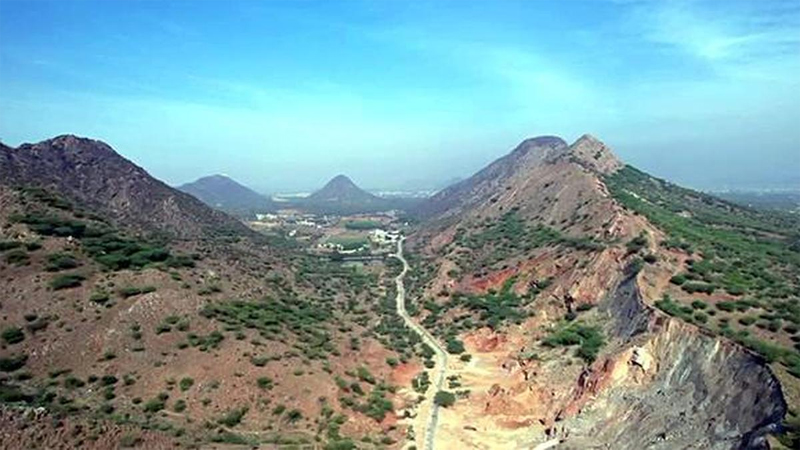
The Supreme Court’s decision to stay its own controversial order redefining the Aravalli hills has come as a moment of relief for environmentalists and concerned citizens alike. The Aravallis are not merely geological formations; they are a living ecological shield whose degradation has already imposed a heavy cost on North India. To tinker with their definition without exhaustive scientific scrutiny was to play with fire. It has been proven time and again that human greed has no natural limits. For decades, rampant and largely illegal mining in the Aravalli range has gnawed away at its very foundations. Forests have been denuded, hillocks flattened, groundwater aquifers punctured, and biodiversity irreversibly damaged. What remains today is a battered landscape bearing testimony to administrative apathy, political patronage and the stranglehold of the mining mafia. The environmental destruction inflicted on the Aravallis is not theoretical; it is visible, measurable and deeply alarming.
The consequences of this sustained assault are increasingly evident in changing weather patterns. Unusually intense and prolonged summers, with mercury levels breaking century-old records, have become the new normal. Unprecedented rainfall events now flood areas that have historically never faced such havoc. Dust storms, erratic monsoons and prolonged dry spells are no longer isolated phenomena but recurring realities. Most recently, worsening air pollution has emerged as a public health emergency. India now carries the dubious distinction of hosting many of the world’s most polluted cities, and unscientific mining and construction are among the major contributors to this toxic air.
Against this backdrop, the Supreme Court’s earlier acceptance of a definition that recognised only landforms rising 100 metres above local relief as “Aravalli hills” was deeply troubling. India is home to thousands of small hills and hillocks that play a critical ecological role despite not meeting such arbitrary benchmarks. In practical terms, very few formations qualify under the 100-metre criterion. By that logic, vast stretches of the Aravallis-long protected through judicial and administrative interventions-would suddenly become fair game for mining and construction. This single judgement threatened to open a Pandora’s box. If such a restrictive definition were applied elsewhere, many other mountain ranges and fragile hill systems across the country could be stripped of protection. Environmental regulation would be reduced to a technical exercise divorced from ecological reality. It is hardly surprising that the ruling triggered a hue and cry across the entire Aravalli belt, drawing widespread protests and support from scientists, environmentalists and local communities.
The influence of the mining mafia cannot be ignored in this context. That such a definition could find its way into a Supreme Court order, despite severe opposition backed by detailed scientific reports, raises uncomfortable questions. The experience of the past shows that where mining interests are involved, laws are bent, institutions weakened, and environmental concerns sidelined. Rivers across the country bear witness to this reality. Illegal sand mining has ravaged riverbeds, destabilised bridges, altered river courses and destroyed aquatic ecosystems, all in the name of “development”.
Development, however, cannot be a euphemism for destruction. Economic growth that hollows out mountains, poisons air and water, and leaves future generations a degraded planet is not progress; it is collective self-harm. Environmental damage does not respect class or geography. Its consequences are beyond imagination, and ultimately, everyone has to suffer – from farmers facing water scarcity to urban residents gasping for breath.
In this context, the Supreme Court’s decision to put its own order on hold and constitute a high-powered expert committee is a welcome course correction. It reflects the wisdom that environmental adjudication cannot be rushed or reduced to simplistic definitions. The Aravallis demand a holistic, science-based approach that recognises their role in climate moderation, groundwater recharge, biodiversity conservation and protection against desertification. The onus now lies on the environmental and scientific community to assist the Court with rigorous, evidence-based inputs. The committee must include ecologists, geologists and environmentalists, not just bureaucrats, to ensure credibility and balance. There is no urgency so compelling that it justifies irreversible damage. After all, this is not merely a legal or policy debate; it is a question of survival – of the present generation and those yet to come.
 Follow our WhatsApp channel
