

- India’s New 1983 Moment
B S Dara
bsdara@gmail.com
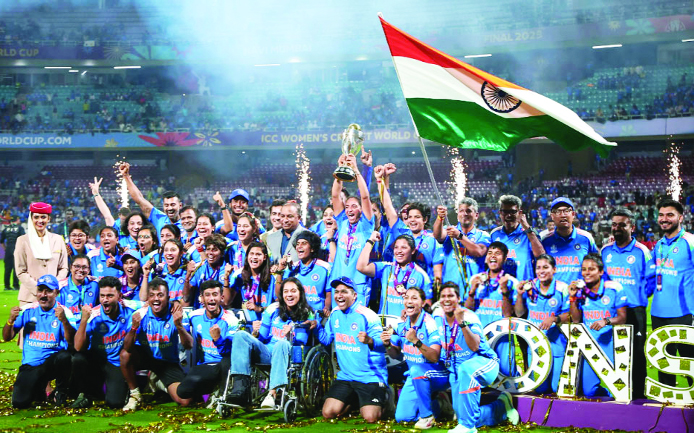
On the evening of 2 November 2025, at the DY Patil Stadium in Navi Mumbai, history was rewritten. The Indian women’s cricket team defeated South Africa Women by 52 runs in a nail-biting final of the 2025 ICC Women’s Cricket World Cup to claim their first-ever women’s ODI world title.
This victory is a watershed moment in Indian sport that echoes the seismic shift triggered by the men’s triumph in the 1983 Cricket World Cup. On that summer day in Lord’s on June 25, 1983when Kapil Dev and his band of underdogs defeated the mighty West Indies, the course of Indian cricket changed forever, a victory that profoundly changed the course of Indian cricket history. And now, more than four decades later, the women of India have lit a new flame of possibility.
Back in 1983, India’s win under Kapil Dev shattered expectations. The team had entered the tournament as rank outsiders, the victory galvanized an entire nation’s relationship with cricket. Youth turned into hope, stadiums into cauldrons. The image of Kapil’s leap and Yashpal Sharma’s gritty innings became part of our sporting DNA.
In contrast, India’s women’s side stepped into 2025 carrying the weight of many near-misses and shattered ceilings. They had finished as runners-up in the Women’s World Cup in 2005 and 2017, each time coming agonisingly close. The dream was real but elusive.
This time, their campaign had early setbacks: three successive defeats threatened to derail the momentum. But the turnaround was dramatic. A semifinal win over defending champions Australia Women via a record chase, and then the final versus South Africa, sealed the deal.
In the final, India posted 298/7 with a stellar 87 from Shafali Verma and 58 from Deepti Sharma. South Africa, led by captain Laura Wolvaardt’s 101, threatened until India’s bowlers tightened the noose.
Just as 1983 ignited millions of young Indians to pick up a bat, the 2025 triumph offers a fresh horizon to girls across India. When commentators begin to call this win the “1983 moment for women’s cricket”, they are not exaggerating. The face of cricket is no longer just male-dominated, it is inclusive, aspirational.
This victory challenges earlier biases that women’s cricket exists in the shadow of men’s cricket. It sends a message that elite sporting success is not gender-exclusive. With this win, the “Women in Blue” will have a shelf of silverware matching the “Men in Blue”.
Victories of this magnitude drive investment and infrastructure. From grassroots programmes and academies to broadcast deals and sponsorships, the ecosystem must respond. Much like the post-1983 surge in television viewership and commercial interest in cricket, expect a similar uplift for women’s cricket now.
Legends such as Mithali Raj ,who captained the side to earlier finals ,and Jhulan Goswami have long carried the dream. Mithali herself, on social media, described the moment as “two decades of a dream finally realised.”Their sacrifices laid the foundation, this team walked the path they paved.
In India’s cricket-mad landscape, moments like this ripple beyond the boundary ropes. The image of the national flag raised, crowds roaring, women in sports gear revered, these become normalised. In towns and villages alike, young girls watching the final will now believe: ‘Yes, I can lift that trophy too.’
In 1983, Kapil Dev’s side upset the established order and instilled belief. The win triggered a cultural metamorphosis: cricket became truly a mass sport in India, corporate sponsorship soared, and the infrastructure expanded. In that sense, the 2025 women’s world-cup win may usher in a similar metamorphosis for the women’s game in India.
Consider the parallels, both teams were not favourites, they seized the moment. Both wins sparked deep national fervour. Just as 1983 inspired generations of male cricketers, this will inspire female cricketers in unmatched numbers.Post-1983 brought a wave of money into Indian cricket. Post-2025, commercial brands will pay heed to women’s sport in a new way.1983 broadened cricket’s appeal across India’s diverse regions. Now the women’s win will bridge gender divides and open sporting culture to a broader cohort.
This victory is the beginning, not the end. To convert this moment into a sustained movement requires action. The success will bolster calls for a robust women’s premier league, with franchise-style competition across India. Funding and coaching must reach rural India, ensuring that talent is nurtured early and broadly. Women’s matches must be given prime slots on TV and digital platforms, with the production quality equal to men’s games. Brands will now see women’s cricket as a viable platform, the challenge is to sustain interest beyond the headline victory. For decades, sporting participation for girls has faced social and infrastructural barriers. This win pushes back against those barriers.
The scenes in Navi Mumbai last night ,the tears, the cheers, the Tricolour aloft ,will live in India’s sporting memory. Prime Minister Narendra Modi led the tribute, calling it a “historic win” that will motivate future champions. The board rewarded the team handsomely, a clear signal that women’s cricket matters.
Back in 1983, Kapil Dev held the trophy aloft and began an era. Tonight, captain Harmanpreet Kaur leads a team of champions ,and they hold more than a trophy: they hold the future.
In the years ahead, historians will point to 2 November 2025 as a key turning point. Already, young girls in small towns across the country are asking: Who will be the next one to lift the trophy? And because this team showed what is possible, the answer now is: Yes, it could be me.
The 1983 victory gave birth to a sporting revolution. The 2025 women’s crown may well birth an inclusion revolution, where Indian cricket truly becomes the sport of every Indian. For the game, and for the nation, this is the moment where history meets tomorrow.
 Follow our WhatsApp channel
