

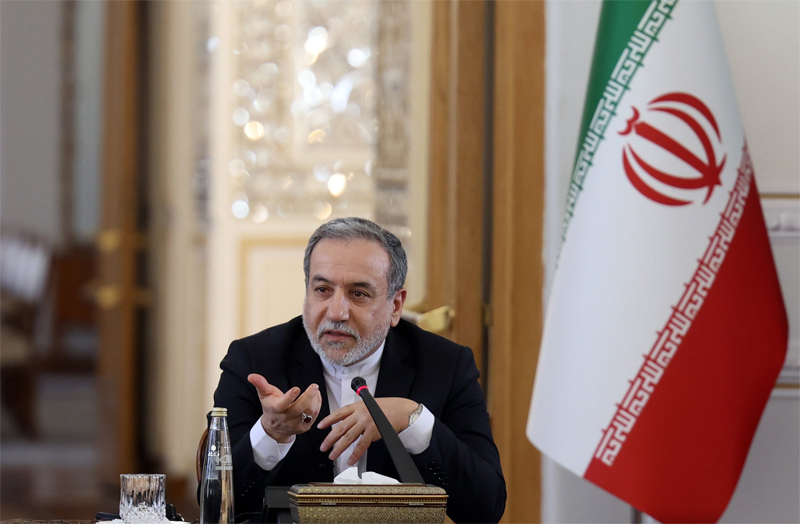
TEHRAN, Oct 18 : Iran declared on Saturday that it is no longer bound by the restrictions of the 2015 nuclear deal, – given the accord’s expiration, but reiterated its “commitment to diplomacy.”
The Joint Comprehensive Plan of Action (JCPOA) – pushed by former US President Barack Obama – was signed in Vienna by Iran, China, the UK, France, Germany, Russia and the US in July 2015.
The deal saw the lifting of many crippling international economic sanctions against the Islamic Republic in exchange for several restrictions on its nuclear program.
This included capping its uranium enrichment to a mere 3.67%, and allowing strict unhindered supervision of its nuclear facilities by the UN’s nuclear watchdog, the International Atomic Energy Agency (IAEA).
But Washington, under the first Trump presidency, left the deal in 2018 and reinstated sanctions, after which Tehran began stepping up its nuclear program, leaving the pact in tatters. Any subsequent attempts at restoring the deal proved fruitless, as Iran continued to pull away from its commitments after the unilateral US withdrawal.
The reimposition the of UN sanctions via the deal’s ‘snapback mechanism’ came in August as the E3 nations- the UK, France, Germany – accused the Islamic Republic of non-compliance and later formally requested the UN to reimpose all previous sanctions over the non-compliance.
The UN acquiesced to Europe’s request, and effectively rendered the accord moot.
“Iran’s efforts to revive the exchanges (with the IAEA) that led to the agreement in Cairo were also sabotaged by the irresponsible actions of the three European countries,” the Iranian Foreign Ministry said in a statement on Saturday, referring to a recent framework to resume cooperation.
The accord’s formal expiry, known as ‘Termination Day,’ was listed as Oct 18, 2025, just ten years after it was endorsed by the UNSC Resolution 2231. With its expiration, Tehran announced that all restrictions and related mechanisms are now void.
“All of the provisions, including the limitations on Iran’s nuclear programme, are considered terminated,” the Iranian Foreign Ministry said in a statement, adding that “Iran firmly expresses its commitment to diplomacy.”
The move follows months of heightened tensions between Iran and Western powers, after Tehran suspended its cooperation with the IAEA in July, accusing it of failing to condemn Israeli and US airstrikes on Iranian nuclear facilities during the 12-day war between Israel and Iran earlier this year.
Iranian Foreign Minister Abbas Araghchi in a letter addressed to the UN on Saturday wrote that the expiration of the 2015 deal renders the sanctions “null and void.”
The unprecedented bombing campaign by Israel and the subsequent retaliation by Iran during the 12-day war had derailed all ongoing nuclear negotiations between Tehran and Washington.
Israel said Iran had taken steps toward imminent nuclear weaponisation when the IDF launched its opening strike on the Islamic Republic’s military leadership, missile production and nuclear facilities early on June 13.
Tehran has long been accused by global observers of secretly trying to weaponise its atomic program, by not allowing international inspectors to assess its facilities, expanding its ballistic missile and drone arsenal to great levels, despite its denial.
The Islamic Republic, which has sworn to eradicate Israel from the world map, is noted to have amassed a massive stockpile of heavily enriched uranium by the IAEA.
The enrichment level is reported to be over 60.8%, which is well beyond civilian uses (requiring little more than 3-4%), and just slightly short of the required 90% threshold needed for producing atomic bombs.
(UNI)
 Follow our WhatsApp channel
