

Manzoor Ahmed Naik
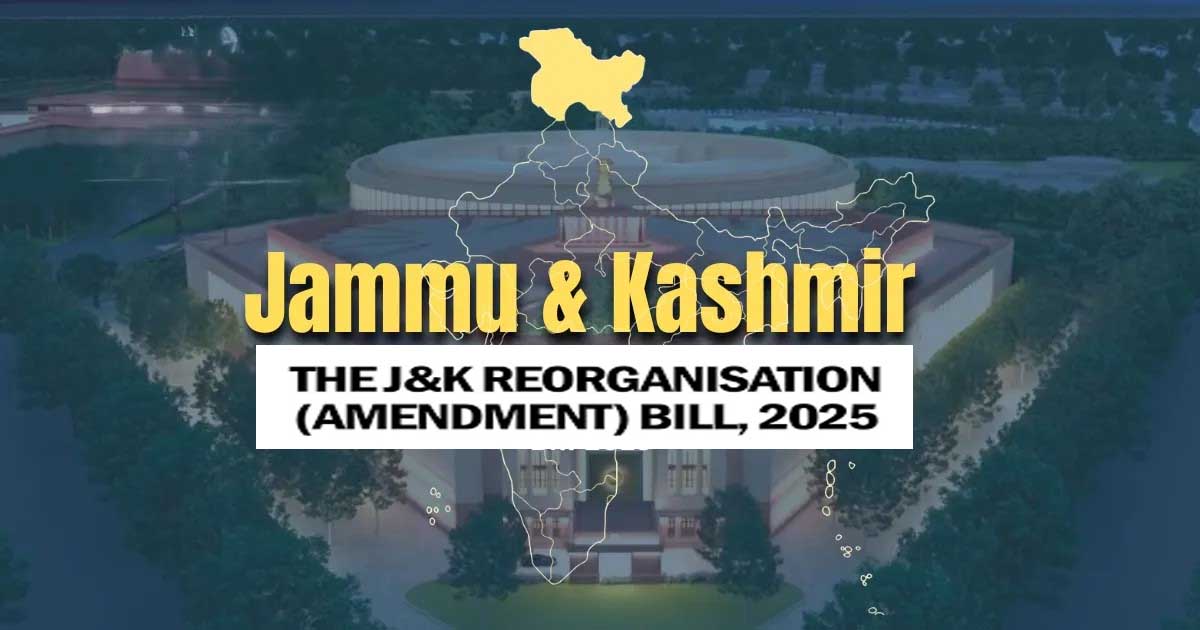
In a move being hailed by the Bharatiya Janata Party (BJP) as a landmark step towards clean governance and accountability, the Lok Sabha recently passed the Jammu & Kashmir Reorganisation (Amendment) Bill, 2025. The Bill, introduced by Union Home Minister Amit Shah, seeks to close long-standing legislative gaps by ensuring that individuals holding high constitutional offices in Jammu & Kashmir cannot continue in power while under prolonged arrest on serious criminal charges.
The amendment introduces a critical clause into the Jammu & Kashmir Reorganisation Act, 2019, aimed directly at maintaining the dignity of democratic institutions. If a Chief Minister or Minister is arrested and detained for more than 30 days in connection with an offence punishable with five years or more, they will automatically lose their office on the 31st day. The Lieutenant Governor (LG) will be empowered to act upon such circumstances, ensuring continuity and integrity in governance. After their release, such individuals may be reappointed, but only through fresh advice of the Chief Minister or the Council of Ministers, thereby reinforcing institutional checks and balances.
This provision, the Government asserts, protects the principle of accountability-that those facing serious criminal scrutiny should not continue to wield executive authority.
The BJP has projected the Bill as a bold anti-corruption measure, fully in line with Prime Minister Narendra Modi’s promise of “Na Khaunga, Na Khane Dunga”. Party leaders argue that the amendment safeguards democratic morality by ensuring that governance in Jammu & Kashmir is not held hostage to leaders facing grave legal proceedings.
Union Home Minister Amit Shah, while moving the Bill, said, “The people of Jammu & Kashmir deserve a politics free from corruption, criminality, and compromise. This amendment is a guarantee that the integrity of institutions will be upheld at all times.”
Predictably, opposition parties have voiced sharp criticism, branding the law as “draconian” and vulnerable to misuse through politically motivated arrests. Leaders like Priyanka Gandhi Vadra and AIMIM’s Asaduddin Owaisi accused the Government of attempting to undermine democracy by weaponizing central agencies against non-BJP leaders.
The BJP, however, has countered these claims, pointing out that the law applies uniformly-to any Chief Minister or Minister in Jammu & Kashmir, regardless of political party. Similar provisions are being debated at the national level for Prime Ministers and Union Ministers, proving that the intent is institutional reform, not political vendetta. Opposition objections betray a fear of accountability, since only those with criminal liabilities need worry.
The Bill also has wider implications. By strengthening the role of the Lieutenant Governor and ensuring a tighter mechanism of oversight, the Centre has sent a strong signal that restoration of full statehood to Jammu & Kashmir remains a calibrated, long-term process.
For the BJP, this is a conscious political choice: statehood cannot precede political maturity, transparency, and accountability in governance. In this view, the amendment is not a setback, but a preparatory step toward stable democratic institutions in the Union Territory.
The passage of the J&K Reorganisation (Amendment) Bill, 2025 must be seen in continuity with earlier reforms such as the 2023 Amendment, which expanded Assembly seats, introduced reservations for Scheduled Tribes and Scheduled Castes, and ensured representation for displaced Kashmiri Pandits and PoK refugees.
Together, these measures represent the BJP’s dual strategy for Jammu & Kashmir. First Deepening democracy by empowering underrepresented communities. Secondly Strengthening accountability by preventing criminally tainted individuals from clinging to power.
The 2025 amendment is not just a legal innovation but a political statement-that the era of impunity in Jammu & Kashmir is over. While the opposition may dismiss it as central overreach, the BJP has made clear that it sees the law as a guarantee to the people of J&K that their future will be shaped by leaders of integrity, not those weighed down by criminal cases.
For PM Narendra Modi led Government, this is yet another milestone in its mission to bring clean politics, stable governance, and long-term peace to the region.
 Follow our WhatsApp channel
