

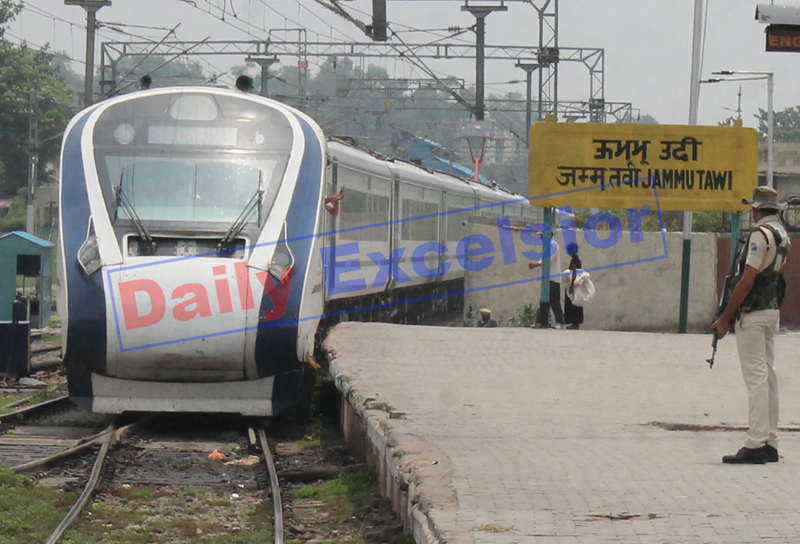
The Ministry of Railways’ sanction of the Final Location Survey for an alternative railway line between Jammu and Katra marks a transformative development in the region’s infrastructure landscape. At a time when the Indian Railways is achieving feats like the Kashmir rail link-an engineering marvel marked by high-altitude bridges and tunnels-this move signals not just an extension of physical connectivity but a calculated investment in regional development, pilgrimage facilitation, and long-term economic planning.
The need for an alternative rail line between Jammu and Katra stems from a chronic and structural bottleneck in the existing railway infrastructure. While the double line from Delhi up to Jammu has sufficient capacity, the final stretch from Jammu to Katra-spanning a mere 78 km-remains single-laned and critically overburdened. This segment, part of the broader Udhampur-Srinagar-Baramulla Rail Link, is functioning at over 100% of its capacity, with 30 tunnels and multiple sharp curves restricting train speeds to 75 km/h. This constraint jeopardises operational efficiency and safety and severely limits the number of trains that can be run, especially during peak pilgrimage seasons. During Navratras and the summer rush, the footfall to the Shri Mata Vaishno Devi Shrine soars exponentially, and Delhi-Katra trains face an unmanageable load. Despite the progress in road connectivity, including the upcoming Delhi-Katra express highway that promises a shorter, faster route, long-distance pilgrims from other parts of India still overwhelmingly prefer trains due to affordability, comfort, and convenience.
Given these realities, the double-laning of the existing Jammu-Katra line might appear to be the most straightforward solution. However, due to the terrain’s natural constraints-steep gradients, fragile geology, and closely spaced tunnels-this is not technically feasible. Hence, the decision to survey an entirely new alignment is both logical and visionary. But what elevates this move from being an infrastructural add-on is its potential to be a game-changer for Jammu’s broader tourism economy. If the proposed new line is planned with foresight, it could unlock the tourism potential of yet-untapped areas like Patnitop, Sudh Mahadev, Mansar, or Surinsar. Each of these destinations, rich in natural beauty, religious significance, and cultural heritage, has suffered from inadequate connectivity. Integrating them into the railway map could rejuvenate Jammu’s fading tourism sector and bring long-overdue attention to destinations outside the main pilgrimage circuit.
The socioeconomic benefits of such a realignment are manifold. A new railway corridor connecting alternative tourist sites will boost local economies, create jobs, and open new avenues for small and medium businesses. The multiplier effect of rail connectivity on education, healthcare access, and regional markets cannot be overstated. For a region like Jammu, often overshadowed by the Valley-centric narrative in tourism and development, this project could act as a much-needed corrective.
Yes, the project will take time. The FLS alone is expected to take 8-10 months, and only upon successful feasibility will a DPR be prepared, followed by budgeting, approvals, and eventual execution. We are likely looking at a timeline of several years before the first train chugs along this new line. However, the very fact that the process has been initiated soon after the near-completion of the Kashmir rail link reflects the Government’s strategic intent and sustained focus on comprehensive infrastructure development in Jammu and Kashmir. Northern Railway’s engineers, emboldened by the successful navigation of formidable challenges in the USBRL, are well-equipped to undertake this next chapter. Their proven expertise in building high-altitude bridges and tunnelling through treacherous Himalayan rock gives stakeholders confidence that this project, too, will be executed with similar precision and perseverance.
The ball has been set rolling. Now, it’s imperative that planners think beyond mere alignment and look at this alternative Jammu-Katra line not just as a logistical necessity but as a blueprint for regional rejuvenation. It is a unique opportunity to merge pilgrimage with potential, transit with tourism, and connectivity with community development. The proposed new route is more than just an escape valve for an overburdened railway-it is a strategic lever for reshaping Jammu’s destiny.
 Follow our WhatsApp channel
