

Chander M Bhat
Brahmarandhram Hingulaaym Bhairavvo Vimallochanah
Kottari Saa Mahaaamaayaa Trigunaa Yaa Digamvari
Nestled deep within the arid expanse of Hingol National Park in Balochistan, Pakistan, stands one of the most sacred and enigmatic shrines in the Hindu spiritual landscape: the shrine of Hinglaj Mata, also reverently known as Hinglaj Devi or Nani Mandir. This cave temple, perched within the rugged terrain of the Makran coast, has for millennia drawn seekers, saints, and pilgrims who brave the harshness of the desert in pursuit of divine grace. Steeped in legend and sanctified by tradition, Hinglaj Mata is more than a religious monument; She is a living embodiment of Shakti…the primordial feminine energy.
The religious sanctity of Hinglaj Mata stems from her revered status as one of the 51 Shakti Peethas. According to Hindu mythology, these sacred sites mark the earthly locations where parts of Sati’s dismembered body fell as Lord Vishnu, in an effort to pacify the grief stricken Shiva, used his Sudarshan Chakra to separate her corpse into fragments. Each site came to be associated with a powerful manifestation of the Divine Mother. At Hinglaj, it is believed that the Brahmarandhra…the crown of Sati’s head…descended to the earth, imbuing the land with a potent and eternal spiritual charge. In the spiritual geography of the subcontinent, Hinglaj represents not just a physical destination, but a confluence of myth, memory, and transcendence.
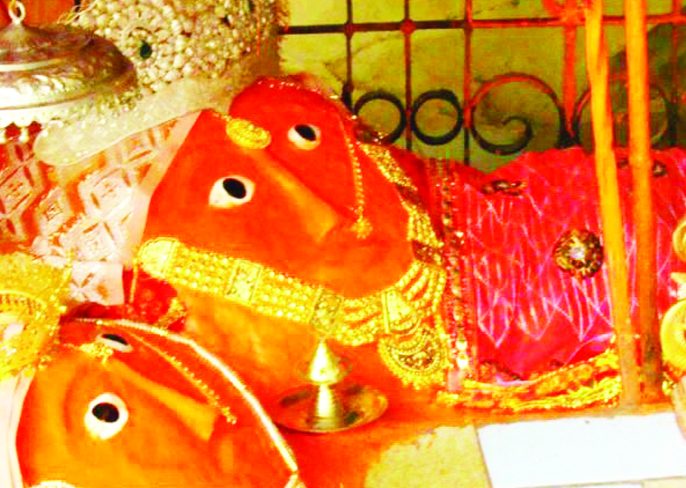
The absence of a sculpted idol at the shrine is significant. Instead, a natural rock formation within a cave signifies the presence of the goddess, accompanied by a sacred banyan tree that sways gently, as if in eternal obeisance. Here, rituals are simple yet profound…pilgrims offer coconuts, flowers, sweets, and heartfelt prayers. The deity Herself, an aspect of Durga or Parvati, is especially venerated for blessings of marital bliss, longevity, and spiritual purification.
Bhimlochana Bhairava is the terrible eyed guardian of Hinglaj. Among the fierce protectors of Shakti Peethas, Bhimlochana Bhairava stands out as a formidable guardian. His name, derived from the Sanskrit words Bh?ma (terrible or awe inspiring) and Lochana (eyes), refers to his piercing gaze that obliterates darkness and deception. In the Tantric cosmology of 64 Bhairavas (Chatushashti Bhairavas), Bhimlochana is associated with the Southwestern direction, an elemental realm of fire, destruction, and transformation.
As a Dikpalaka Bhairava in the context of the Shaktisamgama Tantra and other allied texts, Bhimlochana plays the role of a fierce guardian stationed at sacred thresholds. At Hinglaj Mata Peetha, where Sati’s head is believed to have fallen, his role is deeply symbolic. The Brahmarandhra represents the seat of supreme consciousness. Bhimlochana, with his blazing third eye, guards this cosmic gateway and ensures that only the spiritually prepared may draw near to the divine source.
In Tantric tradition, every Shakti Peetha is accompanied by a Bhairava who not only protects the sanctum but also balances the fierce feminine with the stabilizing masculine. While the goddess embodies compassion and creative power, the Bhairava represents detachment, protection, and transcendence through destruction. Thus, Bhimlochana is not merely a sentinel but a purifier, burning away karmic impurities with his fiery gaze.
Worshippers approaching Hinglaj during the annual yatra invoke Bhairava through subtle gestures and mantras, whether explicitly or through the rituals that incorporate his presence. Some older Tantric manuals list Bhimlochana as the Bhairava of Hinglaj, paired with the Yogini Raktaambika, a red hued goddess embodying blood energy and transformative power. This pairing suggests a powerful Tantric confluence of Shakti and Bhairava, where the fierce grace of Hinglaj Mata is complemented by the unwavering watch of Bhimlochana.
What makes Hinglaj even more remarkable is its role as a site of shared sacredness. While deeply embedded in Hindu religious practice, the temple is also revered by local Muslim communities, who affectionately refer to it as “Nani Mandar”. In a rare and touching example of syncretic tradition, local Baloch tribes have long served as guardians of the temple. Some even act as custodians and guides, preserving the sanctity of the site with as much devotion as the Hindu pilgrims they host.
History has acknowledged this unique spiritual mosaic, noting that the Hinglaj Mata Mandir is closely associated with the Charani tradition of goddess worship, further underscoring its deep cultural and religious roots that transcend any one community. This blending of beliefs has allowed the shrine to survive even in the face of historical tumult, political upheavals, and demographic changes.
The origins of Hinglaj Mata are veiled in the mists of antiquity. The shrine is thought to predate the Arab invasions of the 7th and 8th centuries CE, with archaeological hints suggesting its sanctity stretches into pre Islamic, possibly prehistoric times. Before Islam took hold in Balochistan, the region was governed by Hindu dynasties like the Sewa and Brahman rulers of Sindh, under whom Hinglaj likely flourished as a powerful regional sanctuary to the mother goddess.
As the centuries rolled on, and empires rose and fell, Hinglaj remained an unshaken axis of devotion. Whether during the Buddhist influence in Central Asia, the Persian sway over Bloch lands, or the subsequent advent of Islamic and colonial powers, the site retained its luminous appeal. Pilgrims…particularly from the Sindhi, Charan, and Bhavsar communities…continued their arduous treks across the desert to pay homage.
In the colonial and post Partition eras, although the demographic landscape of Pakistan shifted dramatically, Hinglaj remained a beacon of Hindu faith. The 1947 exodus saw most Sindhi Hindus relocate to India, yet a devout minority stayed behind, keeping the flames of devotion alive. Their efforts, combined with the goodwill of local Muslim tribes, ensured that the shrine would continue to echo with chants of the Mother, even in an era of growing isolation.
The scriptural validation of Hinglaj Mata is found in various Puranas and Tantric texts that form the bedrock of Hindu cosmology. The Shiva Purana, Padma Purana, and Skanda Purana recount the moving tale of Sati’s self immolation at the sacrificial altar of her father Daksha, and the consequent dismemberment of her body by Vishnu. The tale is more than allegorical; it is symbolic of the goddess’s indestructible essence diffusing across the land.
In these accounts, Hinglaj is mentioned as the sacred site where Sati’s head fell…a detail that renders it supremely potent in Tantric traditions, where the crown of the head (Brahmarandhra) is seen as the gateway to cosmic consciousness. Later compilations like the Tantrachudamani, Kubjika Tantra, and Pithanirnaya reinforce this association, referring to Hinglaj (sometimes by the variant names “Hingula” or “Hingulata”) as an essential Peetha.
These mentions not only validate the site’s spiritual stature but also root it firmly in the matrix of Shakti theology, where every Peetha is both a mythic location and a living axis of divine feminine energy. At such places, Bhairavas like Bhimlochana play a vital yet silent role…ensuring the devotee is inwardly ready before approaching the Devi.
Each spring, usually in April, Hinglaj Mata comes alive in a spectacular and emotionally charged event known as the Hinglaj Yatra. Often coinciding with the Chaitra Navaratri, this four day pilgrimage represents the largest Hindu religious gathering in Pakistan. Devotees assemble during this sacred time, with pilgrims coming from every corner of Pakistan, especially the Sindh region.
The yatra is far more than a spiritual exercise; it is an act of devotion, endurance, and collective memory. Pilgrims often travel in caravans of buses or, in the older tradition, trek barefoot through the Makran desert. Their journey is marked by hymns, stories of miracles, and communal solidarity. Upon arrival, the rituals unfold in three stages: devotees first bathe in the Hingol River to cleanse themselves physically and spiritually then pilgrims ascend this nearby volcano, considered sacred. There, they cast offerings into the crater, symbolic of surrendering ego, desires, and karmic burdens and the final stage is the darshan of the goddess inside the cave. Here, the atmosphere is electric with devotional songs, the scent of incense, and the flicker of lamps.
The rituals are conducted by hereditary priests…often Brahmakshatriyas of Gujarati origin…who chant mantras and perform yagna inside the cave. The devotees believe that a pilgrimage to Hinglaj during this yatra absolves them of past sins and grants divine protection.
The festival also highlights remarkable hospitality. Communal kitchens operate throughout the duration, feeding thousands daily. Volunteers serve water, food, and medicine, embodying the values of selfless service and compassion.
In the heart of an Islamic republic, Hinglaj Mata stands as a shining relic of Hindu continuity, a sacred fire that has burned uninterrupted through millennia. Her legend is cradled in the hymns of ancient Puranas, her presence etched into the stones of a desert cave, and her light reflected in the tearful eyes of countless pilgrims who cross barren lands seeking only a moment of communion.
Thus, whether known as Hinglaj Mata to a Sindhi devotee, or “Nani Mandir” to a Baloch tribesman, this hallowed cave echoes an eternal truth: that where the divine mother resides, there lies a home for all.
 Follow our WhatsApp channel
