

Landmark occasion for people of Valley: Omar
Excelsior Correspondent
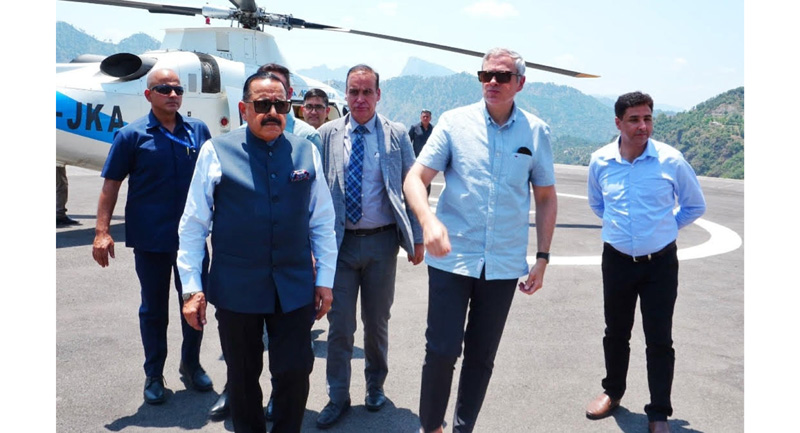
JAMMU, June 5: Union Minister of State in the Prime Minister’s Office (PMO) Dr Jitendra Singh and Chief Minister Omar Abdullah today visited Katra to review arrangements, a day ahead of Prime Minister Narendra Modi’s visit during which he will flag off train to the Kashmir valley.
Follow the Daily Excelsior channel on WhatsApp
Dr Jitendra Singh along with Omar Abdullah visited different venues of the Prime Minister’s function including the iconic Chenab railway bridge, the highest in the world constructed over river Chenab in Reasi district and Katra Railway Station from where the Prime Minister will flag off Vande Bharat train to Srinagar and Srinagar to Katra.
Click here to watch video
The Union Minister and the Chief Minister inspected the specially-designed Vande Bharat train which will be flagged off by Modi to mark the completion of Udhampur-Srinagar-Baramulla Railway Link to connect Kashmir with the rest of the country.
“Last minute touches at the site of the inauguration of the world’s highest railway bridge, the Chenab Bridge, by PM Narendra Modi tomorrow,” Dr Jitendra Singh wrote on X, also sharing pictures of his visit to the bridge along with Abdullah.
Speaking to reporters in Katra, Dr Jitendra Singh lauded Prime Minister Narendra Modi for ensuring a speedy completion of the USBRL project after taking office in 2014 and said it marks the beginning of a historic journey in setting up the world’s highest railway bridge in Jammu and Kashmir.
Dr Singh said in the coming days, the project will become a crucial part of the developmental journey of “Viksit Bharat” (developed India).
“When Narendra Modi became the Prime Minister in 2014, this work had almost come to a halt. The world’s tallest railway bridge, which the Prime Minister is now going to inaugurate, was surrounded by many controversies. There were doubts — would building it be feasible? Would it be safe?” Dr Singh said.
He said several Railway Ministers repeatedly visited the site. “A new alignment was made. It was realised that the bridge would be extremely high. Upon checking, we found that it is actually 35 meters taller than the Eiffel Tower. That marked the beginning of a historic journey under the Modi Government,” he said.
The Union Minister said the train route will now serve as a path for business, travel and commerce. “You will be able to reach Srinagar in just three hours from here,” he said.
He said in the times to come, if the Government and policymakers think imaginatively, the project could become a major tourist circuit.
“Even the pilgrims visiting Mata Vaishno Devi can be integrated into this circuit. I believe that travel agencies should be prepared for this. After visiting Vaishno Devi shrine, tourists can come here and then reach the (Kashmir) valley in just three hours,” he said.
Asserting that the journey on Vande Bharat trains through the hills will be beautiful, Dr Singh said, “It is a scenic route with beautiful views along the way. Children, youngsters and even couples can take photos en route. This will also serve as an alternative route and reduce congestion on the highway.”
He said as an experiment, a passenger train was launched recently, along with another one for Army troops. “Earlier, due to Army movements, there used to be a lot of pressure on the highway and extensive security arrangements had to be made. With the Army now using the train route, the load on the highway has significantly reduced,” he added.
The Union Minister termed the train to Kashmir the beginning of a new chapter and said, “The Katra station has already played a major role in connecting Jammu and Kashmir with India’s growth story. In the coming days, this project will become a crucial part of the developmental journey of Viksit Bharat.”
Dr Singh said the project is a historic one. “First of all, I believe that there is a long history behind this. The vision of laying railway tracks in Jammu and Kashmir and connecting Kashmir with the rest of the country and the world was conceived nearly 150 years ago by Maharaja Pratap Singh,” he said.
He said engineers and architects were brought in, and at that time, there were plans to lay a narrow-gauge track like the ones seen in Darjeeling or Shimla.
“A similar kind of railway line was envisioned,” Dr Singh said, adding, “But the plan did not move forward then. Then came Independence and we had to wait until 1972 for the first train to arrive in Jammu. Earlier, we used to have a railway station in Sialkot, which was lost after Independence.”
Singh said the train route will be unique. “It will go uphill and then pass through snowy regions. Coaches had to be designed keeping both the terrain and the climate in mind. In February, the snow in Jammu starts to melt due to warmer weather. It is going to be a unique experience,” he said.
Meanwhile, noting that he has been “waiting for this day for a long time”, Chief Minister Omar Abdullah said the inauguration of rail service is better late than never as it will be a landmark occasion for the people of the valley.
He told reporters in Katra that start of the rail service will enable people to travel without spending much and put an end to the practice of some air service providers who “rob us” by selling tickets worth Rs 5,000 at Rs 20,000.
Omar invited pilgrims to come in large numbers for the annual 38-day Amarnath yatra, scheduled to commence in south Kashmir Himalayas on July 3.
“If I say that I have been waiting for this day for a long time, it won’t be an exaggeration. This project started when I was in school, maybe in class 7 or 8. Today, my children have also completed their education and are now working,” he said.
“It is better late than never. Finally, we have reached that stage when the Prime Minister will come and inaugurate the Kashmir rail service which will benefit all of us,” he said.
The start of the direct rail service to Kashmir will put an end to this and also facilitate transportation of horticulture produce including apples and cherries to reach the markets.
Asked whether the direct train service to Kashmir will also revive tourism which was badly hit in the Valley following the April 22 Pahalgam terror attack, he said “unfortunately, the summer season is over…we should not expect much but we have hope for the next summer.”
Omar said he would like pilgrims to visit Amarnath cave shrine in large numbers during the yatra starting on July 3.
“Let them come. benefit from our hospitality and enjoy ‘darshan’ (glimpse of naturally formed Ice-Shivling) before returning safely. Like yesteryears, we will try to ensure a successful yatra,” he said.
On security, he said there is no need to worry as adequate security arrangements are in place for the safety of the railway infrastructure and the passengers.
“The train service has been running without any problem in the Valley for many years. The Katra-Sangaldan section is being commissioned and we are ready for it,” Omar said.
On Chenab and Anji bridge, he said the 272-km railway line between Udhampur to Baramulla has set a lot of records.
“The Chenab bridge is higher than the Eiffel Tower in Paris, making it the highest bridge in the world. I have come from there and it is scary to look down from there. Similarly, the Anji bridge is India’s first cable-stayed railway bridge,” Omar said.
Abdullah said the project was very challenging and the railway track along Katra-Banihal section is mostly going through the tunnels, having very little open air track.
“The railway line will be beneficial to our economy, tourism, trade and (create employment) for locals. It will benefit everyone,” he said.
He said the ticket price is not high and a traveller can reach Srinagar within four hours from Katra.
“In next few months when the construction work at Jammu Railway Station gets completed, the train will run from there instead of Katra,” he said.
 Follow our WhatsApp channel
