

Prof D Mukherjee
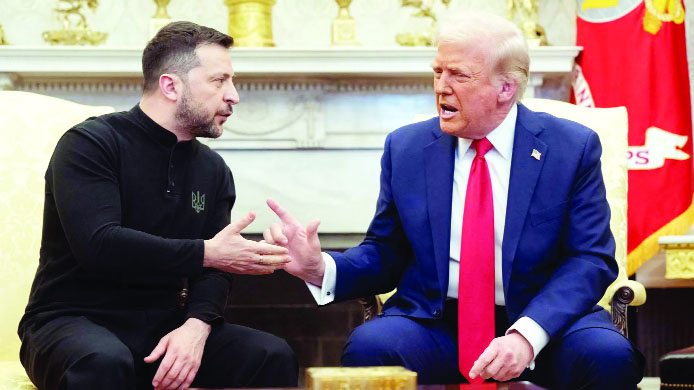
The highly anticipated summit between Ukrainian President Volodymyr Zelensky and the 47th and current U.S. President Donald J. Trump took place at the Oval Office in the White House on February 28, 2025. The meeting was framed as a potential turning point in the ongoing Russia-Ukraine war, which began on February 24, 2022, when Russia launched a large-scale invasion of Ukraine. Russian President Vladimir Putin justified the war as a “special military operation” aimed at “demilitarizing and denazifying” Ukraine, claiming to protect Russian-speaking populations in the Donbas region and counter what he perceived as NATO’s eastward expansion threatening Russian sovereignty.
The war has since led to catastrophic consequences, with estimates suggesting over 200,000 military casualties from both sides and tens of thousands of civilian deaths according United Nations (2025) reports. Ukraine’s economy has suffered immensely, with GDP shrinking by over 30% in 2022 alone as per World Bank Data, 2025. The U.S. has provided Ukraine with more than $350 billion in military and economic assistance since the war began, including advanced weaponry and humanitarian aid as disclosed by President Trump while both the leaders were before the press on 28th February 2025. In a bid to recover some of this significant assistance, the U.S. requested 50% of Ukraine’s rare mineral deposits as a repayment strategy, a proposal that President Zelensky vehemently rejected. Zelensky’s dismissive remark that Ukraine is fighting “on its own capability” and only received “helpful” assistance from the U.S. and Europe painted a misleading picture, undermining the extent of foreign aid that has been pivotal to Ukraine’s resistance.
The summit was part of President Trump’s broader geopolitical strategy under the “Make America Great Again” (MAGA) agenda, which he emphasized during his inauguration as the 47th U.S. President on January 20, 2025. Trump’s approach aimed at balancing American interests, reducing prolonged foreign engagements, and promoting global peace through diplomacy rather than force. His administration’s efforts to broker a resolution to the war were seen as a critical step towards restoring stability in Europe and reinforcing the United States’ leadership on the global stage.
However, the summit, which was expected to mark a breakthrough, ended up highlighting stark differences between the U.S. and Ukrainian leadership. Instead of moving towards a peace process, the summit exposed Ukraine’s impatient stance and lack of diplomatic flexibility, casting doubts on whether the war could be resolved through diplomatic means. Analysts argue that this missed opportunity not only weakened Ukraine’s position but also risked polarizing the international community further, potentially leading to new geopolitical alignments among world powers, including the U.S., Russia, and China. This write up highlights some of the critical issues forming the part of the agenda of the summit, the reasons behind its failure, and its implications for the future of the Ukraine-Russia war, with a particular focus on the roles of major global actors and potential mediators, including India. The broader question remains whether diplomatic patience and strategic negotiation could pave the way for peace or whether the world might witness an escalation into a broader international conflict, as cautioned by President Trump
The summit in the Oval Office was a globally televised event, with every gesture and word closely scrutinized by international media. President Trump, along with Vice President J.D. Vance, maintained a calm and composed demeanour, demonstrating a readiness to discuss pathways to peace. In contrast, President Zelensky exhibited signs of frustration and impatience, leading to several uncomfortable exchanges. His approach, which seemed to lack strategic patience, was a stark contrast to Trump’s diplomatic resilience. The media captured Zelensky’s apparent inability to navigate the nuances of diplomatic discourse, which ultimately diminished the prospects of achieving a constructive outcome. Observers noted that the Ukrainian leader’s behaviour not only undermined his position but also jeopardized the vital support Ukraine receives from the U.S.
While highlighting the salient issues of argument between Zelensky, Trump, and Vance, it may be mentioned that central focus to the summit’s discourse was Zelensky’s persistent demand for immediate, unwavering U.S. support in the war against Russia. President Trump, advocating a more strategic approach, emphasized the importance of negotiations and exploring peaceful solutions. Vice President Vance echoed Trump’s stance, promoting a pragmatic perspective that aimed to prevent further escalation. Zelensky’s dismissive response to these suggestions led to a palpable tension in the room. The clash highlighted a critical disconnect between Ukraine’s urgent military needs and the U.S. administration’s broader geopolitical strategy. Many analysts believe that Zelensky’s unwillingness to compromise not only alienated potential diplomatic allies but also risked Ukraine’s standing on the international stage.
The inconclusive summit has deepened concerns about the future of the Ukraine-Russia war. As Russia continues to demonstrate its military and economic strength, Ukraine’s position becomes increasingly precarious. The apparent strain in U.S.-Ukraine relations could weaken NATO’s resolve and diminish the likelihood of coordinated international support. Analysts warn that unless a miracle shifts the dynamics, Ukraine may face prolonged suffering and an extended economic and humanitarian crisis. Without renewed diplomatic engagement from the U.S., the balance of power might tilt further in Russia’s favour, complicating efforts to bring about a peaceful resolution. Despite the disappointing outcome, there remains hope if the U.S. re-engages with a focus on global peace and stability. Historically, the U.S. has been instrumental in mediating international conflicts. Its absence as a mediator in this scenario risks leaving a dangerous vacuum in global diplomacy. To reignite peace efforts, the Trump administration might need to adopt a more resilient and accommodating stance. This approach could help create a viable platform for negotiations that balance Ukrainian sovereignty with Russian security concerns, keeping the broader goal of global peace at the forefront.
The failed summit is a diplomatic windfall for Russia. It provides Moscow with a narrative of Ukrainian obstinacy and a missed opportunity for peace. By showcasing Ukraine’s strained relations with the U.S., Russia could further isolate Ukraine on the global stage. Kremlin strategists are likely to exploit this diplomatic misstep, strengthening Russia’s influence in international forums and justifying its military actions as a necessary defence against a volatile and uncompromising Ukrainian regime. The summit’s failure may prompt global leaders to rethink their approaches to the Ukraine crisis. European nations might advocate for a more pragmatic stance, balancing support for Ukraine with calls for diplomacy. Neutral countries and international organizations could push for renewed mediation, possibly under the auspices of the United Nations. Ukraine, on its part, must recalibrate its strategy by demonstrating diplomatic flexibility and a willingness to engage in good-faith negotiations. By rebuilding trust with allies and showing a readiness for peaceful resolution, Ukraine could restore its image as a rational and strategic player in the global arena.
The inconclusive summit may lead to a recalibration of geopolitical alliances. While the U.S. showed restraint, Russia might seek to solidify its strategic partnership with China. This could lead to a strengthened Russia-China axis, challenging Western influence. China, maintaining a diplomatic yet ambiguous stance, might use the situation to increase its influence in Eastern Europe and global politics. The U.S. may need to reinforce alliances with NATO and consider nuanced engagement with both Russia and China to prevent a power shift that could destabilize global order. President Trump’s statement about the risks of global polarization and the potential for a third world war underscores the gravity of the situation. His assertion that Zelensky’s actions could lead to such a crisis reflects deep concerns about the broader consequences of the war. The inability to mediate peace could push world powers into opposing blocs, reminiscent of Cold War dynamics. Trump’s emphasis on avoiding such a scenario highlights the need for careful, strategic diplomacy to prevent catastrophic global conflict.
India, under Prime Minister Narendra Modi, has consistently advocated for diplomacy and dialogue as solutions to geopolitical conflicts. With its non-aligned stance and credibility as a global peace promoter, India could act as a neutral mediator between Ukraine, Russia, and the U.S. Leveraging its strong ties with all parties, India could facilitate back-channel negotiations and propose frameworks for a peaceful resolution. By championing dialogue over force, India could play a crucial role in bridging gaps and restoring stability in Eastern Europe.The Zelensky-Trump summit, intended as a beacon of hope for peace, instead underscored the fragility of Ukraine’s diplomatic strategy resulted into a missed diplomatic opportunity. While President Trump exhibited remarkable patience and a clear vision for peace, Zelensky’s inability to engage constructively cast doubt over Ukraine’s strategy. The war’s future remains uncertain, and without renewed U.S. involvement and a genuine diplomatic effort, the prospects for peace appear bleak. Global powers, including India, may need to step forward to ensure that this conflict does not spiral into a broader geopolitical crisis.
(The author is an Educationist, a Management Scientist and an Independent Researcher)
 Follow our WhatsApp channel
