

Ashok Ogra
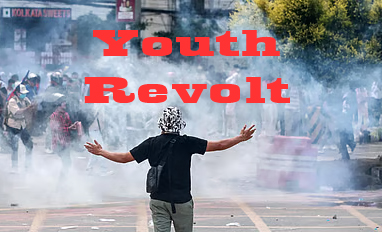
Student and youth protests have long acted as powerful accelerators in the course of history as they are the first to rise when change is needed. What often starts as a small spark on a university campus can quickly spread and shake entire nations. This year alone, countries like Bangladesh, Sri Lanka, and Nepal have seen how student and youth anger can grow overnight into massive movements that topple leaders who once seemed untouchable.
Admittedly, interim Governments have been established in both Bangladesh and Nepal; however, the future remains fraught with constitutional crises.
Also, one must credit the military leaderships of countries like Sri Lanka, Bangladesh, and Nepal for resisting the temptation to seize power during times of crisis. This restraint is quite remarkable, especially when compared to neighboring Pakistan, where the army has often taken control at the slightest pretext.
What social media has done in recent years is to boost protest gatherings dramatically. A single video of police violence or a viral hashtag can gather thousands in protest within hours. The streets fill quickly, voices amplify, and Governments find themselves scrambling to respond.
But if history has taught us anything, it is that the collapse of authority rarely leads to a smooth or easy transition. Students and young people have always been brilliant at tearing down old systems, but less successful at building new ones. Their idealism can go astray – leading to confusion, division, or even new forms of repression.
These uprisings often create political vacuums. In the days following the fall of a regime, chaos can reign before any order is restored.
This pattern is as old as the modern era itself. In South Asia, for instance, student protests have repeatedly shaken the foundations of power. In 1990, students helped end General Ershad’s authoritarian rule in Bangladesh, but democracy since then has been marked by fierce, often bitter political clashes, leaving institutions weak and the country’s future uncertain.
Sri Lanka offers a similar story. Student and youth protests (as well as the public) were instrumental in bringing down Mahinda Rajapaksa’s Government amid the 2022 economic crisis, reflecting deep dissatisfaction among the younger generation and wider population. But like so many uprisings before it, the fall of a leader has not yet translated into lasting political stability. The aftershocks continue, reminding us that while student and youth movements have the energy to demand change, they often struggle to define what comes next.
Across the world, these patterns repeat. The late 1960s saw an explosion of youth activism that reshaped societies in profound ways. In France, the events of May 1968 remain legendary. Students began by occupying universities, protesting rigid educational systems and authoritarianism. Police clashed violently with protesters, and the hero of World War II, President Charles de Gaulle, fearing the collapse of the state, briefly fled to a military base to consult his generals. The protests didn’t lead to revolution in the strict sense, but they permanently shifted French politics, culture, and society, inspiring generations to question authority and demand change.
In Eastern Europe, student activism was a constant thorn in the side of communist regimes. The 1956 Hungarian uprising, sparked by students in Budapest, was crushed within days by Soviet tanks. Twelve years later, in 1968, the Prague Spring saw students join intellectuals demanding reform in Czechoslovakia-only to be violently suppressed by another Soviet invasion. It was not until 1989, when Soviet power finally began to crumble, that student-led protests helped bring down the Communist regimes in places like Prague and Budapest peacefully. Even then, the joy of revolution was tempered by the economic hardships and political fragmentation that followed.
In the United States, the 1960s and early 1970s were marked by fierce student activism centered on the Vietnam War and civil rights. Campuses like Berkeley, Columbia, and Kent State became battlegrounds of political dissent. Students organized massive protests, sit-ins, and teach-ins that helped shift public opinion and delegitimize the war effort. While American democracy survived, the era exposed deep cultural and political divides whose effects remain visible today.
Elsewhere, student protests had darker outcomes. In Iran, students played a central role in toppling the Shah in 1979, initially pushing for a pluralistic revolution. However, their hopes were soon dashed as the new regime became a theocratic dictatorship, with students eventually becoming tools of state repression themselves. Indonesia’s experience was similar. Students helped remove Sukarno in 1966, but this paved the way for General Suharto’s decades-long authoritarian rule. Even when Suharto was ousted in 1998, the transition was marred by riots, economic collapse, and ethnic violence before some stability returned.
Who can forget the scenes witnessed during the Tiananmen Square protests against the Chinese Government in 1989?
The recurring thread throughout all these movements is the same: students and young people possess the idealism, energy, and moral clarity to challenge entrenched power. They are less weighed down by the compromises and responsibilities that come with governance. Protests can dismantle the old order, but building a new one requires organization, patience, and often, compromise-things that are hard to sustain amid the emotional intensity of youth.
The internet also amplifies misinformation and factionalism, making post-protest politics even more chaotic. In this way, social media gives protest wings but no anchor.
India’s own history of student and youth protests mirrors these global patterns. Since independence, students have been a key barometer of social and political change. From the anti-Hindi agitations in Tamil Nadu in the 1960s to the radical Naxalite movements in Bengal during the 1970s, student activism has repeatedly pushed the nation to confront its social and political contradictions.
The 1970s also saw students mobilize against corruption and authoritarianism, culminating in the Bihar Movement led by Jayaprakash Narayan, which directly challenged Indira Gandhi’s Government, and that ultimately led to the imposition of the draconian and unconstitutional Emergency in 1975. Fortunately, people’s verdict prevailed and she was over-thrown from power in 1977.
The 1980s and 1990s saw protests over issues like illegal immigration in Assam and caste-based reservations. Yet, much like elsewhere, the energy and hope generated by these protests have rarely translated into sustained institutional reforms or shifts in governance.
What drives students and young people to protest? It is partly a psychological mix of emotional intensity, moral idealism, and a quest for identity. Young people at university and beyond are forming their worldview and often confront a world that fails to live up to their ideals. They feel the gap sharply between what society promises and what it delivers. This sense of injustice, combined with the collective courage that comes from joining peers, fuels rebellion.
But history reminds us of a sobering truth: students and young people excel at resistance but struggle with governance. The aftermath of a protest requires different skills than the protest itself.
This romanticism of rebellion is best captured in the Bollywood film HazaaronKhwaisheinAisi (2003), and the descent from idealism to disillusionment in the film Yuva (2004).
Needless to say, India too has been experiencing what Nobel Laureate V.S. Naipaul called ‘A Million Mutinies’ – metaphorically to describe the countless small-scale rebellions taking place in Indian society. These have been assertions of identity and selfhood by groups and individuals-Dalits, women, linguistic communities, regional movements-who had felt marginalized in traditional hierarchies. To Naipaul this is a way of India’s democracy producing a restless energy where every community asserts itself, leading to social churn but also democratic vitality. India’s democratic setup acts as a safety valve, channelling protests and discontent into elections, parties, and public debate.
Caveat: history also informs us that survival in the face of violent protests is not just about safety valves as enshrined in democracies. It also rests on the resolve of Governments to negotiate challenges without losing risking losing stability. To paraphrase Lenin: Governments must know when to combine steel-like firmness with the softness of compromise.
(The author works as Advisor for reputed Apeejay Education, New Delhi)
 Follow our WhatsApp channel
