

Lalit Gupta
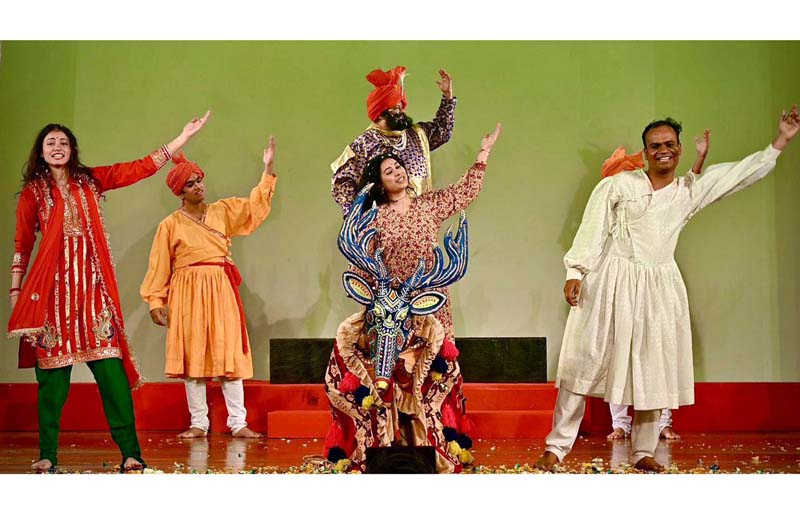
JAMMU, Mar 27: As part of the World Theatre Day commemoration, Jasma, a Dogri play, was presented by the students of the Department of Performing Arts, Cluster University of Jammu, under the sponsorship of the Jammu & Kashmir Academy of Art, Culture and Languages (JKAACL), at Abhinav Theatre here today.
Based on the original Gujarati play Jasma Oden by Shanta Gandhi and translated into Dogri by Kavi Rattan, today’s production, directed by Abhishek Bharti and Aparna, appeared in a new avatar. To localize the context, the Dogri folk theatrical form of Haran replaced the Gujarati Bhavai form used in the original version.
The play is based on a folk legend about an apsara who, cursed by a rishi, is born on earth and, in turn, curses the rishi to become her husband. Reborn as labourers, the couple, Baishno and her husband, along with their nomadic community, are tasked by a local king to dig a deep pond. Captivated by Jasma’s beauty, the king attempts to pursue her. What follows is the story of her unwavering love for her husband, set against the lust of the tyrant king, culminating in her ultimate sacrifice to protect her honour and marital fidelity.
Narrated by two sutradhars who guide the audience through Jasma’s journey, the performance effectively uses the Dogri folk form of Haran, blending singing, acting, and storytelling. Diksha Pandita as Baishno, Karan as Basant, and Ravinder Sharma as King Bhairo delivered impressive performances. The energetic interplay of dance and song sequences kept the stage dynamic, with the young cast portraying different characters with commendable ease.
The production emphasised visual appeal through colourful costumes, traditional music, and heightened acting styles, sustaining strong audience engagement. Younger viewers, in particular, responded enthusiastically to the earthy Dogri idioms and elements of slapstick comedy expressed through exaggerated gestures and physical humour.
The use of folk religious motifs, including elements of sacred possession, added both local and universal dimensions, especially in the climactic scene where, after the massacre of her community, Baishno slays the king and manifests as a form of Devi Kali.
Designed by Kuldeep Raina, the live music, performed by teachers and students, emerged as an integral component of the production. The use of Dogra folk theatrical forms for urban audiences signals a possible revival of indigenous theatrical idioms in the region.
Apart from the entertaining performance, the highlight of the event was the felicitation of five theatre personalities of Jammu and Kashmir by Brij Mohan Sharma, Principal Secretary, Department of Culture, and Harvinder Kaur, Secretary, JKAACL. The honourees included Balwant Thakur, Mohan Singh, Deepak Kumar, A.K. Bharati, and Mohammad Ayash Arif.
 Follow our WhatsApp channel
