

Manisha Dogra
For thirty years, until my husband superannuated from the Indian Army a couple of years ago, my life beat to the quiet rhythm of a soldier’s world. I have been wedded to the olive green, a term that only begins to describe the profound journey of being an officer’s wife. The world often sees the uniform, the valour and the sacrifices made on the border. What it does not see is the parallel force that operates in the shadows, the silent ranks that guard the home front with just as much dedication. To the casual observer, I am a housewife. But within the ecosystem of national security, I have always been a part of the bedrock that allows a soldier to serve without looking over his shoulder. This, I have realised over three decades, is where our story of empowerment truly begins.
When society speaks of women’s empowerment, the imagery is often of corporate boardrooms, financial independence and breaking glass ceilings. While that is a vital part of the narrative, my years in the Army have taught me that empowerment is a far deeper concept. It is, at its core, about agency: the ability to make decisions, to shoulder immense responsibility, to build capability and to stand tall in the face of adversity without losing one’s compassion. It is the power within to manage extreme stress and the power with others to build a community that thrives on mutual respect. By this definition, the life of an Army wife is a living, breathing case study in quiet, steadfast empowerment.
Our primary contribution to national security is the most invisible yet the most foundational: we secure the home fort. When our forces carried out strikes during operations like Sindoor, in thousands of homes like mine wives sat in pin-drop silence, eyes glued to the television, hearts pounding with a fear we could never express. When my husband was deployed to the icy heights of Kargil or the dense forests during counter-insurgency operations, his mind had to be clear. A soldier can only face the enemy if he has absolute peace knowing his own fort is secure. For months on end, I became a single mother by circumstance, managing children’s education, their emotional upheavals and ageing parents, all while a silent prayer lingered for his safe return. There were nights I lay awake staring at the ceiling, wondering if he was safe, if the next news bulletin would bring tidings I could not bear. Yet when morning came, I would pack the children’s tiffin with a smile and tell them their father was protecting the nation. This is not mere household management; it is high-stakes crisis management. We handle midnight emergencies, sudden illnesses and the silent terror of not knowing, all while maintaining a brave face. This emotional resilience, this ability to absorb stress so the soldier can focus, is our distinct marker. We are the emotional infrastructure of the force, and when that infrastructure is strong, the nation stands taller.
The loneliness of this life is a constant companion, yet over the years we learn to transform it into strength. There is a special emptiness when you finally close the door to an empty bedroom, sleeping with worry in your chest. You learn to celebrate birthdays over crackling phone lines, to hold back tears when the call drops, to explain why Papa cannot come for the school play. Through it all, you become both mother and father: teacher, counsellor and anchor. You create continuity for children even as the address changes every two years and friends are left behind. You turn uncertainty into stability. That is nation building at its most foundational level: raising emotionally secure citizens who grow up understanding that service before self is not just a motto but a way of life. Looking back now, after my husband has hung up his uniform, I see that those years of seeming solitude were actually years of profound purpose.
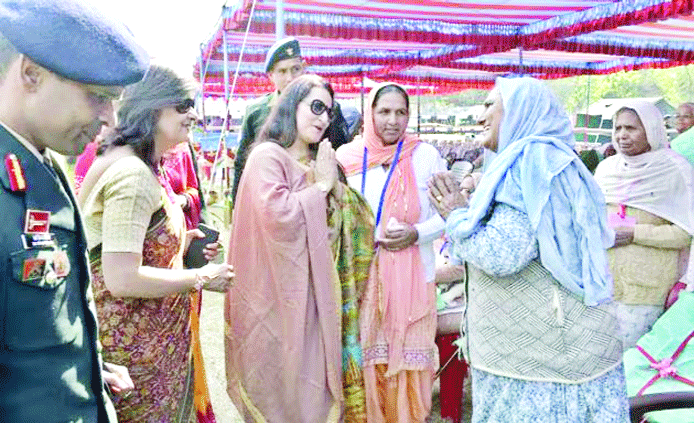
Beyond the immediate family, our role extends to nurturing the larger Army community. One of the most rewarding aspects of my journey has been mentoring the wives of jawans, many of whom come from rural India where literacy is low and patriarchal norms run deep. In them, I saw not a subordinate but a sister in need of a handhold. We would sit together, patiently explaining reproductive health, financial literacy and how to navigate schools or hospitals. I recall the spark in a young woman’s eyes when she first understood that she could learn a skill, earn her own income and have a say in her family’s future. By encouraging them to recognise their own potential, we were building a more equitable society from the grassroots up. This is empowerment that spreads horizontally, woman to woman, creating ripples far beyond the cantonment.
This spirit finds formal expression in the Army Wives Welfare Association. Through skill training centres, we provide accredited courses that enable women to become financially self-reliant. Outlets showcasing handmade goods give them a platform to sell their creations, fostering pride and economic independence. These are nation-building exercises that ensure the human resource of the Armed Forces remains motivated and secure. When a wife learns to earn, she gains a voice, an identity and a confidence that transforms every aspect of her life. I have seen shy, hesitant women blossom into entrepreneurs and community leaders, and in their growth, I have witnessed empowerment in its truest form.
The most sacred duty, however, is hand-holding our Veer Naris, the widows of martyred soldiers. When a soldier makes the ultimate sacrifice, the nation salutes, but it is our community that must ensure his family does not feel abandoned. I have sat with young widows, their eyes hollow with shock, unable to comprehend a future without the man they married. In those moments, no form or entitlement can fill the void. It is the simple act of sitting quietly, holding a hand and whispering that they are not alone that begins the healing. We guide them through paperwork, help them navigate their children’s schooling and, most importantly, restore their sense of belonging. I think of widows who have transformed grief into purpose, who have gone back to study, who have started small businesses and raised extraordinary children. Their courage has been my inspiration. This is empowerment redefined: ensuring sacrifice does not lead to abandonment, but to social inclusion, capability and restored identity.
So how do we redefine women’s empowerment in the context of an Indian Army wife? It is an influence that comes not from a formal rank but from the capacity to navigate a complex web of expectations with grace and competence. It is the sense of self-determination that comes from being an active member of a community that values mutual respect. We are not passive bystanders waiting for our husbands to return. We are the backbone of a unique socio-cultural milieu. We uphold the dignity of the uniform even in our domestic choices, symbolising that service continues in a different form. As Jawaharlal Nehru wisely said, to awaken the people, it is the women who must be awakened. Once she is on the move, the family moves, the village moves, the nation moves.
Now that my husband has retired and we have stepped into a new phase of life, I often reflect on those three decades. The postings, the separations, the makeshift homes, the constant goodbyes they have all shaped me in ways I could never have imagined. The olive green may no longer be a daily presence in our home, but its imprint on my soul is permanent. Our lives are, and will always be, wedded to the olive green. But in that union, we have found a strength that is entirely our own. We empowered our husbands to fight, our children to lead and our sister-wives to thrive. We managed the house, the heart and the community. In doing so, we have proven that the greatest security a nation can have is not just the weapons its soldiers carry, but the unyielding, resilient and empowered spirit of its women who stand firmly behind them.
(The author is the wife of a retired army officer and a post graduate from Jammu University)
 Follow our WhatsApp channel
