

T N Ashok
Twenty-seven years is a long time to wait for a revolution. India’s Women’s Reservation Bill — now the Constitution (106th Amendment) Act — was first introduced in 1996 when Deve Gowda led a fragile coalition government and the idea of reserving one-third of Lok Sabha seats for women seemed, to many in Parliament, both radical and threatening.
It was shouted down, stalled, delayed, and buried across seven prime ministers, four ruling coalitions, and a dozen sessions of Parliament. In September 2023, it finally passed both houses with near-unanimous support. The applause was deafening. So was the silence around what came next. What comes next, it turns out, is more waiting.
The law will not take effect until after the next Census — delayed from 2021 by the pandemic — and a subsequent delimitation exercise that redraws parliamentary constituencies. By any realistic calculation, that puts implementation no earlier than 2029, perhaps 2031. India has passed the most ambitious gender quota in the world, and then politely postponed it.
This is the central paradox of the bill: a reform genuinely historic in its scope, timed with surgical precision to coincide with five state assembly elections and a general election cycle, but structured in a manner that delivers its benefits to a future electorate, not the present one. Whether that makes it visionary or cynical is a question that cuts to the heart of how Indian democracy operates — and how political parties, perpetually calculating, navigate the space between principle and power.
The bill’s 27-year journey is not a story of neglect. It is a story of deliberate obstruction dressed in procedural clothing. Regional parties — the Samajwadi Party, the Rashtriya Janata Dal, the Janata Dal (United) — repeatedly blocked the legislation on a politically potent argument: that without a sub-quota for Other Backward Classes and minorities, the reserved seats would be captured by upper-caste, English-speaking, urban women who already possess the social capital to contest elections. Their concern was not with women’s representation per se. It was with which women would be represented. That argument has not gone away. It has merely been overridden, not answered.
What changed the political arithmetic in 2023 was not a sudden conversion to feminism on the Treasury benches. It was data. Women now constitute nearly half of India’s electorate, and in state after state — Uttar Pradesh, Bihar, Maharashtra, Himachal Pradesh — female voter turnout has risen to rival and sometimes exceed that of men.
A woman voter, polling strategists have concluded, is no longer a marginal variable. She is the variable. In that context, opposing the Women’s Reservation Bill became electoral suicide, and supporting it cost precisely nothing, since its benefits remain safely hypothetical until after the next general election.
The case for the legislation, stripped of its political packaging, is genuinely compelling. India’s record on women’s legislative representation is an embarrassment for a country that prides itself on democratic depth. Women hold approximately 15 percent of Lok Sabha seats — below the global parliamentary average of 24 percent, and a fraction of what Rwanda (61 percent), Sweden, or even Mexico has achieved.
The structural reasons are well-documented: campaign finance heavily favors incumbents, who are overwhelmingly male; party hierarchies resist disrupting safe-seat calculations; and the physical dangers of public life deter women candidates in ways that are rarely discussed openly.
The evidence from India’s own Panchayati Raj system — which has mandated one-third reservation for women in local governance since 1992 — offers cautious optimism. Studies across multiple states show that women-led village councils invest more heavily in water, sanitation, health, and primary education. The mere presence of women in decision-making rooms, research consistently finds, shifts what gets decided. A critical mass — not a token few — is what changes institutional culture.
A law that takes India from 15 percent to 33 percent women in Parliament would constitute one of the most significant redistributions of political power in the nation’s democratic history. In sheer scale, it would be without precedent in any democracy of comparable size and complexity.
The bill’s omissions are as revealing as its provisions. The most glaring is the absence of a sub-quota for OBC women and religious minorities. India’s affirmative action framework, constructed painstakingly over decades, has always acknowledged that disadvantage is intersectional — that a Dalit woman and an upper-caste woman face structurally different barriers. The Women’s Reservation Bill acknowledges the first (it includes reservations within existing SC and ST quotas) but ignores the second. Critics argue, with considerable force, that this will produce a parliament more female in composition but not necessarily more representative in its social texture.
The 15-year sunset clause introduces a different anxiety: that the reform is structurally temporary, subject to the political winds of a future Parliament that may choose not to renew it.
Then there are the subtler concerns about the gap between representation and power. India’s political landscape is crowded with women who hold office while husbands, fathers-in-law, or party bosses hold authority. The phenomenon has a name — the “proxy politician” — and it is a documented feature of Panchayati Raj governance, where research shows that male relatives frequently attend meetings in place of elected women members. Without parallel investment in training, financial support, and institutional mentorship, the risk is that the law produces a statistical correction without a substantive one.
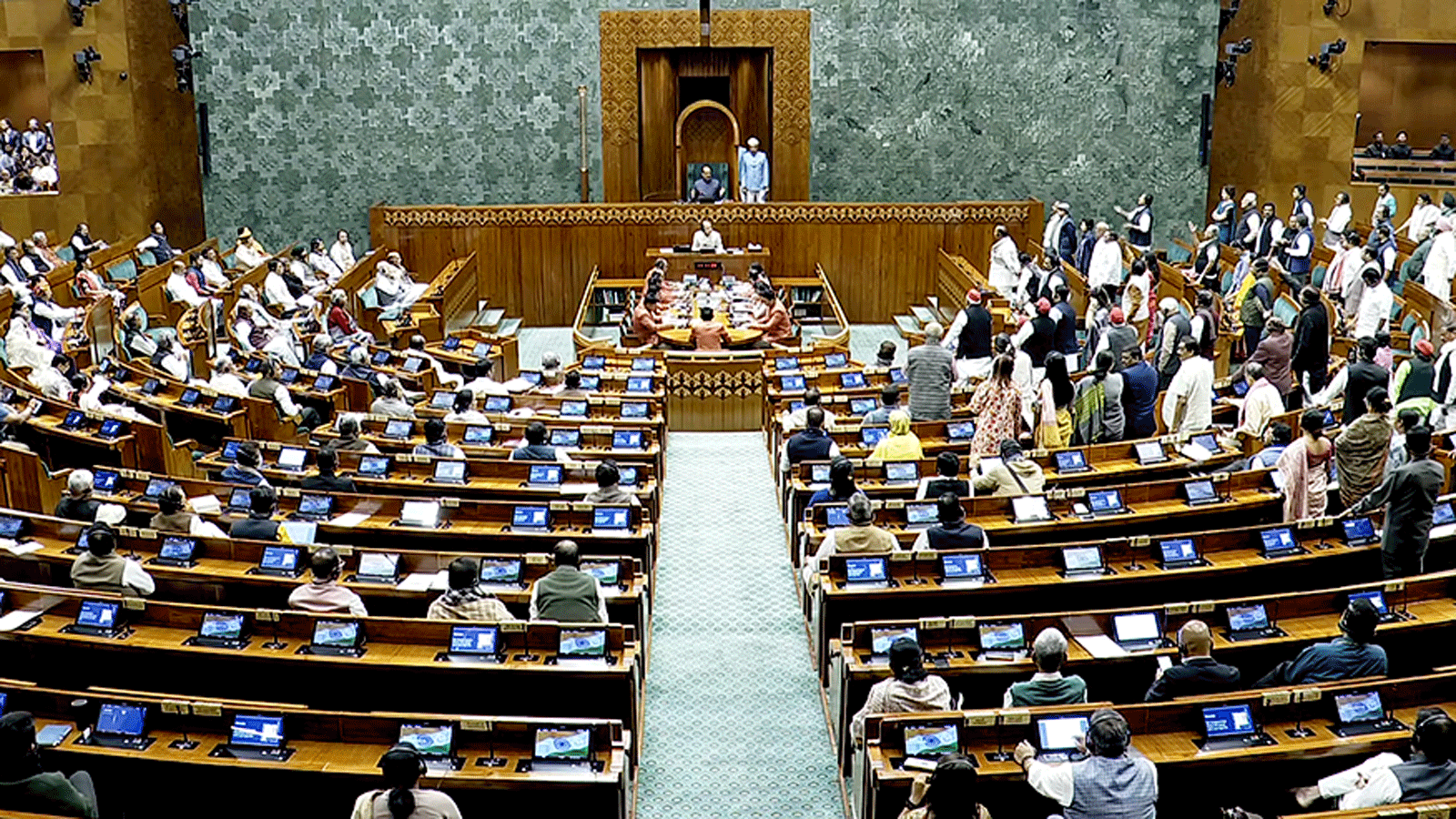
Timing, in Indian politics, is never accidental. The bill was introduced in a specially convened session of the new Parliament building — itself a theatrical gesture — just months before assembly elections in Madhya Pradesh, Rajasthan, Chhattisgarh, Telangana, and Mizoram, and ahead of the 2024 general election. The ruling Bharatiya Janata Party, led by Prime Minister Modi, had been investing heavily in women voters through targeted welfare schemes: the Ujjwala cooking gas program, housing allotments, cash transfers under PM-Kisan. The reservation bill extended that narrative — from women as beneficiaries of state welfare to women as co-architects of the state itself.
The opposition was placed in an impossible position. Opposing the bill risked alienating half the electorate. Supporting it meant handing the government a historic achievement. Most chose, with varying degrees of enthusiasm, to support it while simultaneously demanding OBC sub-quotas — a position that allowed them to vote yes while registering dissent. It was a manoeuvre as politically sophisticated as the bill itself.
Regional parties, whose influence rests on caste-based social coalitions, have the most complex relationship with this reform. The Samajwadi Party’s base — the Yadav and Muslim communities of Uttar Pradesh — has historically seen upper-caste domination of institutional politics as an existential threat. For them, gender reservation without caste reservation is not reform. It is displacement.
The world is watching, and the stakes are real. If India implements this law effectively and on schedule, it will become the most consequential example of constitutional gender quota politics in democratic history. Larger than France’s gender parity legislation, more durable than Norway’s party-level quotas, more ambitious than anything attempted in South Asia or Sub-Saharan Africa at comparable scale. It could redefine what is politically possible for democracies that have long treated gender representation as aspirational rather than structural.
If the law is further delayed, hollowed out in implementation, or captured by elite women while OBC and minority communities are left at the margins, it will serve a different purpose — as a cautionary tale about the distance between legislative symbolism and democratic transformation.
India has a history of both. The Right to Education Act, the Forest Rights Act, and the National Food Security Act all announced transformative intent. Their implementation stories are considerably more complicated.
What India has done is legislate a future. Whether it inhabits that future depends on questions the law itself cannot answer: whether political parties will select candidates based on merit and social diversity or on pliability and familial connections; whether institutional support structures will be built alongside the quota; whether the Census and delimitation timeline will be accelerated or stretched to political convenience.
The bill’s passage is real. So is the delay. Both are, in their way, characteristic of Indian democracy — a system capable of breathtaking ambition and breathtaking evasion, sometimes within the same parliamentary session.
What is not in doubt is the significance of the threshold crossed. India has declared, in its constitutional text, that one-third of the voices shaping its laws must be women’s voices. That declaration will outlast the Parliament that made it, the election that motivated it, and the political calculations that shaped it. The world is watching to see what India does with what it has promised itself. (IPA Service)
 Follow our WhatsApp channel
