

Harsha Kakar
kakarharsha@gmail.com
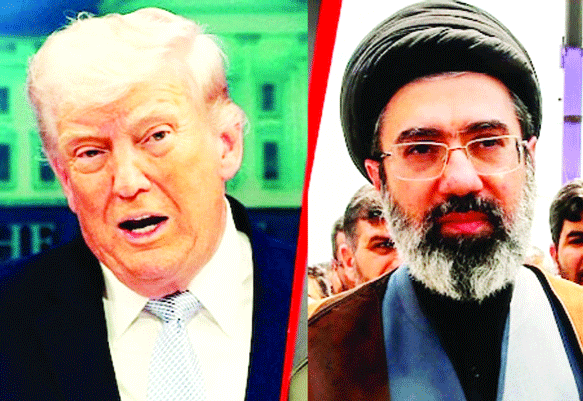
The ceasefire announced with much fanfare by Donald Trump in his ongoing conflict with Iran, supposed to have been negotiated by Pakistan, does not possess logical trappings for a peaceful settlement. The US appears to give more than it takes, despite investing billions of dollars in the conflict. Even the mediation, announced simultaneously by Trump, Iranian foreign minister, Seyed Abbas Araghchi, and Pakistan PM Shehbaz Sharief, appears doubtful. The question is that if the terms are unequal, can the ceasefire last and can an agreement benefitting both sides emerge at the end of discussions. Further what would happen in case the discussions continue beyond two weeks.
The true architects of the ceasefire were US Vice President, JD Vance, and China, which applied pressure on Iran to bend and accept. Pakistan was nowhere in the picture other than possibly relaying messages. For Trump to acknowledge China as the master mediator would be detrimental within the US. Even the tweet pushed by Shehbaz on the ceasefire was drafted in Washington as it mentioned ‘Draft for Pakistan PM.’ No one in Pakistan would term him as Pakistan PM but just PM. The tweet mentioned conversations of Shehbaz and Asim Munir with Trump, while in reality they did not happen.
An assessment of the 10-point Iranian proposal being the basis for discussions, as mentioned by Trump in his tweet, while announcing the ceasefire, appear to be largely one-sided benefitting Iran, possibly to lull it into complacency. A reason which possibly compelled Trump to bend was the US armed forces refusing to follow his directions of engaging targets like power plants and bridges which serve the Iranian public thereby opening the army leadership to charges of crimes against humanity.
Trump may end his tenure but the charges could be brought about by the new government. Another matter of concern was that the Iranian public had formed human chains around power plants and major bridges, destroying which could result in immense civilian casualties, which the military would be hesitant to do. A ceasefire will end such protests and these objectives can then be engaged in case Iran refuses to bend.
Trump was also losing popularity within the US, which for him was a matter of concern. His constant rambling to reporters contradicting himself, illogical, insulting and frustrating tweets on his social media platform, losing allies across the world, rapidly changing end states, rising cost of gasoline and inflation within the US, which could have cost his party valuable votes in the forthcoming midterm polls, opening doors for his impeachment. The US public was aware that Iran was never a threat to them and hence Trump entered the conflict in support of Israel.
His best option was to attempt to end the conflict which he entered against the advice of his own generals, who were aware that Israel was leading him down the garden path. If talks don’t succeed or he places unacceptable terms then he could claim that he tried to resolve the conflict and Iran refused.
Trump’s two tweets, the first, ‘We received a 10-point proposal from Iran, and believe it is a workable basis on which to negotiate,’ and the second, ‘The United States of America will be helping with the traffic buildup in the Strait of Hormuz. There will be lots of positive action! Big money will be made. Iran can start the reconstruction process,’ indicate a ceasefire benefitting Iran.
Not a single US objective has thus far been met. Fissile material remains within Iran, the regime continues, possibly with greater brutality, its support to its proxy groups is untouched, its ballistic missile capabilities may have diminished but are still substantial and ships transiting the Strait of Hormuz would pay Iran, enabling it to rebuild its military power. In addition, Iran would continue selling its oil. The IRGC would only enhance its control over the state. The Strait of Hormuz was open prior to the conflict and free, will open again but every ship crossing would have to pay. This would mean an increase in global oil prices. The only issue that the US would insist on is that the payment for transiting Hormuz would be in USD as against Iran’s demand for the Yuan.
Israel is the one nation miffed at the US. The decision for the ceasefire was taken by Trump unilaterally, though he claims that Israel was involved. While Trump announced that the ceasefire involves all sectors, including Iran’s proxies, Israel refuses to stop its operations in Lebanon. Israel had 26 dead and over 7000 wounded in the conflict. It faced destruction in every part of the country from Iran’s missiles as also its economy has been severely dented. The 10-point Iranian proposal was unacceptable to Israel. It was working to target the current leadership when Trump announced the ceasefire. Continuation of the conflict also saves Netanyahu from his corruption cases. In all likelihood the government would now be toppled and Netanyahu dethroned.
The US has paid equally in the war. It has spent billions on the conflict, had major damages to its bases and radars in the Middle East, run out of reserves of air defence missiles, drifted away from its allies in NATO and lost global trust and support. Almost twenty aircraft were damaged or destroyed alongside similar number of Predator drones. Such was the expenditure that the Pentagon is seeking an additional USD 200 billion in funding from the Congress.
In such a scenario, it is unlikely that Trump would give much without major reason or that the ceasefire is just an option of buying time before striking again and as last time, a surprise strike.
While the world hopes peace is restored, oil and gas prices drop, Hormuz remains open, Trump is considering his next move, which could be Iran a second time or Cuba or possibly even Greenland. The President who claims he is a man of peace has been engaged in constant conflict.
The author is Major General (Retd)
 Follow our WhatsApp channel
