

Prof D Mukherjee
mukhopadhyay.dinabandhu@gmail.com
For over a hundred years, the Middle-East has remained one of the most strategically important and politically unstable regions in the world. Its significance is not determined by location alone, but also by its long history, religious importance, vast energy resources, and the involvement of major global powers. Positioned between Europe, Asia, and Africa, the region holds some of the largest oil and gas reserves in the world, making it vital for global energy supply. Since modern economies depend heavily on oil and energy transportation, political instability in this region quickly becomes an international issue rather than a purely regional one. Conflicts in the region have involved not only regional powers such as Iran and Israel, but also external powers such as the United States and several European countries. Many local disputes gradually developed into proxy conflicts involving global powers, making peaceful resolution more difficult. Religious differences, territorial disagreements, political ideologies, and competition for regional influence have all contributed to repeated instability. The region is also globally important because of oil transportation routes, especially the Strait of Hormuz, through which a large share of the world’s oil trade passes. Any disruption in this route affects oil prices, shipping costs, and inflation worldwide. Therefore, the Middle-East conflict must be understood as a global economic and security issue rather than merely a regional conflict.
The countries directly involved in war suffer the most severe and lasting consequences. Armed conflict destroys not only military assets but also civilian infrastructure, economic institutions, and social stability. Roads, bridges, ports, airports, power stations, oil facilities, hospitals, and schools are frequently damaged or completely destroyed, and rebuilding such infrastructure requires enormous financial resources and many years of sustained effort. The economic impact of war is equally damaging. Industrial production declines, trade routes are disrupted, foreign investment declines, and governments are forced to spend heavily on defence rather than on education, healthcare, and infrastructure development. Inflation often increases, unemployment rises, and national currencies weaken due to economic uncertainty and declining exports. Economic sanctions imposed during conflicts can further worsen the situation by restricting access to global markets and financial systems. This reduces export earnings, particularly from oil, leading to budget deficits, reduced public services, and falling living standards. Human losses are the most tragic of all. Wars lead to deaths, injuries, displacement, refugee crises, and long-term psychological trauma. Many young people lose education and employment opportunities, slowing national development for decades. War therefore leaves deep economic, social, and developmental damage rather than real victory.
In an increasingly interconnected global economy, the consequences of war are seldom limited to the countries directly involved in the conflict. Even nations far removed from Middle-East battlefields experience economic and financial repercussions. The most immediate effect is usually visible in global oil markets. When conflict threatens oil production facilities or transport routes, oil prices rise due to uncertainty and fears of supply disruption. Rising oil prices increase transportation, manufacturing, electricity, and agricultural costs, which eventually leads to inflation across many countries. Oil-importing nations such as India, Japan, and several European economies are particularly affected because higher import bills widen trade deficits and weaken national currencies.
Maritime trade is also affected when conflicts occur near major sea routes. Shipping insurance, security costs, and freight charges increase, and these higher costs are passed on to consumers through increased prices of goods and services worldwide. Conflicts also create refugee movements into neighbouring countries, placing pressure on housing, employment, healthcare, and education systems. Thus, even countries not directly involved in war experience inflation, trade disruption, economic uncertainty, and social pressures as indirect consequences of Middle-East conflicts.
At the global level, conflict in the Middle-East influences economic growth, financial stability, energy security, and international trade. Oil remains a critical resource for modern economies, and sudden increases in oil prices can slow economic growth across many countries. When oil prices rise, transportation and production costs increase, which leads to higher prices and inflation in multiple sectors of the economy. Global financial markets are highly sensitive to geopolitical tensions. During periods of conflict, stock markets often decline as investors shift their investments towards safer assets such as gold and government bonds. Currency markets also experience fluctuations, particularly in oil-importing developing countries where rising import bills put pressure on national currencies. Global supply chains are also vulnerable because major shipping routes pass near Middle-Eastern waters. Disruptions in maritime trade can delay shipments, increase freight costs, and create shortages of goods worldwide. Furthermore, geopolitical tensions often lead to higher defence spending, reducing funds available for development sectors such as education, healthcare, infrastructure, and environmental protection.
The Middle-East occupies a central position in global oil geopolitics due to its vast energy reserves and its control over major maritime oil transport routes. Oil has long been one of the world’s most strategic resources, shaping international relations, military planning, and economic policy. Organisations such as OPEC influence global oil production and prices, which in turn affect inflation and economic growth across the world. The region’s importance is further strengthened by key maritime routes such as the Strait of Hormuz and the Suez Canal, through which a large share of global oil shipments and international trade passes. Because of this strategic importance, major powers maintain political alliances and military presence in the region. As a result, the Middle-East remains not only a political conflict zone but also a centre of global energy and strategic geopolitics.
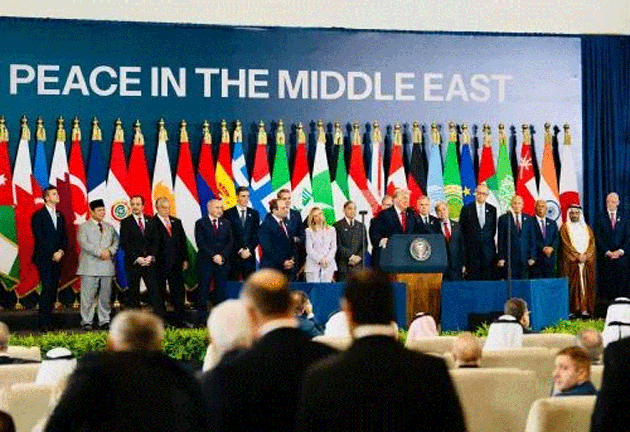
An enduring solution to conflict in the Middle-East cannot be achieved through military action alone. Military victories rarely result in lasting peace and often create new tensions and instability. Long-term peace can emerge only through diplomacy, economic cooperation, security arrangements, and mutual recognition of strategic interests among the countries involved. One possible approach would be the creation of a regional security framework in which major regional powers commit to resolving disputes through negotiation rather than armed confrontation. Confidence-building measures such as arms control agreements, nuclear monitoring mechanisms, and cooperation in maritime security could gradually reduce mistrust and prevent escalation of conflicts. Economic cooperation could also contribute significantly to peace. Increased trade, infrastructure development, energy partnerships, and regional investment could create economic interdependence, making conflict economically harmful for all parties involved. Countries that are economically connected are generally less likely to engage in prolonged conflict. A balanced diplomatic arrangement could address the concerns of key stakeholders, including Iran and Israel, while global powers would benefit from stable energy prices, secure trade routes, and reduced military expenditure in the region. Such an approach would promote shared stability and mutual economic benefit rather than political victory for any single country.
A long-term solution to instability in the Middle-East must include the protection and neutral management of major maritime trade routes, particularly the Strait of Hormuz. Since a significant portion of global oil supply passes through this route, any conflict in this area immediately affects global energy prices and economic stability. One possible long-term approach would be an internationally supervised maritime security arrangement to ensure that shipping routes remain open and neutral despite political tensions. Multinational naval cooperation could focus on protecting commercial shipping rather than promoting national strategic interests. Diversification of energy transport through pipelines and alternative routes could also reduce dependence on a single chokepoint. Over time, the global shift towards renewable energy may further reduce dependence on Middle-Eastern oil. Ultimately, long-term peace in the region will depend on economic development, regional cooperation, political stability, and integration into the global economy.
For countries such as India and other major economies, stability in the Middle-East is crucial for energy security, stable trade, and sustained economic growth. Many countries rely heavily on oil imports from the region, and any disruption in supply directly affects inflation, currency stability, and overall economic performance. India and other global powers should therefore pursue balanced foreign policies that maintain diplomatic relations with all major Middle-Eastern countries while supporting peaceful conflict resolution through international institutions. Building strategic petroleum reserves, investing in renewable energy, and diversifying energy import sources are important policy measures to reduce vulnerability to geopolitical shocks .Global leaders must recognise that conflict in the Middle-East is not merely a regional issue but a global economic and security challenge. Long-term peace would benefit all countries through stable energy prices, secure trade routes, and economic stability. Sustainable peace will depend on diplomacy, economic cooperation, maritime security, and mutual security guarantees among nations.
(The author is a Bangalore based educationist, management scientist and an independent researcher)
 Follow our WhatsApp channel
