

Prof Raj Shree Dhar
dharrajshree@gmail.com
Elevate mathematics as reasoning tool and thinking skill, not just rote formulas. Reform curriculum to focus on fundamentals, reduce overload, and provide choice and flexibility. Link mathematics education to broader 21st-century skills like critical thinking, data literacy, and problem-solving. Encourage implementation that is country-wide but flexible to local contexts.-Prime Minister Narendra Modi
Indian mathematics holds a special place in the history of human knowledge. It is not only one of the world’s oldest mathematical traditions but also a foundation upon which much of modern mathematics was later built. Indian Mathematics refers to the body of mathematical ideas, discoveries, and methods that were developed on the Indian subcontinent over thousands of years may be before the Vedic period. It is not only a collection of results but also a distinct philosophical and practical approach to understanding numbers, patterns, and the universe. Mathematics in ancient India was not a separate discipline; it was woven into astronomy, architecture, art, philosophy, and even poetry. Learning about it connects us to a rich intellectual and cultural tradition that valued logic, precision, and innovation. Indian mathematicians developed unique methods such as the sutra (verse) system for concise problem representation and algorithmic solutions, as seen in Vedic mathematics books and texts like the Sulba S?tras. These approaches foster creative, pattern-based thinking useful even in today’s computational and engineering contexts. Revisiting Indian mathematics encourages pride in indigenous knowledge systems and can inspire modern students to think critically and innovatively. It also reminds us that scientific inquiry has deep roots in our own land. Studying Indian mathematics is not merely about revisiting history, it is about recognizing India’s role in shaping world knowledge, learning alternative problem-solving traditions, and understanding how intellectual innovation transcends time and culture.
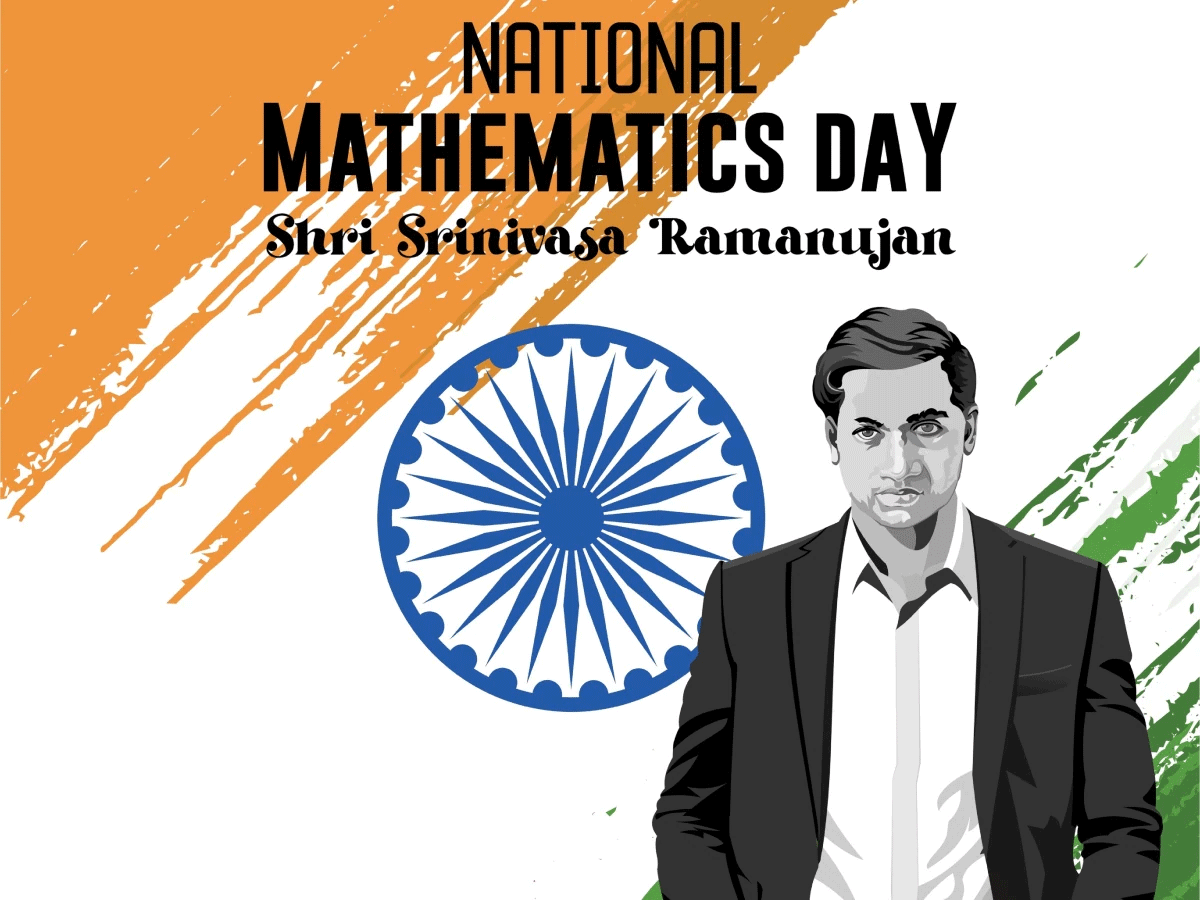
National Mathematics Day
Ancient Indian mathematics was intuitive, practical, and deeply connected to life, cosmos and nature, while modern mathematics is formal, abstract, and globally standardized. Yet, modern mathematics stands firmly on the foundations laid by ancient Indian scholars, especially the invention of zero and the decimal system. Key contributors of Indian Mathematics include ?ryabha?a, Brahmagupta, Bh?skara II, Madhava, Ramanujan etc. and fields of focus include Arithmetic, geometry, algebra, trigonometry, and early calculus whereas those of Modern Mathematics include Newton, Euler, Gauss, Cantor, Hilbert, and many others and fields of focus include all classical fields plus modern branches like topology, statistics, abstract algebra, computer science, etc.
The University Grants Commission (UGC) recently released a draft undergraduate syllabus for mathematics under the National Education Policy (NEP 2020). While the policy aims to modernize higher education and integrate India’s cultural heritage, the proposed syllabus has sparked strong protests from mathematicians across the country. The central concern is that the new draft dilutes core mathematical content. Topics fundamental to higher studies and research such as Analysis, Linear Algebra, Abstract Algebra, and Differential Equations have been reduced or simplified. Scholars fear that this will leave students ill-prepared for advanced degrees, research, and competitive examinations like CSIR-UGC NET or GATE. A second major issue is the overemphasis on ancient Indian mathematics. While India’s mathematical heritage is a source of pride, critics argue that the draft replaces essential modern topics with loosely presented material on Vedic Mathematics and Sulba Sutras. They stress that these subjects should be studied critically, with scholarly references, rather than inserted without academic balance.
Another point of contention is the lack of expert consultation. Mathematicians from IITs, IISc, and major universities have stated that they were not adequately involved in framing the draft. This has raised questions about the transparency and credibility of the revision process. Academics also warn that the proposed changes could lower national standards and affect global recognition of Indian mathematics degrees, undermining employability and research potential. Mathematicians emphasize that they are not opposing NEP 2020 or India’s ancient knowledge, but advocating for a curriculum that maintains rigor, reflects global best practices, and respects India’s intellectual traditions in a scholarly manner. Their message is clear: Honor India’s mathematical heritage but do not weaken the scientific foundation of our education.
Manjul Bhargava, the mathematician of Indian origin who has won the Fields Medal often called as “Nobel Prize of Mathematics” believes that India’s mathematical heritage deserves more recognition in modern curricula e.g., contributions to number theory, combinatorics, and the decimal system. He feels delighted that “in the next five years or so, students will become as familiar with names like Pingala, Madhava … as they are with Pythagoras or Euclid.” He stressed that finishing a syllabus is less important than ensuring students have strong foundational skills and also explains that change takes time and that vision alone isn’t enough, he said “we have made a good start” but the full impact will become evident only after some time. He pointed out that in India; mathematics often gets sidelined as a tool for engineering, rather than being taught as an independent subject where students can love the subject for its own sake. From Bhargava’s remarks we can infer how he envisions an ideal mathematics syllabus aligned with NEP: it would prioritize understanding and problem-solving rather than rote computation. It would integrate historical, cultural, and conceptual aspects for example, India’s contributions alongside modern mathematics. It would break down early specialization, letting students explore mathematics, arts, and sciences in a more flexible way. It would give teachers and institutions the autonomy to adapt methods, use games, puzzles, creative modules. It would ensure foundations are strong like numeracy, sense of number, & patterns before advancing to heavy abstraction. It would connect mathematics with other fields like music, poetry, art to make it engaging, and alive.
India has produced some of the world’s most brilliant mathematical minds includes Srinivasa Ramanujan, whose genius stunned western scholars, Shakuntala Devi, celebrated as the “Human Computer.” Yet, paradoxically, many Indians have not fully recognized or celebrated their achievements during their lifetimes. This hesitation has historical, cultural, and systemic roots. Centuries of colonial influence created a deep-seated belief that true excellence must be validated by the West. Ramanujan gained recognition only after his work was endorsed by G. H. Hardy at Cambridge. Shakuntala Devi’s global fame was often celebrated abroad before it was respected at home. This tendency to seek foreign approval continues to affect how India perceives its own intellectuals. India’s academic system often favors conformity over creativity. Independent thinkers like Ramanujan, who worked outside formal education systems, or Shakuntala Devi, who defied conventional academic paths, struggled to find institutional backing or mentorship in India. Shakuntala Devi faced additional challenges as a woman in a male-dominated field. Her mathematical feats were often dismissed as performance rather than scholarship.
Such biases prevented her from receiving the academic recognition she deserved. Indian society traditionally values humility over self-promotion. As a result, many intellectual achievements remain understated and underpublicized. The West, by contrast, invests heavily in showcasing and commercializing talent like God’s particle or the Mandelbrot set – often called a “window into God’s creation” because of its astonishing beauty, infinite complexity, and deep connection between mathematics, nature, and philosophy.
Indian mathematics, when seen through Sri Aurobindo’s lens, is not only a science of numbers but a spiritual exploration of order and creation. It reflects the same truth that his philosophy expresses that the universe is Divine Consciousness expressing itself through harmony, pattern, and infinite perfection.
(The author is former Dean-Cluster University of Jammu & Principal Higher Education Department, J&K Government, J&K).
 Follow our WhatsApp channel
