

Tehran urges youth to form human chains
*Russia, China veto UN resolution on Hormuz
TEHRAN, Apr 7: US President Donald Trump threatened Tuesday that a “whole civilization will die tonight” if Iran fails to meet his latest deadline to strike a deal that includes reopening the Strait of Hormuz, while the Islamic Republic urged young people to form human chains around power plants and other potential targets.
Follow the Daily Excelsior channel on WhatsApp
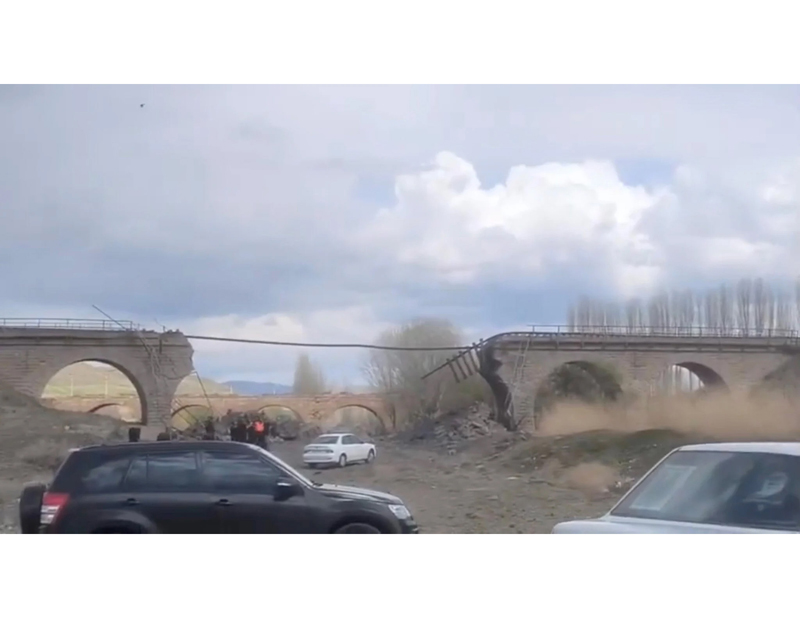
Even before the deadline, airstrikes hit two bridges and a train station, and the US hit military infrastructure on Kharg Island. It was the second time American forces struck the island, a key hub for Iranian oil production.
Click here to watch video
Since the war began, Trump has repeatedly imposed deadlines linked to threats, only to extend them. But the president insisted this one is final and will expire at 8 pm in Washington without a major diplomatic breakthrough.
He has also offered contradictory statements about what might actually happen.
Trump has made reopening the strait – through which a fifth of the world’s oil transits in peacetime – part of avoiding wider attacks and suggested that the waterway is not as vital to US oil interests as it to other countries.
He has also said he would be willing to deploy ground troops to seize Iranian oil, while maintaining that major combat operations in that country could soon conclude.
That means the next moves by the US are largely a mystery, even as rhetoric on both sides has reached a fever pitch.
Meanwhile, Iran’s president said 14 million people, including himself, have volunteered to fight. That’s despite Trump threatening that US forces could wipe out all bridges in Iran in a matter of hours and reduce all power plants to smoking rubble in roughly the same time frame. He also suggested the entire country could be wiped off the map.
It was not clear if the latest airstrikes were linked to Trump’s threats to widen the civilian target list. At least two of the targets were connected to Iran’s rail network, and Israeli Prime Minister Benjamin Netanyahu said Israeli warplanes struck bridges and railways in Iran.
Tehran fired on Israel and Saudi Arabia, prompting the temporary closure of a major bridge.
While Iran cannot match the sophistication of US and Israeli weaponry or their dominance in the air, its chokehold on the strait is roiling the world economy and raising the pressure on Trump both at home and abroad to find a way out of the standoff.
Officials involved in diplomatic efforts said talks were ongoing, but Iran has rejected the latest American proposal.
“A whole civilization will die tonight, never to be brought back again,” if a deal isn’t reached, Trump said in an online post Tuesday morning. But he also seemed to keep open the possibility of an off-ramp, saying that “maybe something revolutionarily wonderful can happen.”
Earlier, Iranian official Alireza Rahimi issued a video message calling on “all young people, athletes, artists, students and university students and their professors” to form human chains around power plants.
Iranians have formed human chains in the past around nuclear sites at times of heightened tensions with the West. Some images of people surrounding power plants were posted Tuesday by local Iranian media, though how widespread the practice was is unknown.
President Masoud Pezeshkian posted on X that 14 million Iranians had answered campaigns urging people to volunteer to fight – and said he would join them – while a Revolutionary Guard general urged parents to send their children to man checkpoints.
The Guard warned that Iran would “deprive the US and its allies of the region’s oil and gas for years” and expand its attacks across the Gulf region if Trump carries out his threat.
Intense airstrikes pounded Tehran, including in residential neighbourhoods. In the past, such strikes have targeted Iranian government and security officials.
The Israeli military said it attacked an Iranian petrochemical site in Shiraz, the second day in a row it hit such a facility. The military later said it also struck bridges in Tehran, Karaj, Tabriz, Kashan and Qom that were being used by Iranian forces to transport weapons and military equipment.
A US official, who spoke on condition of anonymity to discuss sensitive military operations, described the strikes on Kharg Island as hitting targets previously struck and not directed at oil infrastructure.
Saudi Arabia said it intercepted seven ballistic missiles and four drones launched by Iran.
Saudi Arabia temporarily closed the King Fahd Causeway, the only road connection between Bahrain, home to the US Navy’s 5th Fleet, and the Arabian Peninsula. Iran also fired on Israel.
In Baghdad, American journalist Shelly Kittleson, who was kidnapped from a Baghdad streetcorner last week, has been released, an Iraqi official with direct knowledge of the situation said on Tuesday.
Kittleson was freed in the afternoon, said the official, who spoke to The Associated Press on condition of anonymity because he was not authorised to comment publicly. He did not share her current whereabouts but said that prior to her release, she had been held in Baghdad.
In United Nations, Russia and China on Tuesday vetoed a UN Security Council resolution on reopening the Strait of Hormuz, a vital maritime chokepoint through which a fifth of the global oil passes, blockaded by Iran.
The 15-nation UN Security Council voted on the resolution proposed by Bahrain, which got 11 votes in favour, two against and two abstentions.
The resolution could not be adopted because veto-wielding permanent members Russia and China voted against the resolution.
Before the vote, the UAE Mission to the UN said in a post on X, “Skyrocketing food prices and fuel costs. Blocked raw materials and essential supplies. Billions of people around the world are paying more for basic commodities due to Iran’s illegal actions. Now is the time for international action to protect freedom of navigation in the Strait of Hormuz.”
The UAE urges the UNSC to adopt the “Open the Strait” resolution and end Iran’s attacks and threats to the global economy, it said. Bahrain, supported by the Gulf Cooperation Council (GCC) and Jordan, proposed the Security Council resolution on the Strait of Hormuz.
Bahrain is currently president of the Council for the month of April. (Agencies)
 Follow our WhatsApp channel
