

Ankit Sharma
ankit.cloudnine@gmail.com
“In an age of viral news, AI and instant reactions, April Fool’s Day is no longer just a joke, it is a reflection of our times.”
Imagine waking up to a shocking headline, forwarding it instantly to friends and then realizing a few minutes later that it was just an April’s Fool’s prank. For decades, April Fool’s Day has been about harmless deception, playful tricks, light-hearted lies and laughter shared among friends. But in 2026,something has changed. The line between a joke and reality is no longer as clear as it once was.
From Pranks to Possibilities
The origins of April Fool’s Day are often linked to the shift from the Julian Calender to the Gregorian Calender in the 16th century, when those who continued celebrating the New Year in early April were mocked as “Fools”. Over time, this mockery evolved into a tradition of pranks. For generations, the format remained simple- school jokes, fake stories, harmless surprises. The intention was clear, to make people laugh. But today, the tools have changed. A prank no longer requires planning. It requires a smartphone. A rumour no longer travels by word of mouth. It travels at the speed of a click. And sometimes,it does not even need to be a prank at all.
April Fool in the Digital Age
In an era of artificial intelligence, edited videos and viral forwards, the idea of being ” fooled” has taken on a new meaning. What was once limited to a single day now feels like a daily challenge. A message appears on a screen. A video looks convincing. A headline seems urgent. And the mind reacts before it reflects. Even global brands like Google, once known for their elaborate April Fool’s jokes, have grown more cautious in recent years, aware that in a world already dealing with misinformation, the difference between humor and confusion is delicate.
Generations Apart, Yet Connected
April Fool’s Day also reveals an interesting generational shift.
Millennial’s remember it as a day of innocent fun- classroom pranks, friendly tricks and shared laughter.
Gen Z , however, experiences it differently. Growing up in a digital ecosystem up in a digital ecosystem, they create and consume content at lightening speed. Memes, reels and satirical posts blur the line between humor and reality. And yet, they are also more alert. They question, verify and often hesitate before believing perhaps because they have seen how easily perception can be shaped.
When Reality Completes with Satire
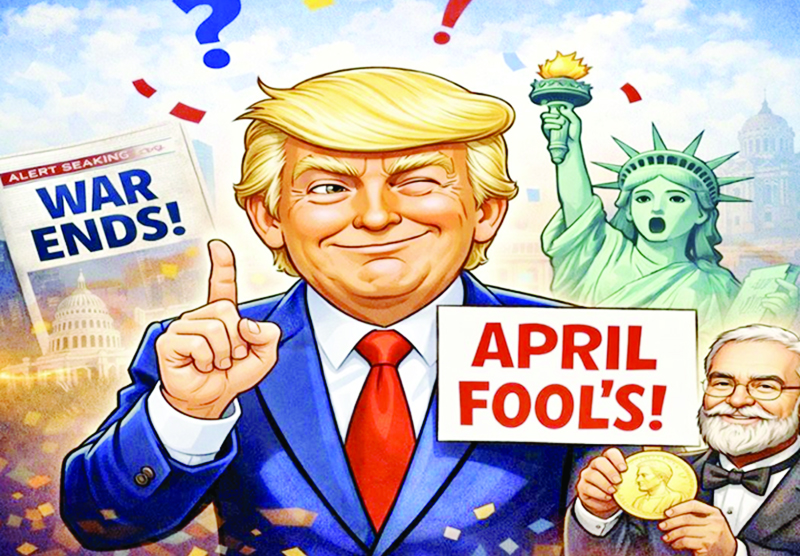
In 2026, April Fool’s Day faces an unusual competition: real-world events themselves. Statements, announcements and headlines today often arrive with such intensity that they can feel almost theatrical. Few public figures illustrate this better than Donald Trump. Known for his direct and unpredictable communication style, his words have repeatedly sparked instant global reactions, moving markets, dominating headlines and igniting debates within minutes. At times, the reaction carries an unusal undertone: ” Is this serious… or something else?” Not because it is a prank, but because the world today has reached a point where reality itself can feel like one.
A Witty Thought: Trump and the “Ultimate April Fool”
Imagine this: Its 1st April 2026. The world wakes up to a breaking headline: ” Major global announcement by Donald Trump”. Social media explodes. News channels go into overdrive. Experts start analyzing within seconds.And then comes the twist…Half the world thinks it’s an April Fool’s prank. The other half thinks it’s absolutely real. And that’s the real genius of the moment- when people can’t decide whether something is a joke or reality anymore. Because in today’s world, the most powerful move is not just making a statement, it’s making people question it.
His “Next Move”- A Thought Provoking Angle
What could be the next big April Fool style moment? Not necessarily a prank, but something that feels like one.
l A surprising announcement that sounds too dramatic to be true.
l A statement that divides opinion instantly.
l Or a move that dominated headlines before anyone can verify it.
In the age of attention, the real game is not just truth vs lie- it is speed vs understanding. And leaders who understand this don’t need April Fool’s Day. They create moments that feel like it, any day of the year.
The Real Lesson of April Fool 2026
April Fool’s Day is no longer just about laughter. It is a quiet reminder, to pause before believing, to verify before sharing and to think before reacting. Because in today’s world, the cost of being fooled is no longer just embarrassment. It can influence opinions, shape narratives and affect decisions.
A Soldier and Monk Reflection
There was a time when April Fool lasted for a day. Today, the challenge is to not be fooled every day. Wisdom in 2026 is not just about knowledge. It is about discernment. To recognize what is real. To question what appears unreal. And still, to retain the ability to smile.
 Follow our WhatsApp channel
