

Prof Suresh Chander
suresh.chander@gmail.com
(Note: This article presents an alternative scenario to the article Indian Civilization Vs India The Man Indian Civilization (Not India) Refuses to Thank published in the Daily Excelsior on 22 March 2026)
A Different Kind of Question
Civilizations do not change in only one way.Sometimes they are broken suddenly – through invasion, destruction, and visible rupture.
At other times, they are reshaped gradually – through processes that are slower, layered, and less immediately visible.
This reflection is concerned with the second kind.
It serves as a prelude to a different argument – one that examines not how continuity changes, but how it is preserved; not a transformation that occurred, but a catastrophe that did not.
To understand that argument, it is useful first to recognise that civilizational change need not always announce itself dramatically.
Not All Change Announces Itself
History is often written in the language of events.
Battles are recorded.
Capitals fall.
Empires rise and decline.
We are trained to recognise rupture – moments when something breaks visibly and irreversibly.
But civilizations do not always change through such moments.
Sometimes, they change quietly.
Gradually.
Layer by layer.
Without a single event that announces the shift.
Beyond Rupture: The Slower Movement of Change
When we think of civilizational transformation, we often imagine invasion or destruction. These leave behind evidence – ruins, chronicles, and memory.
Yet there is another pattern.
A civilization may not be destroyed.
It may be reconfigured over time.
Not through one decisive event, but through a series of processes which, individually, may appear limited – yet collectively reshape civilizational character.
A Layered Example
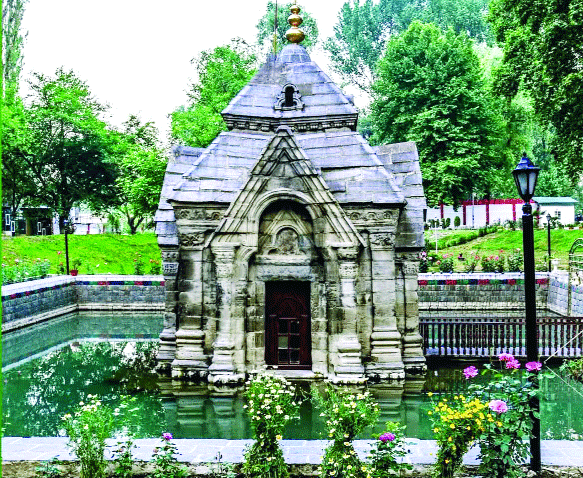
The Kashmir Valley offers a complex and layered example. From being a major centre of Sanskrit learning and Kashmir Shaivism, it appears over time to have undergone a significant transformation in its religious and cultural composition. By the late 14th and early 15th centuries, particularly during certain phases of political change, new institutional and cultural influences became more prominent, while earlier traditions receded from public life.
This transition does not lend itself to a single-cause explanation.
It does not present a single moment of rupture comparable to events like the fall of Baghdad in 1258.
Instead, it suggests a gradual reconfiguration – unfolding across time, shaped by multiple interacting influences.
Processes Without a Single Cause
Such transformations may involve:
* Shifts in political patronage
* Changes in institutional structures
* Cultural and linguistic realignments
* Social and economic incentives
* Patterns of persuasion, adaptation, and, at times, coercion
Classical Indian thought captures this range in the phrase sam dam, dand, bhed – an acknowledgment that change may occur through multiple pathways.
The relative role of each factor may vary.
The cumulative effect, however, can be significant.
Geography and the Depth of Change
Geography may also play a role.
The Kashmir Valley, bounded by mountains, has historically been both connected and insulated. Such insulation can preserve distinct traditions, but it may also limit sustained interaction with broader civilizational currents.
In such contexts, change – once initiated – may unfold with a certain depth, within a relatively contained cultural space.
Continuity Beyond Region
Even where transformation occurs locally, continuity does not necessarily disappear.
Civilizations often persist through diffusion.
Traditions may shift location.
Ideas may travel.
Practices may survive in altered forms.
What recedes in one region may continue elsewhere.
Civilization, therefore, is not a uniform presence.
It is sustained continuity across space and time.
Aftereffects That Do Not End
Transformations of this nature do not conclude with their immediate context.
They may leave behind long-term aftereffects:
* In collective memory
* In identity formations
* In social and cultural discourse
At times, such processes may appear to extend across generations – even into the present – and perhaps continue to evolve in ways that are not yet fully understood.
Without drawing firm conclusions, it may be worth considering whether some contemporary tensions reflect not isolated events, but longer civilizational transitions still unfolding.
In the case of Kashmir, the process of transformation appears not to have reached closure even in recent times. Elements of unease, subtle and often unarticulated, seem to have persisted beneath the surface. Such undercurrents were not always part of public discourse, yet they were not entirely unnoticed. Even as early as 7 August 1940, while addressing young Kashmiri Pandit youths, Jawaharlal Nehru alluded to concerns that suggested the presence of deeper anxieties within the Valley’s social fabric.
In later decades, these undercurrents appear to have taken more visible forms. One possible reading is that a long, largely non-violent process of civilizational shift reached a point of rupture towards the end of the twentieth century, influenced in part by externally supported militancy, and perhaps also by a complex interplay of local responses that are not easily reduced to a single explanation.
This raises a difficult question – why has the return of the Kashmiri Pandit community to the Valley, a land with which it shares a long historical association, remained so limited? The answers, if they exist, are unlikely to be singular.
It would be neither fair nor accurate to place this in the realm of simple blame. At an individual level, the people of the Valley – including its Muslim population – have long been known for warmth, cultural depth, and personal generosity. Yet societies, like individuals, carry layers of historical memory and subconscious conditioning that unfold over time in ways not always fully understood.
How such long-embedded civilizational patterns shape collective behaviour remains an open question – one that perhaps calls for reflection more than conclusion.
A Note of Method
This reflection does not claim completeness. It merely suggests that civilizational change may occur not only through visible rupture, but also through processes that are slower, subtler, and therefore less frequently examined.
If one form of change is sudden and visible, another may be gradual and diffused.
Both shape history.
Both influence continuity.
(The author is former Head of Computer Engineering Department in GB Pant University of Agriculture & Technology)
 Follow our WhatsApp channel
