

Abhishek Kaiyat
In the remote highland pastures and forested trails of Jammu and Kashmir, the Gujjar and Bakerwal communities lead a life of seasonal migration, moving with their livestock in search of greener pastures. While this traditional nomadic lifestyle is deeply rooted in their cultural identity, it presents a significant challenge: success to consistent education. To bridge this gap, the concept of mobile schools had emerged as a transformative solution. These schools travel with the migrating families, ensuring that children from these marginalized communities do not miss out on their fundamental right to education. This article explore the innovative approach of mobile schooling for Gujjars and Bakerwals in J&K, highlighting its impact, challenges, and the road ahead in promoting inclusive and accessible education.
These ethnic groups, including various tribal communities, call Jammu and Kashmir home, and they all make significant contributions to the region’s rich cultural heritage and diversity. Scheduled Tribes (STs) make up around 11.9% of the Union Territory’s population, according to the 2011 Census. The Gujjars and Bakarwals comprise the largest portion of the major tribal groups, which also include the Gaddis, Sippis, and Gujjars. According to Veenapani Rajeev Verma “These ethnic communities have unique languages, immigration, and ways of life that are based on mobility and the natural world. They mostly live in remote hills and wooded areas, and they frequently deal with socioeconomic issues like low literacy rates, limited access to medical care, and poor infrastructure. These groups have historically remained disadvantaged in terms of political representation and development, even despite constitutional safeguards.” Due to the area’s isolation, nomadic method of life, and lack of infrastructure, tribal education in Jammu and Kashmir faces multiple challenges. Regular education can be problematic for communities like the Gujjars and Bakarwals because they regularly migrate seasonally.
Problems faced by the tribal students in J&K
In Jammu & Kashmir, tribal students-especially those from the Gujjar, Bakarwal, Gaddi, and Sippi communities-face several socioeconomic and academic challenges that limit their capacity to advance both academically and socially. Geographic remoteness is the main barrier. Regular school attendance proves difficult for many Indigenous families because they live in isolated mountainous regions or relocate seasonally for livestock grazing. Especially in the winter, schools are frequently situated far from neighborhoods and have little to no access to roads. This has been outlined by Raziq in Educational Challenges to seasonal migrants Gujjars and Bakerwals in J&K.
The shortage of facilities in schools for tribal areas is another significant issue. Poor classroom conditions, a lack of energy, hygiene issues, and a lack of digital resources affect many schools. Tribal student hostels are overcrowded, underfunded, and lacking basic amenities.
Problems with language have an impact on learning results as well. Most tribal students are native speakers of Gojri or Pahari, while Urdu or English are frequently used as the teaching languages. This linguistic gap results in poor academic performance and comprehension. Due to the financial state of tribal families, who mainly depend on subsistence farming or raising animals, children frequently leave school to help support their families. Due to cultural and safety concerns, girls are especially at risk of being kept at home or becoming married young. This has been mentioned by Jazib in ‘Scheduled Tribes of J&K”
Education continuity can be interrupted by the seasonal migration of nomadic tribes such as the Bakarwals. Notwithstanding the launch of programs like mobile schools and seasonal teachers, administrative flaws keep limiting the effectiveness and reach.
WHAT ARE MOBILE SCHOOLS?
According to DM Bhat in his article ‘Make Seasonal Schools operational”:
In Jammu and Kashmir, mobile schools for tribal people are a unique educational project aimed at solving the difficulties that the nomadic tribal communities-particularly the Gujjars and Bakarwals-face. With their livestock, these people have always moved seasonally, spending the summers on highland pastures and the winters at lower elevations. Many tribal children are deprived of fundamental literacy and education because of this continuous travel, which breaks up their educational continuity.
The Jammu and Kashmir Government, working together with the Ministry of Tribal Affairs and regional non-governmental organizations, implemented the idea of mobile schools to address this problem. When nomadic families move seasonally, these specially made portable schools-which can frequently be housed in tents or cars-move with them. Providing that kids from Indigenous backgrounds have ongoing access to school despite their shifting locations is the goal. Tribal children’s needs are met through the curriculum of mobile schools, which frequently incorporate locally spoken languages and culturally acceptable materials. To help children better integrate into society while maintaining their ethnic identity, the educational system emphasizes life skills, (Dar, 2022)
Every Year approximately 612,000 people migrate between the lowlands and the high-altitude pastures of pir panjal they were not reached by traditional schools thus a mobile classroom strategy was implemented to ensure learning continuity.
WHY IS MOBILE SCHOOL are IMPORTANT
In Jammu and Kashmir (J&K), mobile schools are extremely important, especially for the nomadic and tribal tribes like the Gaddis, Bakarwals, and Gujjars that move frequently in search of pastures for grazing. These groups live in remote highland areas, usually far from populated areas and traditional educational institutions. Because of this, it is extremely difficult for kids from these groups to get further education. To provide uninterrupted learning, mobile schools move with the community overcoming this educational gap.
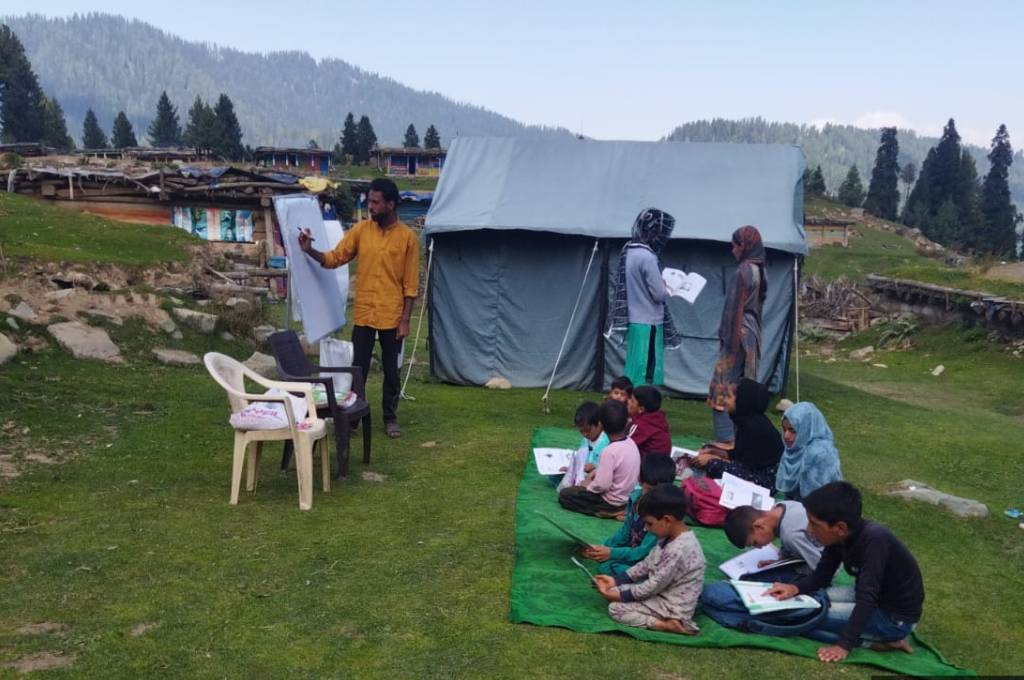
J&K’s challenging geography is one of the main reasons mobile schools are so important there. Regular education is impossible in the Himalayas because many indigenous people migrate between summer and winter pastures. These communities are accompanied by mobile schools, which allow kids to learn wherever they go. These schools are frequently run out of tents, vans, or temporary structures. Even in areas without roads or permanent infrastructure, this movement guarantees that education stays consistent.
Promoting inclusive education demands mobile schooling. Recent studies as well as census data show that J&K’s tribal literacy rates are still far lower than the state average. Due to monetary constraints or lengthy drives to school, many kids leave school early writes Satvinderpal Kaur, in her research article ‘Educational status and challenges of Tribal Community in Jammu and Kashmir.’ Despite offering flexibility, mobile schools lower dropout rates while encouraging the integration of disadvantaged students into regular school systems. Tribal communities’ empowerment is an important asset. Education provided by mobile schools raises awareness, enhances prospects for a living, and gives students the expertise they need to function in today’s world. Better health awareness, involvement in politics, and access to Government programs are further benefits writes Ganaie. N in his newspaper article “empowering tribals with literacy and life skills”.
PRESENT-TIME CHALLENGES FACED BY MOBILE SCHOOLS
* Lack of skilled teachers is one of the main challenges. About 20% of J&K’s teachers do not fit the requirements set out in the Right to Education Act. Also, 48% of the region’s government schools lack faculty with specialized knowledge, especially in subjects like science, math, and English. Tribal children’s educational quality is at risk due to this lack of qualified teachers.
* Logistically, mobile schools can be particularly challenging because of their season. Although these schools have been designed to relocate migrant populations, there have been reports of irregularities in their daily operations. Certain mobile schools are unable to move with the tribes, which causes interruptions in the learning process. For example, because there are insufficient classroom facilities in the Doodhpathri region of Kashmir, students frequently find themselves studying outside under the open sky.
* One of the main factors limiting access to education is financial limitations. The labour of their children is essential to the subsistence of many tribal families, particularly during the busiest agricultural seasons. This need for money frequently results in absenteeism and, occasionally, early marriages, which further hinder obtaining an education.
* The digital divide is another serious issue. In J&K, just 30% of schools have internet access, which makes it difficult to integrate online learning platforms and digital learning tools. This restriction is especially destructive to tribal students, who may already have trouble accessing instructional materials.
Conclusion
In Jammu and Kashmir, mobile schools are an important lifeline for tribal and nomadic communities like the Gujjars, Bakarwals, Gaddis, and Sippis, who are continuously denied education because of their geographical isolation and migratory way of life. These groups live in isolated, mountainous areas that are frequently remote from conventional educational facilities. Regular school attendance is practically impossible for many tribal children due to gender-based disadvantages, socioeconomic hardship, linguistic hurdles, and seasonal mobility. Mobile schools are a transformative educational initiative in this environment. Mobile schools help close long-standing gaps in literacy and access by traveling with these communities across lower valleys and highland grasslands, ensuring continuity in education. Better comprehension and academic outcomes are promoted by a more inclusive and relevant educational experience created through the use of regional languages and culturally sensitive curricula. Importantly, these schools raise knowledge about participating in society, health, cleanliness, and livelihood skills while also empowering students.
The Government must make investments in educating more teachers from tribal backgrounds, ensure logistical consistency in school mobility, improve digital infrastructure, and offer incentives to tribal families to keep their kids in school if it hopes to fully realize the possibilities of mobile schools. Mobile schools should be seen as a first step toward educational justice and social inclusion for the tribal population of Jammu and Kashmir, not as a temporary solution. For some of the most marginalized groups in the area to be empowered, this model must be strengthened.
(The author is Research Scholar from Central University of Punjab)
 Follow our WhatsApp channel
