

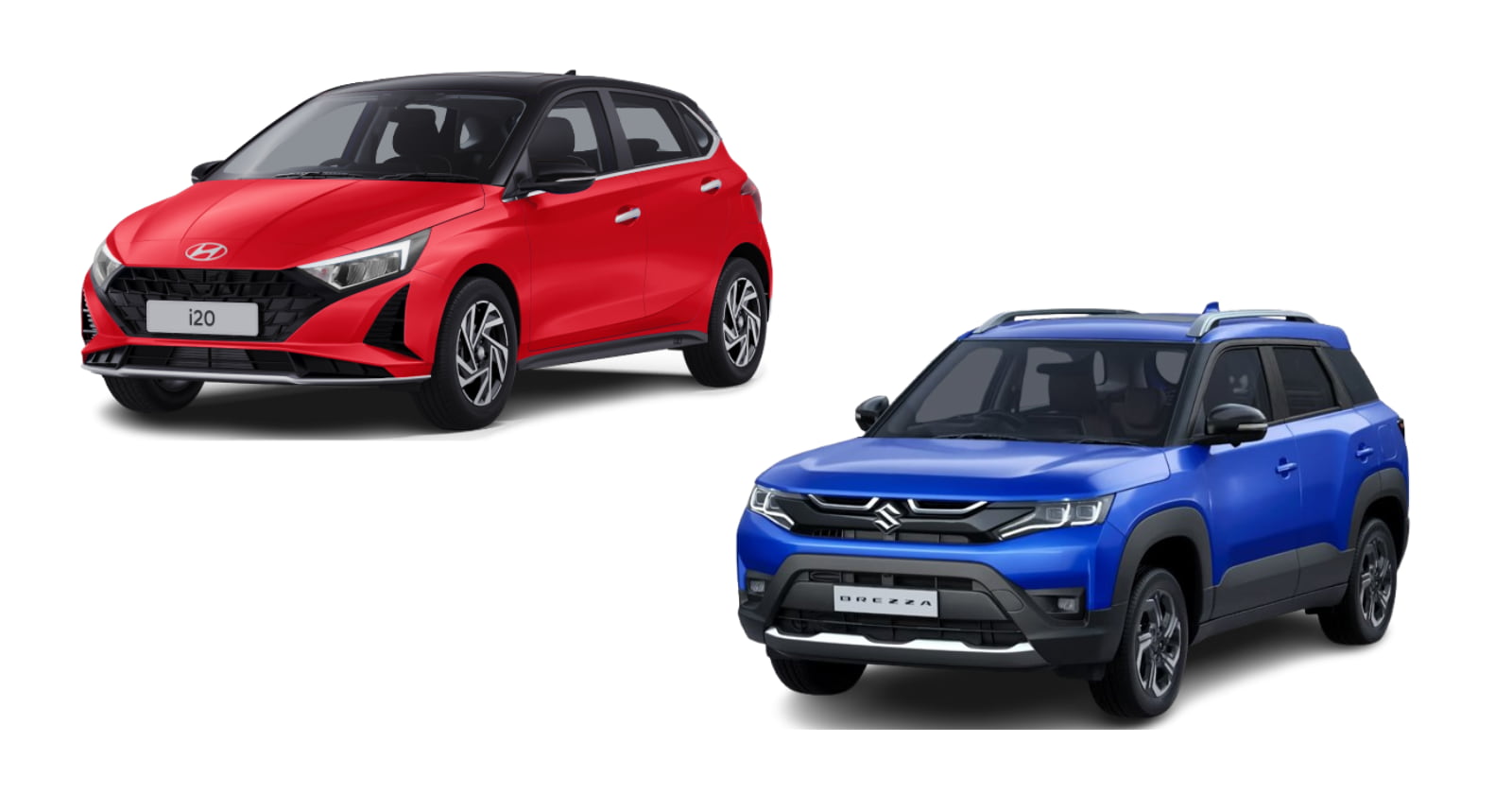
Urban mobility in India has undergone a visible shift over the past decade. Traditional hatchbacks once dominated city roads due to their efficiency and manageable size. Today, compact SUVs increasingly share that space, offering elevated driving positions and broader versatility. The Hyundai i20 and Maruti Brezza illustrate this transition clearly. While the i20 represents the continued appeal of premium hatchbacks, the Brezza highlights the growing preference for compact SUVs within urban environments.
Together, they reveal how buyer priorities are evolving rather than simply shifting.
From Compact Efficiency to Elevated Confidence
The Hyundai i20 reflects the traditional urban car philosophy—compact dimensions, smooth driving dynamics, and refined cabin experience. Measuring 3,995 mm in length with a 2,580 mm wheelbase, it remains agile and easy to handle in crowded city streets.
Its 1.2L Kappa petrol engine is tuned for consistent city commuting, offering balanced power delivery and efficiency. For buyers prioritising daily manoeuvrability and fuel-conscious operation, this format continues to make practical sense.
The Maruti Brezza, however, signals a growing demand for elevated confidence. At 1,685 mm in height, it offers a higher driving position that improves road visibility. This feature has become increasingly important in congested cities, where taller seating can enhance awareness and perceived safety.
Urban mobility is therefore shifting from purely compact efficiency to a blend of efficiency and elevated assurance.
Changing Road Conditions and Ground Clearance
City infrastructure has also influenced buyer choices. Speed breakers, uneven roads, and frequent construction zones create demand for higher ground clearance.
The Maruti Brezza’s SUV stance and robust underbody clearance provide reassurance over varied road surfaces. Its 1.5L Advanced K-Series engine supports both city and highway driving, broadening its appeal beyond strictly urban contexts.
The i20, while stable and well-balanced, sits lower to the ground. For drivers encountering mostly paved city roads, this may not present an issue. However, changing road conditions have contributed to the SUV format gaining popularity.
Technology as a Standard Expectation
Another aspect of changing mobility preferences is digital integration. Buyers now expect connectivity and advanced infotainment even in city-focused vehicles.
The i20 integrates a 26.03 cm HD touchscreen infotainment system with Bluelink connected features and over-the-air updates. It also includes a Bose 7-speaker audio system and voice-enabled sunroof, reflecting premium hatchback refinement.
The Brezza responds with SmartPlay Pro+ infotainment, wireless connectivity, a 360-degree view camera, and a head-up display. These features align with the broader expectation that SUVs should offer advanced convenience technologies.
Urban buyers are no longer satisfied with basic transportation; they seek digitally integrated mobility.
Safety Across Body Styles
Safety priorities have also evolved.
The Hyundai i20 includes six airbags as standard, along with Electronic Stability Control and Vehicle Stability Management.
The Maruti Brezza likewise offers six airbags and Electronic Stability Program with Hill Hold Assist.
The convergence of safety standards across hatchbacks and compact SUVs suggests that buyers now expect comprehensive protection regardless of body style.
Lifestyle Flexibility and Space Expectations
Urban mobility is increasingly lifestyle-oriented. Buyers evaluate not only commuting needs but also weekend travel and occasional family use.
The Brezza’s 328-litre boot space supports grocery runs and short trips with greater ease. Its wider cabin enhances rear-seat comfort.
The i20, meanwhile, focuses on efficient cabin packaging and refined interior space, delivering comfort within compact proportions.
This reflects a shift toward flexible urban mobility—where buyers want a single vehicle to serve multiple purposes.
Research-Driven Urban Decisions
Modern urban buyers increasingly rely on structured research before making purchase decisions. On platforms such as ACKO Drive, where vehicle specifications, safety systems, and variant features can be compared alongside buying cars online, buyers can evaluate whether a hatchback’s agility or an SUV’s practicality better suits their city lifestyle.
Digital transparency reinforces informed choices aligned with real usage rather than aspirational assumptions.
Conclusion
The Hyundai i20 and Maruti Brezza highlight how urban mobility choices are evolving. The i20 continues to represent premium hatchback efficiency and refined driving dynamics. The Brezza reflects a broader shift toward elevated seating, versatile cargo space, and SUV-inspired confidence.
Rather than replacing hatchbacks entirely, compact SUVs have expanded the range of urban mobility solutions. The choice between them ultimately depends on how city drivers define practicality—through compact agility or elevated versatility.
 Follow our WhatsApp channel
