

Rainfall deficit drops from 80% to 42%
Suhail Bhat
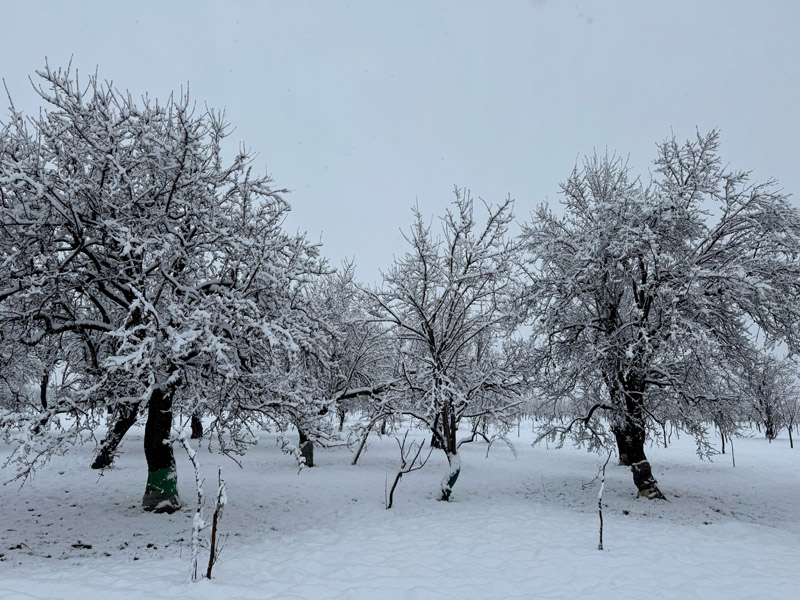
Srinagar, Feb 28: A prolonged dry spell in Kashmir has finally ended with continuous rains and snowfall, providing much-needed relief to farmers and reviving crucial water bodies.
The wet spell, which began on February 25, has replenished soil moisture, reduced the rainfall deficit, and increased water levels in the Jhelum River and other water bodies. The precipitation has also revived several springs that were on the brink of drying due to the prolonged dry spell.
Farmers, who had been struggling with depleted soil moisture, say the timely precipitation has saved their crops. “The rainfall has provided essential moisture to orchards, cooled the roots, and brought down temperatures, preventing early blooming,” Farooq Ahmad, an orchardist, said. He added that early blooming weakens fruit quality and reduces yields, making the current weather conditions beneficial for apple and other fruit crops.
In South Kashmir’s Tral area, Sajjad Ahmad, a garlic farmer, said his crops were struggling due to the prolonged dry spell. “The rainfall has given them a new lease of life. I was afraid they would wither, but now there’s hope,” he said.
Saffron growers also welcomed the rains, emphasizing the importance of soil moisture at this stage. “The saffron corms are in their reproductive phase, and this rain will directly impact this year’s production,” Ali Mohammad, a grower, said.
According to the Meteorological Department, the wet spell has significantly reduced the rainfall deficit from 80% to 42%.
One of the most significant impacts has been on Kashmir’s main water source, the Jhelum River, which had dropped to a record low of 0.65 feet at the Sangam gauge. The rainfall has increased its water level to nearly 3 feet, restoring its flow and alleviating concerns about water shortages.
“A few weeks ago, the sight of a nearly dry Jhelum was heartbreaking. Now, seeing it flow again fills me with relief,” Noor Mohammad, a resident of Srinagar’s Qamarwari area, said.
Other key water bodies, including Sukhnag, Kal Nag, Lidder, Bringi, and Romshi, have also been recharged, benefiting thousands of people dependent on them and were previously facing water shortage.
Chief Engineer of the Jal Shakti Department, Brham Joyti Sharma, said that the precipitation has replenished all major water sources and ended the water shortage. “With the rain and snowfall we received, there should be no water shortage for at least the next two months. It is a much-needed blessing,” he added.
 Follow our WhatsApp channel
