

Ranbir Singh Pathania
rspathaniamla@gmail.com
Change is as spontaneous as the flow of water. In public policy, stagnation is often the ugliest choice of all. Laws and policies are not relics to be preserved in a steel frame; they are living instruments meant to respond to evolving realities and exigencies.
For nearly two decades, the Mahatma Gandhi National Rural Employment Guarantee Act (MGNREGA) has enjoyed cult status in India’s welfare politics. Question its design or efficacy, and one risks political outrage replacing reasoned analysis. Yet policies must evolve-nostalgia cannot dictate governance.
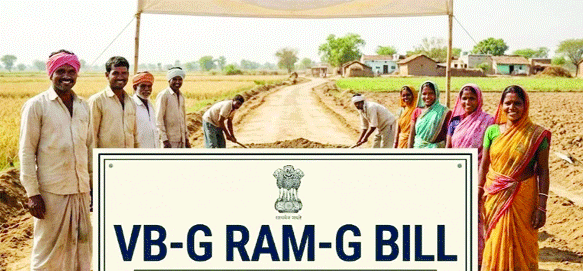
The replacement of MGNREGA with G Ram G reflects both sentiment and gospel-an effort to make rural employment policy more comprehensive in scope, more inclusive in reach, and more beneficial in outcome. Far from being an abandonment of social commitment, the new legislation represents a considered recalibration, designed to align welfare with productivity, flexibility with dignity, and entitlement with long-term rural development-refurbishing employment while building infrastructure in priority sectors.
The Viksit Bharat Jeevan Rojgar Act heralds this prominent pivot, shifting from MGNREGA’s entitlement-based model to empowerment-led growth. The melodrama built on half-baked truths, selective realities, and performative outrage reveals more about the stasis of the political bandwagon than about the law’s flaws-if not an obsession to dispute and decry anything and everything, opposition merely for the sake of opposition.
MGNREGA’s Core Flaws
Launched amid acute rural distress, MGNREGA was designed primarily for consumption smoothing, not wealth creation or durable infrastructure building. Three major flaws now stand exposed:
– The rigid cap of 100 days of employment has proven inadequate for landless and seasonal workers, especially amid climate shocks-an outdated and stagnant limitation.
– The narrow definition of permissible activities, largely low-productivity in nature, failed to create lasting assets or meaningful economic gains. The CAG has repeatedly observed 40-50% inefficiency in several States and Union Territories.
– As per RBI data for 2024-25, wage payments were delayed by 60-90 days on average, prompting Supreme Court interventions and the creation of a “delayed payment compensation” regime to be borne by states.
– Corruption, leakages, ghost beneficiaries, administrative delays, and elite capture gradually turned the scheme into a fiscal drag.
Most critically, it locked rural India into subsistence rather than aspiration.
What the New Law Does Differently
The Viksit Bharat Jeevan Rojgar Act represents a major adaptation. It does not abandon rural employment guarantees; it reinvents their purpose in line with the principle of the greatest good of the greatest number. It recognises that rural India today is no longer the rural India of 2005.
By increasing the number of guaranteed working days, the law responds to climate-induced disruptions, agrarian volatility, and migration pressures. Crucially, it introduces shiftable employment windows, allowing work allocation to align with local agricultural cycles, weather patterns, and regional economic needs-flexibility that MGNREGA structurally lacked.
Even more significant is the expansion and diversification of eligible activities. The new framework links rural employment with infrastructure creation, water conservation, renewable energy support systems, digital facilitation, storage facilities, village-level logistics, and maintenance of public assets. In doing so, it transforms employment from a stop-gap relief measure into a driver of local economic multiplier effects.
This is not merely job provision; it is productive engagement with measurable outcomes.
Debunking the Loose Narrative
The opposition has clung to three misleading claims:
“Dilution of the right to work”:
This claim is demonstrably false. A law that offers more working days, flexible scheduling, and higher economic value through asset creation cannot logically be described as dilution. What the Congress appears to miss-or deliberately ignore-is that rights are meaningful only when they deliver dignity and opportunity to the last person in the last row.
“Corporatisation of rural labour”:
This caricature borders on absurdity. Linking rural employment to infrastructure, skilling, and productivity does not corporatise labour; it future-proofs livelihoods. The real insult to rural workers is trapping them indefinitely in low-value manual work with no pathway to growth.
“Erosion of federalism”:
During the UPA regimes, states repeatedly complained of delayed fund releases and rigid centralisation under MGNREGA. The new framework, by enabling adaptive planning and region-specific activities, actually expands the operational space of states and local bodies.
A Shift Long Overdue
At its core, this reform reflects a deeper philosophical shift in governance. Welfare is no longer treated as charity, but as investment. Rural India is no longer viewed as a vote bank to be managed, but as an economic powerhouse. The objective is clear: progressively lift households out of the PHH category while simultaneously raising rural per capita incomes.
The Congress’s discomfort stems from the exposure of the intellectual exhaustion of its welfare model-one that prioritised political optics over long-term outcomes. Having built its rural narrative around a single scheme, it now finds itself incapable of engaging with a more complex and ambitious vision.
India cannot afford policy paralysis disguised as compassion. Every reform is inevitably labelled a rollback by those who benefit politically from stagnation. The Viksit Bharat Jeevan Rojgar Act is not an abandonment of social responsibility; it is its evolution.
If MGNREGA was about ensuring survival, the new law is about enabling progress. The question before the nation is not whether rural employment should be guaranteed-it must be-but whether it should remain trapped in the logic of the past or be aligned with the aspirations of a transforming Bharat.
History will measure this reform by the rural resilience it creates, not by the noise of opposition.
(The columnist is member of Legislative Assembly of J & K)
 Follow our WhatsApp channel
