

Glaciologists, other experts to suggest mitigation measures
*Step to help in assessing outbursts potential
Mohinder Verma
JAMMU, June 1: Government of the Union Territory of Jammu and Kashmir will shortly constitute different teams for field validation of high-risk glacial lakes so that exact potential for outbursts could be assessed for initiation of mitigation measures and to avoid catastrophic damage to life, property and infrastructure downstream.
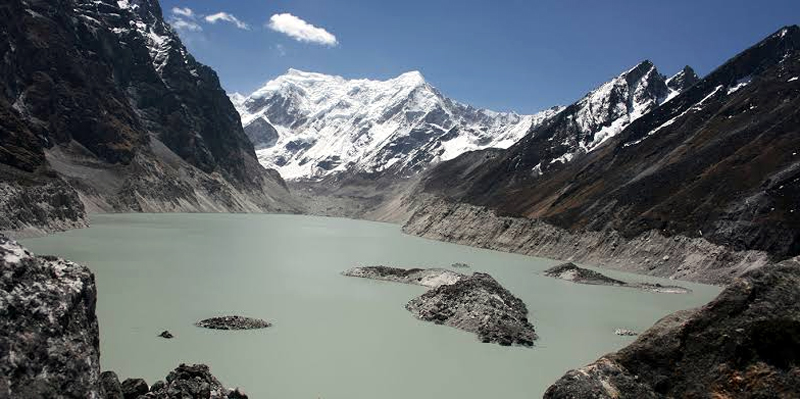
The unique geography with high-altitude glaciers and lakes makes several parts of J&K vulnerable to Glacial Lake Outburst Floods (GLOFs). Further, rising global temperatures are accelerating glacier melting leading to formation of numerous glacial lakes that are at risk of sudden breach and in such a situation will release millions of cubic meters of water and debris.
Follow the Daily Excelsior channel on WhatsApp
To mitigate risks associated with Glacial Lake Outburst Floods, the Government Vide Order No. 930-JK(GAD) dated April 4, 2024 constituted Focused Glacial Lake Outburst Flood Monitoring Committee with the direction to review the current status of glacial lakes and identify the vulnerable ones in terms of GLOFs as per the list provided by National Disaster Management Authority (NDMA).
Further, the Committee was asked to suggest the site-specific best technical measures to minimize the glacial threat in identified glacial lakes and the roles and responsibilities of different stakeholders and to suggest the action required on human resources generation/capacity building towards the study and management of glacial retreat and associated threats.
The Committee has identified 14 high-risk glacial lakes, 3 moderate-risk lakes and 7 low-risk lakes in different parts of J&K. Of the total high-risk glacial lakes, three are in the Kishtwar district.
“As the identification exercise has been completed, the Government will shortly constitute different teams comprising of experts particularly Glaciologists for field validation of glacial lakes”, official sources told EXCELSIOR, adding “the field validation is a process of physically verifying and studying glacial lakes on the ground to confirm and assess the information obtained from remote sensing, satellite imagery or GIS-based analysis”.
In response to a question, sources said, “remote sensing can detect the presence and extent of glacial lakes, but it cannot always accurately assess lake depth or volume, identify drainage patterns or outlet conditions, determine the stability of moraine dams and assess potential for Glacial Lake Outburst Floods”, adding “field validation is essential for ground-truthing satellite data, identifying hazard risks, planning early warning systems and monitoring climate change impacts”.
They further said, “after completion of field validation, which is a time-consuming exercise, the Glaciologists and other experts will suggest mitigation measures to the Government”, adding “preventing Glacial Lake Outburst Floods involves a combination of engineering interventions, monitoring systems, community preparedness and policy measures. While GLOFs can’t always be fully prevented due to their natural causes like glacial retreat, icefalls, earthquakes, or landslides, their risk can be significantly reduced through proactive action”.
Stating that Government of Jammu and Kashmir is taking proactive steps to mitigate the risks associated with Glacial Lake Outburst Floods, sources informed that Government of India also recognizes the importance of the issue and is extending full support to the UT’s efforts.
About three high-risk glacial lakes in Kishtwar district, sources said, “the detailed study conducted by the experts and analysis of satellite imageries of last 20 years clearly indicate that these three lakes are expanding constantly with every passing year”.
About 20 years back the size of these glacial lakes was around 10 to 12 square hectares and at present the same has been recorded at 80 to 90 square hectares as such constant expansion is fraught with the dangers of outburst and subsequent flooding in all the tributaries of River Chenab. On one side of these glacial lakes there is uninhabited area of Zanskar region of Union Territory of Ladakh and on the other side major area of Kishtwar district particularly Warwan and Dachhan.
 Follow our WhatsApp channel
