

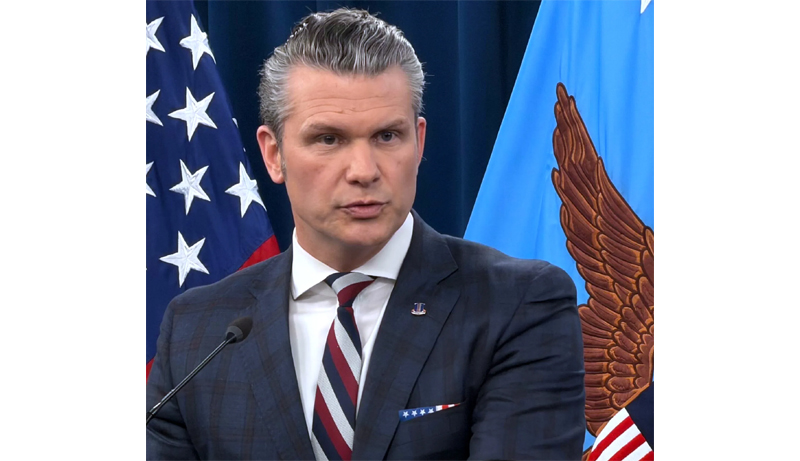
WASHINGTON, March 13 : US Defence Secretary Pete Hegseth said on Friday that the US and Israel jointly struck more than 15,000 “enemy targets” in their war against Iran, describing the campaign as one of the most intense air operations in modern day military history.
Speaking at a Pentagon briefing, Hegseth said the strikes had averaged more than 1,000 targets per day since the conflict began.
“No other combination of countries in the world can do that,” he said.
He added that US aircraft were continuing to fly missions across Iran, with “fighters and bombers all day” selecting targets.
Hegseth claimed the campaign had drastically reduced Iran’s ability to retaliate, with the War Secretary claiming that Iranian missile launches had fallen by over 90% and the use of their so-called one-way attack drones had dropped by 95%.
According to the Pentagon chief, the strikes had also crippled Iran’s ballistic missile production.
“As of two days ago, Iran’s entire ballistic missile production capacity – every company that builds every component of those missiles – has been functionally defeated,” he said.
Hegseth further said that Iran’s new supreme leader, Mojtaba Khamenei, was alive, but in all likelihood was wounded in the early attacks, stating that Khamenei was “wounded and likely disfigured”, though he did not provide details.
Questioning why Khamenei’s first message since assuming power had been delivered as a written statement read on Iranian state television rather than in person, he suggested that this delivery further cemented the rumour that he was disfigured.
“Iran has plenty of cameras and plenty of voice recorders. Why a written statement ” he said.
While Iranian officials have acknowledged the leader suffered minor injuries, they insist that he remains very much alive and well in operational control.
In the statement delivered since he assumed power, Khamenei had vowed to keep the Strait of Hormuz closed as leverage in the conflict and warned that attacks on US targets would continue.
Hegseth said the strait could remain open for transit provided Tehran stopped its interference, remarking that Washington would not allow the key shipping route to stay blocked.
The United States Central Command (CENTCOM) earlier said at least 30 Iranian mine-laying vessels had been destroyed since the war began.
Hegseth said the scale of operations was expected to increase further, adding that Friday would see “the highest volume of strikes” yet carried out over Iran.
He further remarked that all decisions about the duration and intensity of the ongoing war in West Asia ultimately rested with President Donald Trump.
“President Trump holds the cards,” Hegseth said. “He will determine the pace, the tempo and the timing of this conflict.”
Trump has said he expects the war to end soon but has not given a specific timeline, though US officials have said that he has grown wary over its prolonged intensity, and wishes to end it as soon as possible.
(UNI)
 Follow our WhatsApp channel
