

Excelsior Correspondent
SRINAGAR, June 3: The annual Urs of Hazrat Ameer Kabir Mir Syed Ali Hamdani (RA), popularly known as Shah-e-Hamdan (RA) was observed today with religious fervour and gaiety across Kashmir.
Click here to watch video
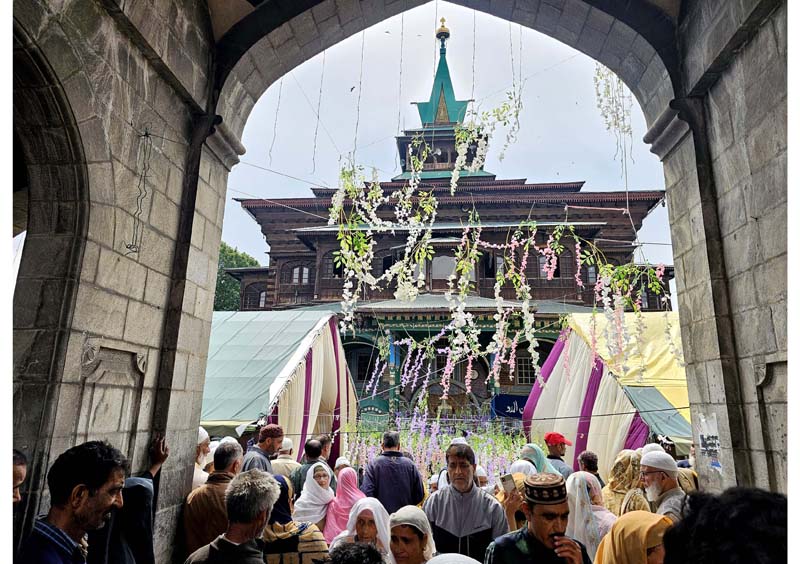
The largest gatherings on the occasion were witnessed at the revered shrine of Khanqah-e-Mualla in Srinagar and Khanqah Faiz Panah in south Kashmir’s Tral.
Devotees from across the Valley thronged Khanqah-e-Mualla from the early morning hours, with many spending the entire day in prayers, recitations of praises, and supplications.
Heartfelt moments were witnessed as devotees joined together in collective prayers and recitations.
Abdul Razzaq, a resident from the city outskirts, said he has been attending the annual Urs since childhood.
“Every year, I make sure to keep my day free for it. It gives me solace; being here soothes me. At the same time, it allows me and others to reflect on who we are and who we should be – what Shah-e-Hamdan wanted us to become,” he said.
To manage the heavy influx of visitors, the administration had put in place special facilities and arrangements at the shrine.
Revered to this day for his wisdom, humility, and vision, Shah-e-Hamdan is believed to have first visited Kashmir in 774 AH, approximately 1372 CE.
Historical records suggest he visited Kashmir three times.
Earlier, night-long special prayers were held on Monday at Khanqah Faiz Panah in Tral, Pulwama, and Srinagar, attended by large congregations seeking blessings and spiritual tranquillity.
Scholars and clerics who addressed the gatherings highlighted the teachings and legacy of Shah-e-Hamdan.
According to them, he was a towering spiritual, cultural, and social reformer whose contributions to Kashmir were vast and transformative, shaping religion, society, economy, and arts.
Grand Mufti Nasir-ul-Islam, speaking on the occasion, said, “This day teaches us to preserve our spiritual bond. It is because of him that we are Muslims. Otherwise, I don’t know what we might have been. He taught harmony and empathy.”
NC President Dr. Farooq Abdulla also visited Khanqah-e-Mualla to participate in the annual Urs.
 Follow our WhatsApp channel
