

By Dr. D.K. Giri
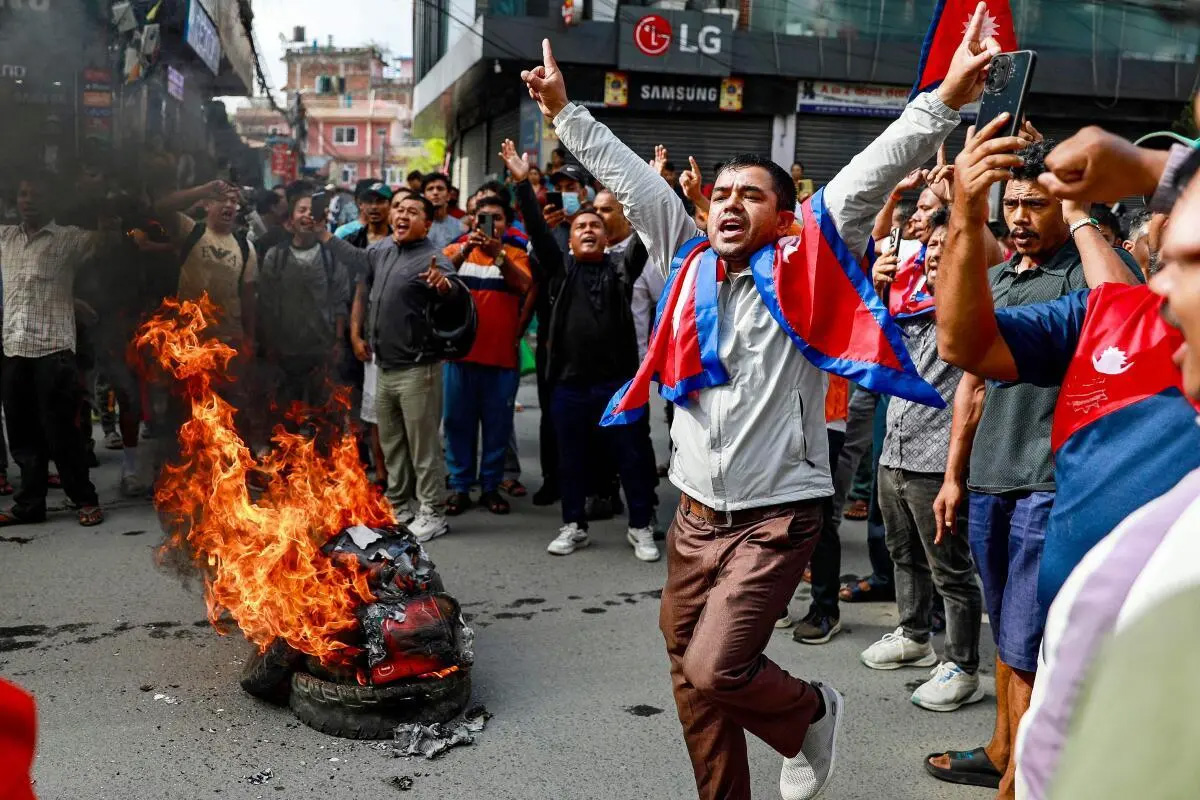
Nepal has been suddenly plunged into an unprecedented political crisis that set public structures including the Supreme Court and the Parliament on fire. The houses of politicians were not excluded. The former Prime Minister Sher Bahadur Deuba and his wife, the Minister of Foreign Affairs in the outgoing government were physically assaulted in their house. What was worse is that about 22 people were killed by the Nepal Security Agencies while controlling the uprising. Reportedly, the revolt was triggered by an accidental death of a youth and the sudden suspension of social media. Both these developments sent an outrage among the so-called Gen-Z. It started with a small group and snowballed into a countrywide agitation.
Who are the participants in this uprising and who is the vanguard? Like many such revolts witnessed across the world including in South Asia, the uprising in Nepal was spontaneous without a particular leadership and was self-mobilised. The uprising in Bangladesh which made the then Prime Minister Sheikh Hasina flee into India, in Sri Lanka throwing out Rajpaksha brothers of the country, Arab Spring and at the time of writing, the agitation in France. These are led by Gen-Z, the youths born roughly between 1995 and 2010 who are net-savvy and are highly dependent on social media for their professional as well as personal interactions.
The movement has been collectively mobilised without any frontline leaders although mature leadership has come up in the form of Balendra Shah, an independent political leader and the Mayor of Kathmandu, and a new political party Rashtriya Swatantra Party, opposed to the mainstream parties. How long their leadership of this movement will continue, is a matter of conjecture, especially when Balendra Shah is making radical demand like dissolution of the Parliament and a fundamental change of the political structure. However, according to the latest reports, the army has taken over and has asked the former Chief Justice of Nepal, Sushila Karki to be the Interim Chief. This is a repeat of Bangladesh. Let’s keep our fingers crossed.
Without any doubt, the uprising was instigated by the ban on social media. Like many such movements, the uprising in Nepal is fast including many other issues such as deep structural failures of Nepal’s democratic experiment bordering on political dysfunction, rampant corruption, nepotism and the lavish lifestyles of political elites’ children while the rest are caught in under development and deprivation; above seven lakh youths have emigrated out of the country in search of jobs and livelihoods. This is not new as such movements assume a broader platform. Way back in 1975, the Nava Nirman Movement led by youths and students initially against corruption in India, turned into ‘total revolution’ under the leadership of Jayaprakash Narain. In Arab Spring, a protest by a fruit vendor against the local authorities in Tunisia turned into a movement for democracy across the Arab world.
Could the uprising be anticipated by the government of KPS Oli? The answer is yes or no. The Nepali politics past the monarchy has been unstable. Since the new Constitution was adopted making Nepal into a Republic in 2008, fourteen governments have been in power, making a new government every 14 months. There have also been movements for revival of monarchy. The alliance formation has been crazy in Nepal. The three big players – The Communist Party of Nepal (CPN-UML) headed by KPS Oli and the Nepali Congress of Sher Bahadur Deuba and the Communist Party of Nepal (Maoist Centre) led by Pushpa Kamal Dahal, known as Prachanda have alternated in power between three of them.
Observers from inside and outside Nepal are contemplating what will happen next? KPS Oli has resigned a day after the uprising. The Nepali army has so far taken a neutral stance while backing up the law and order. The Opposition holds that the current crisis stemmed from the undemocratic alliance between the Nepali Congress and CPN (UML) who instead of ensuring checks and balances have formed a coalition to come to power by undermining democratic norms. Their record of political corruption, misuse of proposed constitutional amendments to weaken smaller parties and suppression of dissent within their own ranks have eroded public trust and instigated widespread frustration. They appeal to the youth for embarking upon peace and dialogue while recognise their concerns against corruption and freedom of expression.
The dominant view in Nepal is that a caretaker government within the constitutional framework ensuring inclusion at a broader scale including the youth should be put in place. Such an arrangement will restore stability, pave the way for necessary reforms to strengthen democracy in Nepal and ensure accountability for the tragic deaths caused by indiscriminate police firing. But who will initiate this process? Although involvement of army generally in politics and in the government formation in particular is not a healthy practice in a democracy, a facilitating role played by the army in a fragile democracy may be accepted.
How is India responding to it? Given the current tenuous ties between India and its neighbours, it is good opportunity for India to help stabilise democracy in Nepal. The Himalayan state of Nepal has a strategic location and is sandwiched between two big powers – India and China. Both the Communist parties look upto China while the Nepali Congress is India-friendly. Be that as it may, India has maintained close contacts with all three of them. This is time for New Delhi to give them a helping hand whereas China cannot do so without any experience of democratic politics.
The diplomatic reaction from India is studied and neutral as it should be. The MEA said that India is closely monitoring the unfolding situation in Nepal post the resignation of KPS Oli on Tuesday, September 9, “We are closely monitoring the developments in Nepal since yesterday and are deeply saddened by the loss of many young lives. Our thoughts and prayers are with families of deceased. We also wish speedy recovery for those who were injured”. The Prime Minister’s reaction was more touching and meaningful, “The violence in Nepal is heart-rending. I am anguished that many young people have lost their lives,” Modi wrote in a post on X on Tuesday. Stressing that “stability, peace and prosperity of Nepal are of utmost importance”, he appealed to “all my brothers and sisters in Nepal to support peace”.
The India-Nepal ties are special and different from India’s relations with rest of her neighbours. Nepal has borders of 1,750 km (466 miles) with five Indian states, Uttarakhand, Uttar Pradesh, Sikkim, Bihar and West Bengal. More than 3.5 million Nepalis work in India without restriction under 1950 Treaty. In addition to this, 32,000 Gorkha soldiers of Nepal serve in the Indian Army. The people-to-people ties are very close, in colloquial terms it is called Roti-Beti relations (sharing a meal and marrying daughters in their respective communities). Yet, India seems to have lost that ‘Midas touch’ in dealing with Nepal. This was largely because of the interference by China in internal affairs of Nepal.
India had taken its eyes off its neighbours in its quest for a world role. But that should start by having a secure and stable neighbourhood. Uprisings took place in Bangladesh, Sri Lanka and now in Nepal. In Bangladesh, it was partly directed against India. So far, it is not the case in Nepal. New Delhi has great opportunity in converting this crisis into a diplomatic opportunity.—INFA
 Follow our WhatsApp channel
