

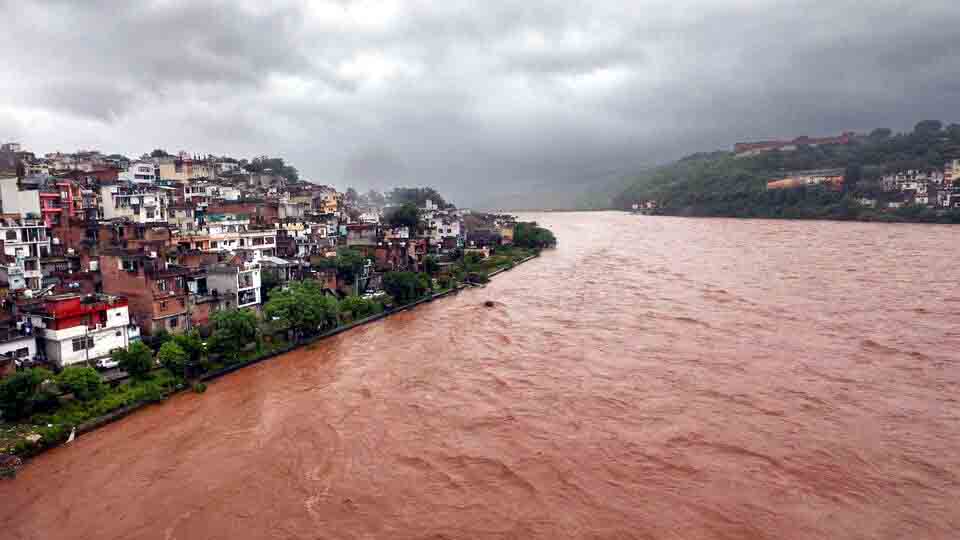
Fifteen years have passed since the Water Resources (Regulation and Management) Act was enacted in 2010, mandating the identification and notification of flood basins. Yet, not a single flood basin of the Tawi or Chenab Rivers has been officially declared. This prolonged inaction is a recipe for repeated disasters. The recent floods on August 25 and 26, which devastated parts of Jammu, washing away bridges, damaging roads, and submerging habitations, underline the consequences of ignoring such an essential precaution. The law clearly states under Sections 75 and 76 that areas comprising riverbeds, adjoining lands, and low-lying zones susceptible to inundation should be declared as flood basins after proper surveys and mapping. These provisions were intended to create an official framework to prevent encroachments, restrict unregulated construction, and safeguard human lives and infrastructure. Unfortunately, these safeguards remain only on paper, and every passing year without implementation adds to the magnitude of risk.
Flood basins are not a formality; they help prevent flash floods, maintain river flow, and recharge groundwater. When such basins are left unprotected, rivers lose their carrying capacity, natural drainage channels shrink, and settlements mushroom in high-risk zones. The unchecked urbanisation particularly along the Tawi is a glaring example of how the absence of enforcement has turned nature’s protective mechanism into a ticking time bomb. The scale of encroachment is so severe that even areas in the heart of Jammu city, such as Peer Kho and Gujjar Nagar, within a stone’s throw of the Deputy Commissioner’s office, have seen rampant illegal constructions. Seasonal nullahs that once carried rainwater safely have been reduced to narrow drains due to years of encroachment, leaving localities that never experienced waterlogging now facing floods almost every year.
The most disturbing aspect is that this situation is not due to lack of awareness or capability. Reports under the Jhelum Tawi Flood Recovery Project have already mapped flood-prone zones, and draft recommendations were prepared. Yet, final notifications remain pending for reasons that appear more political than administrative. This inertia clearly benefits only one group: the land mafia and their influential patrons. Every day that flood basins remain unnotified is another opportunity for illegal colonies, godowns, and commercial complexes to come up on fragile riverbanks and catchment areas. The sight of hundreds of vehicles belonging to automobile dealers and electronic goods floating downstream during recent floods is a testimony to how commercial greed has overpowered public safety. The administration has failed repeatedly to remove encroachments or act against violators. As a result, people who have invested their life savings in these vulnerable zones are left marooned after every spell of heavy rain.
Each flood is followed by high-level meetings, grand announcements, and promises of corrective measures, but once the water recedes, the urgency disappears, and the cycle of destruction resumes. This is not just administrative inefficiency; it is sheer indifference to human life and property. Worse, it reflects a mindset that sees rivers and their basins as real estate opportunities rather than ecological assets that need protection. In an era of climate change, where extreme rainfall events are becoming more frequent and intense, such negligence is unforgivable. Nature is reclaiming its lost space violently, and if urgent measures are not taken, the cost of future disasters will be far greater in terms of both human suffering and financial loss.
Notifying flood basins and declaring non-construction zones must become a top priority. This should be followed by strict enforcement of building restrictions, removal of encroachments with a fair rehabilitation plan, and accountability for officials who allowed such violations in the first place. Politicians must rise above short-term vote bank considerations and support these measures because unchecked urban expansion without scientific planning is a recipe for repeated tragedies. A one-time comprehensive exercise will save hundreds of crores in future relief operations and, more importantly, countless lives. The floods of August 2025 and the memories of the 2014 deluge are stark warnings that cannot be ignored any longer. Nature will not wait for our files to move or committees to decide.
 Follow our WhatsApp channel
