

Ashok Bhan
ashokbhan@rediffmail.com
The debate over the Uniform Civil Code (UCC) has once again returned to the centre of national discourse following recent observations by the Chief Justice of India during a hearing in the Supreme Court. While examining issues relating to alleged discrimination in personal laws governing inheritance, the Court observed that a Uniform Civil Code could be the “most effective answer” to disparities that deny equal rights to women. The remarks have reignited an issue that has remained pending since the framing of the Constitution and underline the continuing tension between personal law systems and the constitutional commitment to equality.
The idea of a Uniform Civil Code is not new. It was envisaged by the framers of the Constitution and placed in Article 44 of the Constitution of India, which directs the State to endeavour to secure a uniform civil code for citizens throughout the territory of India. Though located in the Directive Principles of State Policy and therefore not directly enforceable by courts, Article 44 reflects the constitutional aspiration that civil laws relating to marriage, divorce, inheritance, adoption and maintenance should ultimately be governed by a common legal framework rather than religiously differentiated personal laws.
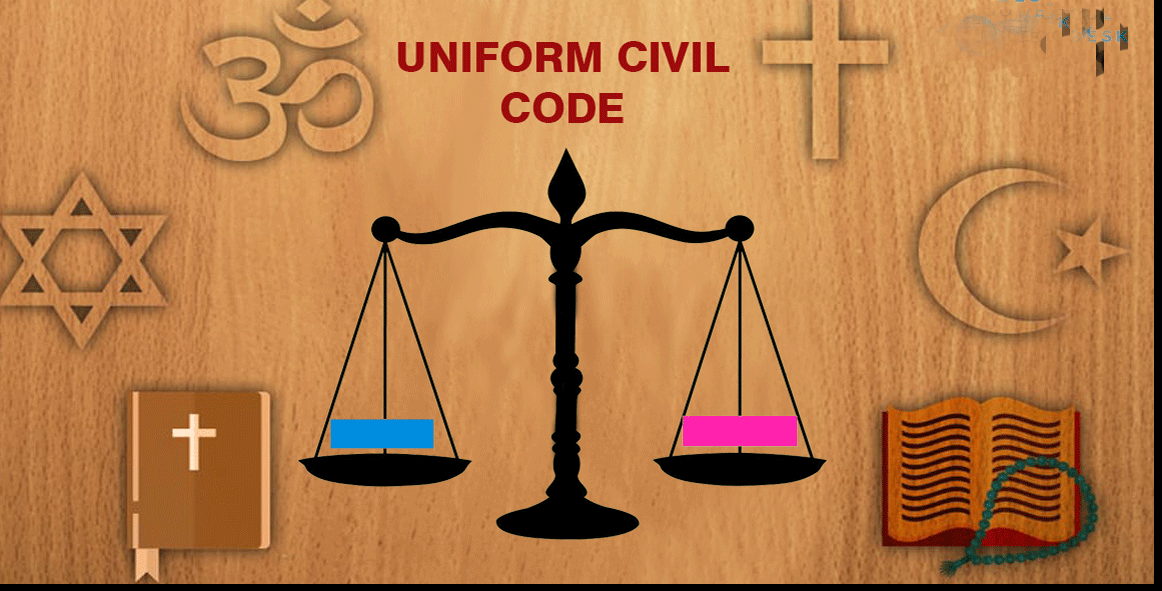
Uniform civil code crusaders believe that personal laws based on religion are an “affront to the nation’s unity” and add that the UCC will ensure the integration of India by bringing different communities on a common platform. They argue that it aims to provide protection to vulnerable sections as envisaged by Ambedkar including women and religious minorities, while also promoting nationalistic fervour through unity. When enacted, the code will work to simplify laws that are segregated at present on the basis of religious beliefs like the Hindu code bill, Sharia law, and others. The code will simplify the complex laws around marriage ceremonies, inheritance, succession, adoptions making them one for all. The same civil law will then be applicable to all citizens irrespective of their faith.
India’s current system of personal laws is rooted in colonial administrative arrangements under which the British chose not to interfere with religious customs governing family matters. Consequently, Hindus, Muslims, Christians, Parsis and other communities continue to be governed by separate personal law regimes in matters of family and succession. While this pluralistic framework was initially justified in the name of cultural autonomy, it has increasingly come into conflict with the constitutional guarantees of equality, particularly where personal laws contain provisions that discriminate against women.
Experts, say: the Muslim Personal laws are “Anglo-Mohammadan” rather than solely Islamic.The Hindu nationalists view this issue in concept of their law, which they say, is secular and equal to both sexes. In the country, demanding a uniform civil code can be seen negatively by religious authorities and secular sections of society because of identity politics.
It is this tension that the Supreme Court has repeatedly highlighted over the decades. From the landmark ruling in Mohd. Ahmed Khan v. Shah Bano Begum to later judgments such as Sarla Mudgal v. Union of India and Shayara Bano v. Union of India, the Court has consistently underlined the need for reform in personal laws to ensure gender justice and constitutional consistency. The recent observations of the Chief Justice therefore follow a long judicial tradition of urging the legislature to address the issue through a comprehensive law.
One of the strongest arguments in favour of a Uniform Civil Code is the imperative of gender equality. Many personal law systems continue to contain provisions that place women at a disadvantage in matters of inheritance, divorce or maintenance. In certain cases women receive smaller shares of property, face procedural hurdles in obtaining divorce or lack equal guardianship rights. These disparities sit uneasily with the fundamental rights guaranteed under Article 14 of the Constitution of India and Article 15 of the Constitution of India, which prohibit discrimination on grounds of religion, race, caste, sex or place of birth.
The Court’s recent observations underline precisely this contradiction: a constitutional democracy committed to equality cannot indefinitely sustain legal regimes that differentiate between citizens on the basis of religious identity. A Uniform Civil Code would provide a framework where civil rights in family matters are determined by constitutional principles rather than by religious doctrines.
Beyond gender justice, a common civil code could also contribute to national integration. India’s legal system already operates on the principle that criminal law applies equally to all citizens irrespective of religion. Civil law, however, remains fragmented along community lines in family matters.
A uniform code would reinforce the idea of common citizenship by ensuring that the same civil rules govern all individuals. Such uniformity would strengthen the constitutional vision of equality before the law and promote a shared civic identity in a diverse society.
Another advantage of the Uniform Civil Code would be the simplification of legal processes. The existence of multiple personal law systems often creates complexities in litigation, especially in cases involving inter-faith marriages or disputes over succession. Courts frequently have to interpret and reconcile different legal traditions, leading to prolonged litigation and inconsistent outcomes. A single, clearly defined civil framework would reduce such ambiguities and promote legal certainty.
However, the issue of the Uniform Civil Code cannot be viewed only through the lens of legal reform. It is also deeply embedded in India’s social and political realities. Critics of the UCC argue that imposing a uniform framework may undermine the cultural and religious diversity that characterises Indian society. Personal laws, they contend, are closely tied to community identity and religious freedom, which is protected under Article 25 of the Constitution of India.
These concerns cannot be dismissed lightly. India’s constitutional structure recognises the importance of pluralism and seeks to balance equality with respect for cultural diversity. The challenge, therefore, is to ensure that the pursuit of uniformity does not translate into the erasure of legitimate cultural practices.
The Supreme Court itself has acknowledged this delicate balance. While pointing to the need for a Uniform Civil Code, the Court has consistently maintained that the responsibility for introducing such a code lies with the legislature rather than the judiciary. Courts may highlight inconsistencies or strike down practices that violate fundamental rights, but the creation of a comprehensive civil code requires political consensus, legislative drafting and extensive consultation with stakeholders.
The path toward a Uniform Civil Code must therefore be gradual and consultative. Rather than a sudden imposition, reform could proceed through incremental harmonisation of personal laws with constitutional values. Several reforms over the years have already moved in this direction. The abolition of practices such as instant triple talaq, the expansion of women’s inheritance rights in Hindu law and progressive interpretations of maintenance laws demonstrate that personal law reform is both possible and necessary.
The ultimate objective should not merely be uniformity for its own sake but the creation of a gender-just and constitutionally consistent civil framework. Such a framework should guarantee equal rights to all citizens while respecting legitimate cultural diversity. The experience of states such as Goa, which follows a common civil law for family matters, indicates that a uniform system can function within India’s plural social fabric.
The Chief Justice’s recent observations have once again reminded the nation that the promise of Article 44 remains unfulfilled. More than seven decades after the adoption of the Constitution, the question is not whether reform is necessary but how it should be carried out. The challenge before policymakers is to build consensus around a legal framework that reconciles equality with diversity.
In a constitutional democracy founded on the ideals of justice, liberty and equality, civil laws must ultimately reflect the rights of individuals rather than the boundaries of communities. The Uniform Civil Code, if crafted with sensitivity and inclusiveness, has the potential to transform this constitutional aspiration into reality. The Supreme Court’s observations should therefore serve as a catalyst for informed debate and legislative action rather than another episode in a recurring but unresolved national conversation.
(The author is a noted Senior Advocate in Supreme Court )
 Follow our WhatsApp channel
