

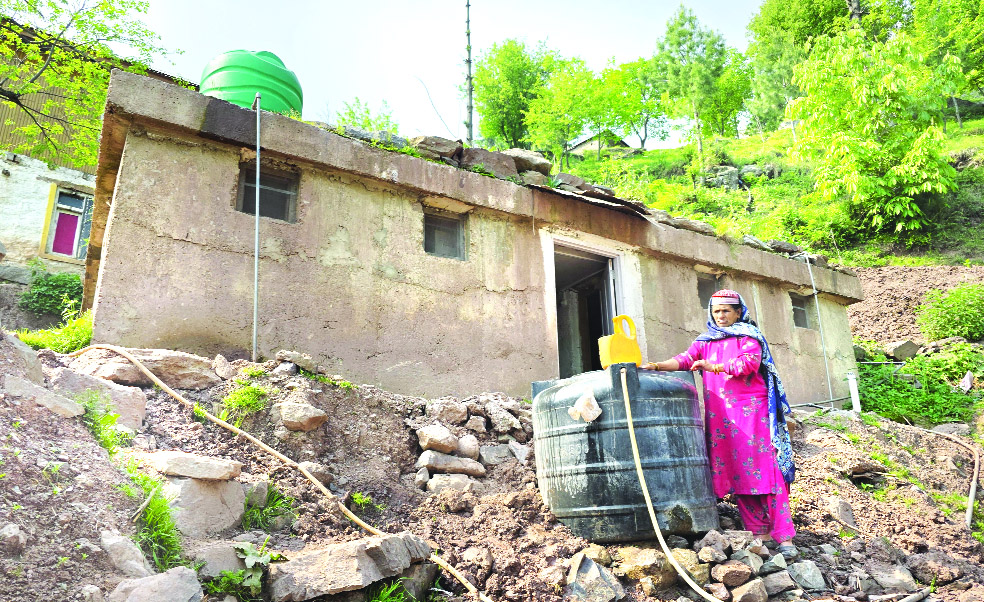
LoC residents demand more bunkers
Fayaz Bukhari
LoC URI, May 1: Despite Indo-Pakistan hostilities after the Pahalgam attack, life in the villages on Line of Control (LoC) in Uri sector is as usual with people heading to work early in the morning and children attending the schools.
Follow the Daily Excelsior channel on WhatsApp
At the Govt Primary school at Churanda, situated amid walnut trees, the morning prayer coincides with cooing of cuckoos sitting atop these trees with villagers praying that roaring of guns positioned on either side of the LoC should not replace melodious sound.
“Schools are running normally here. No advisory has been issued by the Government nor by our department. However, fear among the parents is running high as guns can’t take time to roar again,” said Farooq Ahmad, the school teacher.
Churanda village in Hajipeer sector of Uri is the last village on the Indian side whose 95 percent population lives beyond the LOC fence constructed by the army post 2003 ceasefire. The fence that has been constructed 500 meters to a few kilometres away from the LoC has left thousands of Indian residents in a precarious situation.
The village is one of the worst hit in Uri sector during border hostilities since 1990 as it lies between two mountains on either side and the outposts of the rival troops are positioned on them.
With a population of around 1600 and 1450 are living beyond the LoC fence. Lal Din Khatana, former village head, said that 18 people were killed and scores injured in the LoC shelling since 1990 in Indo-Pak hostilities.
The villagers beyond the fence erected by the Army becomes a no-go zone each time the guns roar in the sector. “It has been calm here since Feb 2021 after the Indo-Pak LoC ceasefire. Now, there is again uncertainty among people here after the Pahalgam attack,” he said.
Abdul Aziz, a college student, basking in the morning sun, told Excelsior that nothing has changed in his village since the Pahalgam attack. “There has been no firing, no troop build up but residents are keeping their fingers crossed as a single fire can disrupt the peace of the place,” he said.
In the foothills of Hajipeer is Tilawari, another hamlet in the sector that is right on the LoC. Sixty-nine-year-old Assadullah Mir is preparing breakfast on a wooden stove outside his house here.
Pointing at Pakistani posts that are perched on a mountain overlooking his village, Mir said, “We are in the direct firing range of these soldiers. Last time it was 2019 when shells landed in the village and damaged around a dozen houses,” he said.
There are around 60 households in the village with 10 being across the LoC fence. Caught between LoC fence and LoC, Ghulam Gania, 65, is worried about the Indo-Pak border tension as his locality is fortified with fences from all the sides.
“In case of shelling, we have nowhere to go. We can’t flee as our locality is fortified from all sides, making us vulnerable,” he said.
To prevent loss of life during the shelling, the Government has constructed underground bunkers in vulnerable villages along the LoC in Kashmir. Majority of these bunkers were constructed in 2018-2019.
Tilawari village has three bunkers for a population of around 400 people which can accommodate only around 50 persons leaving others at the risk of being hit by shells.
“One of the bunkers has not been handed over to villagers yet as it is incomplete. The other two can accommodate around 30 people. Where will the rest of the population go in case of shelling,” asked Gulzar Ahmad Mir, a resident.
Khatana said that in Churanda there are only six bunkers, each catering for around 250 people when a bunker can accommodate hardly 15 people.
Another resident Farooq Ahmad said that few bunkers have seepages and it has left them useless. “There should be more bunkers and existing ones should be maintained,” he demanded.
 Follow our WhatsApp channel
