

Enforcement missing despite repeated high-level directives
*Doctors raise red flag over silent health crisis
Mohinder Verma
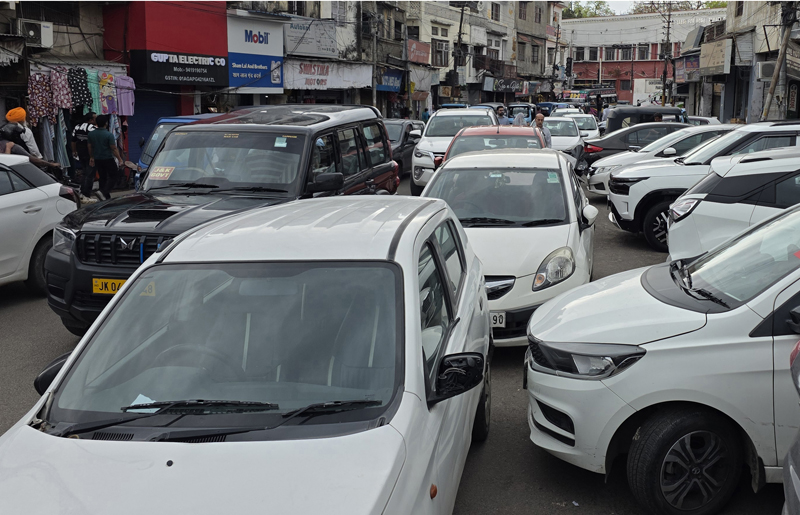
JAMMU, Apr 12: Despite repeated directions from multiple quarters and high-level reviews, the ground situation in Jammu city, the winter capital, remains deeply disturbing with chaotic traffic and unchecked vehicular emissions continuing to choke the city’s air, test public patience and expose weak enforcement and systemic lapses.
Follow the Daily Excelsior channel on WhatsApp
On January 6 and February 4, 2026, the issues of worsening traffic congestion and vehicular emissions were deliberated upon in high-level meetings attended by senior officers of all concerned Government departments. Directions were issued to streamline urban mobility and enforce pollution norms on a war footing. Similar instructions had also been issued in the past to all enforcement agencies.
However, there is little evidence on the ground to suggest that these directives have translated into meaningful action. Instead, Jammu city’s roads continue to present a grim picture.
Overloaded and smoke-belching mini-buses, along with poorly maintained buses and trucks, ply across different parts of the city with near-total impunity, releasing thick plumes of black smoke. From busy intersections to narrow roads, commuters are routinely forced to inhale toxic exhaust, turning daily travel into a serious health hazard.
Similarly, operators of commercial vehicles particularly mini-buses and auto-rickshaws openly violate traffic norms by stopping and starting abruptly at will, causing frequent disruptions. Shockingly, such violations are often ignored by Traffic Police personnel.
“What makes the situation more alarming is not just the scale of violations, but the apparent indifference of enforcement agencies. Traffic Police personnel, who are mandated to check such violations, are frequently seen ignoring violators in broad daylight. This approach has effectively normalised non-compliance, sending a dangerous signal that rules can be flouted without consequence,” several daily commuters told Excelsior.
The problem is further compounded by serious doubts surrounding the integrity of the Pollution Under Control (PUC) certification system. Numerous vehicles, despite emitting dense smoke far beyond permissible limits, continue to carry valid PUC certificates. This glaring contradiction has raised widespread suspicion about the authenticity of emission checks and suggests the possibility of a compromised certification process, where compliance is reduced to a mere formality.
“Despite routinely witnessing blatant violations, especially by commercial vehicles openly flouting traffic and emission norms, many Traffic Police personnel appear to look the other way, for reasons best known to them,” the aggrieved commuters said.
Even more troubling are allegations that when conscientious citizens report offending vehicles, complete with registration details, the information is seldom used to initiate transparent punitive action. Instead, it is perceived to be reduced to an informal mechanism of “on-the-spot settlements,” where enforcement appears negotiable rather than rule-bound. Such practices not only defeat the very purpose of regulation but also erode the credibility of the system, fostering a culture where compliance becomes optional and accountability remains elusive.
According to Dr Vishal Tandon, a Professor in the Government Medical College, Jammu, there has been a noticeable increase in pollution-linked diseases.
“Cases of asthma, Chronic Obstructive Pulmonary Disease (COPD), persistent cough, bronchitis and even cardiovascular complications are rising steadily. Vulnerable groups, including children, the elderly and those with pre-existing conditions are bearing the brunt of deteriorating air quality due to vehicular emissions”, he said. Similar concerns were also echoed by other doctors.
Dr Deepika Slathia of Department of Environment Sciences, University of Jammu has also flagged the long-term implications of unchecked emissions, warning that sustained exposure to high pollution levels could lead to irreversible ecological damage and a chronic public health crisis. She stressed that the situation demands immediate intervention, combining strict enforcement with public awareness and sustainable transport planning.
“The prevailing situation underscores a deeper governance failure where policies exist, warnings are issued and meetings are held, but execution remains inadequate. The gap between intent and implementation has not only undermined regulatory credibility but has also eroded public confidence in the system’s ability to respond to a growing traffic and pollution problem”, observers said.
They further added, “unless accountability is fixed at multiple levels, from enforcement agencies to certification authorities, piecemeal measures will fail to deliver results. There is an urgent need for a comprehensive crackdown on vehicles violating pollution and traffic norms, a transparent audit of the PUC certification process, deployment of real-time emission monitoring systems and a sustained campaign to enforce compliance without exception.”
 Follow our WhatsApp channel
