

Suman K Sharma
s2m2nr@gmail.com
On 24 November, 1947, the Pakistani marauders let loose a diabolic reign of terror on the historic town of Mirpur, slaying thousands of defenceless civilians and leaving behind a trail of arson and plunder in the name of ‘azadi’.
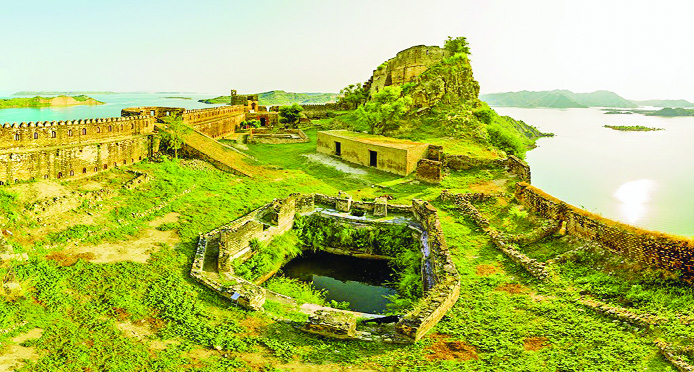
Mirpur could have been barely a few hours’ drive from Jammu. Yet, today, it is as apart from us as a picture is from the real thing. The city has two tales. The tale of the Old Mirpur as evoked by a desecrated temple which, as its undead past,emerges during the winter when the waters of the Mangla Dam recede. The other tale is that of the New City of Mirpur and its conundrum, which some of its beguiled denizens never tire of flashing out on the internet.
The Tragic Tale of Old Mirpur
There is a legend about founding of the old Mirpur, dear to the proponents of Hindu-Muslim unity. A Muslim saint, Mir Shah Gazi, and a Hindu holy man, Gosain Bodhpuri, are said to have co-founded the city in the late fifteenth century. Post partition, however, those across the LOC appear to have discarded this tradition. They credit instead a Ghakhar chief, Miran Shah Gazi, with establishing Mirpur in 1640 AD. In time, the settlement came to include the towns of Rajouri, Bhimber and Kotli as well. The district was a part of the Pothwar plateau of the Western Himalayas. It was bounded by district Poonch to the north, the Punjab plains to the south, the Jhelum to the west and the Chenab to the east. The strategic location and its water resources have given the expansive Mirpura lasting significance.
As it had to be, the territory saw very many regimes. The Ghakhars ruled under the suzerainty of the Mughal empire. Then came the Chibs, the Sikhs, succeeded by the Dogra Dynasty (1846-1947).The Partition brought in its wake Mirpur’s gruesome severing from the State of Jammu and Kashmir, and it became a part of the fanciful ‘Azad’ Kashmir under the hegemony of Pakistan. The new regime had little fascination for its people. It eyed rather its resources. Two decades had not passed when the government of Pakistan, thanks to the financial aid from the World Bank, built the Mangla Dam to meet the nation state’s demands of electricity and irrigation. Old Mirpur was submerged under water for all practical purposes.
Poor New Mirpuris
The new city of Mirpur was built in the 1960s, literally on the bones of the old one. As many as 18000 Hindu and Sikh residents of the defunct city were butchered and the rest of them had to flee for dear life to India. But this ethnic cleansing did not let the Muslim residents live in peace. What now was at stake was their territorial identity, and not their religion (so much for Jinnah’s two-nation theory and creation of Pakistan on the basis of religion). Were they Pothwari, Punjabi, or something quite different? This was – and still remains – not just an emotional issue, but something that impacts their politics, economy and the day-to-day life as well. Reis Haider, a UK-based blogger from the region, asserts in his peculiar style, “Mirpur has never formed part of the Pothwar or the Punjab. False unions between designated groups through false ethnic memories, political claims, and not facts of history….”(see, ‘Appraising Mirpur’s Documented History – the Story of Kashmir Before and After 1846’ – the blog, ‘Portmir’).
Reis Haider may be faulted for his partisan attitude in disowning the identity which has been forced upon his people because of the “priorities of political propaganda and online mistruths/disinformation within the context of conflict.” But his querulous tone reflects a deeper resentment. Mirpuris have given much more than their share to Pakistan. Like him, the host of emigrees from this place to England and other countries contribute substantially to the country’s kitty through their remittances. Yet, they feel to have been short-changed. Their major grudge is about the Mangla Dam, which has proved a bane for them, but a veritable blessing to the Pakistanis. Roger Ballard of the Centre for Applied Social Sciences, University of Manchester, diagnoses what ails Mirpur and the Mirpuris:
“…To Pakistan Mangla is a vital asset which brings many benefits: second only to the mighty Tarbela as a source of hydro-electric power, it also serves as the principal water-storage reservoir for the entire canal system (of) West Punjab. Mangla Dam is thus of critical (importance) to the success of the Pakistani economy as a whole.
“Yet despite the great benefits – in terms of the cheap electricity, year-round irrigation and security from flooding – which Mangla has brought to everyone in Pakistan proper, those unfortunate enough to live immediately upstream the stream have had – as in so many other similar projects elsewhere – to bear the brunt of its environmental costs. It is the Mirpuris who have had to witness the disappearance of much of their fertile agricultural land, as well as the District’s two major market towns, Mirpur and Chaomukh, beneath the waters of the lake; it is they, too, who have to cope with the intensely disruptive impact of the rising waters on the local infrastructure, and particularly on transport and communications.”
– The Kashmir Crisis: A View from Mirpur
Ballard goes on to illustrate how the affected people were annoyed by the tendency of the government of Pakistan to “scrimp and save” in providing them the necessary infrastructure. Dadial was the richest tehsil of the Mirpur District, thanks to the large-scale migration of its residents and the savings they managed to bring from abroad. But the returnees were furious to find that the newly formedMangla Lake had left them hardly with any land route to connect with the rest of the world. Boats were now the only means of transportation for them. “This sense of hostility,” Ballard narrates, “which was fired by their steadily more explicit exploitation by Pakistan came to a head as a result of a disastrous accident. A boat carrying a marriage party of a very influential family in one of the most affluent Dadiali villages sank while crossing that part of the river Poonch that should long since have been abridged. More than fifty people were drowned. This proved to be the last straw. An uprising followed, in which a thana was taken over, the SDM was taken into custody, and so I am told, Indian flags were ironically raised over public buildings. The Dadialis had had enough” (ibid, p.5).
Of course, Ballard is speaking here of Mirpur of the 1970s. But fifty years on -as the young U-tubers from New Mirpur end up showing to the world unintentionally -there is little, if no change, in their perverse condition. The imposing mansions of the expatriate Mirpuris stand lonely and desolate in the midst of all the mud and muck of decades of misgovernance.If that is what ‘azadi’ means to the ‘Azad’ Kashmiris, then they are welcome to wallow in it.
 Follow our WhatsApp channel
