

A Political-Economic Response
By Dr. D.K. Giri
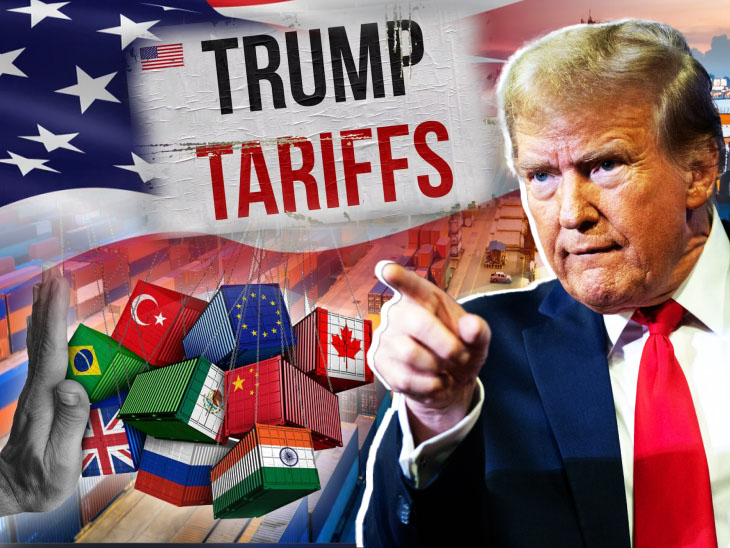
Donald Trump’s tariff on India upto 25 per cent on India seems to have grave consequences for India’s economy and geo-politics. Of course, India is not alone to face Trump’s capricious policies on trade. Given the special relationship, America was building with India and inter-personal warmth between Modi and Trump, latter’s action and attitude towards India are worrying. Even the neutral international observers have begun wondering. Is itjust Trump’s impatient and importunate behaviour or there is something deeper than that? It does require a careful analysis as well as answer to Trump’s latest salvo on India.
Admittedly, the relationship between India and the United States in trade, security as well as geo-politics, has been historically mixed with a bit of cooperation and much of friction. In the last two decades, the ties were growing stronger evolving into a strategic partnership. Such a change has been prompted by the decline of Soviet Union, distancing from Russia by India, growing Indian economy etc. The bilateralism consolidated under the first term of Trump’s presidency. During that period, Trump was targeting China as his main competitor, thereby was building New Delhi as a counterweight to Beijing.
Times have dramatically and drastically changed during Trump’s second term. He walked into the office of the President, in the wake of two devastating wars; in particular, the Russian invasion of Ukraine which was opposed actively by NATO and the West. Trump was particularly disturbed as he had a personal angle to Russian leadership. Perhaps, on the basis of that friendship, he promised to end the war almost in no time. That promise and hope failed. Trump then resolved in his mind to cripple Russia by waging a trade war, that he is good at. This is where India-America ties become wobbly.
Trump decided to target India for buying oil and defence equipment from Russia. He accused India of financing Russian war on Ukraine. In order to pressurise India, he riled New Delhi on its association with BRICS. He commented that BRICS countries are a ‘bunch of juveniles’ trying to do something or the other. More important, Trump decried Indian and Russian economy as two ‘dead economies’ which can go down the slippery road.
Not only that, Trump revived the ties with America’s old ally Pakistan. He went to the extent of building Pakistan as an oil-producing economy and teases India that it could buy oil from Pakistan. It is true that Pakistan was patronised by America to take on Taliban and its previous incarnation. That need is over. Now, it is inferred that America is building Pakistan to cast influence on the MiddleEast. Both these conjectures are unfounded. The political economy of these actions vis-à-vis India is to pressure India into joining the American camp and to stop dithering.
On the trade, there are a couple of persisting contradictions with America. These are: agriculture and oil. American farmers get upto 26 lakhs of subsidy per annum, whereas Indian farmers earn upto 1.5 lakhs. It would be deeply disturbing to Indian agriculture if it is opened to competition with America. Likewise, India has increased its oil purchase from the US. It cannot suddenly stop buying oil or weapons from Russia. However, these problems can be tackled.
The Trump administration’s tariffs on India were part of a broader “America First” economic agenda that sought to reduce the U.S. trade deficit and revive domestic manufacturing. India, which had enjoyed preferential trade status under the Generalized System of Preferences (GSP) since the 1970s, became a target of this policy shift. The GSP allowed duty-free exports of over 3,000 Indian products to the U.S., benefiting Indian sectors like textiles, engineering goods, and agriculture.
In 2018, citing India’s high tariffs on products like Harley-Davidson motorcycles and its trade surplus with the U.S., Trump began pressuring New Delhi to ease trade restrictions. When negotiations failed to yield desired results, the Trump administration revoked India’s GSP status in June 2019, affecting roughly $5.6 billion worth of Indian exports.
This revocation was followed by the U.S. imposing tariffs on Indian steel (25%) and aluminium (10%) under Section 232 of the Trade Expansion Act of 1962. India, in response, levied retaliatory tariffs on 28 U.S. products, including almonds, apples, walnuts, and pulses — commodities with significant export value for American farmers.
Given the above context, India needs to carefully respond in political-economic terms. It is true that Indian economy will be hit more than that of America. At the same time, New Delhi vows to stand-up to American pressure in line of it declared policy of strategic autonomy.
The tariff war has strained the bilateral relations, especially as it coincided with broader geopolitical cooperation on defense, counterterrorism, and Indo-Pacific security. At a time when both countries were moving closer strategically — evident in defence deals and dialogues like the 2+2 Ministerial — the economic rift exposed the fragility of the commercial relationship.
Despite several rounds of negotiations, no comprehensive trade deal was finalised during Trump’s presidency. While India offered concessions on medical devices and agricultural imports, it remained firm on retaining sovereign control over digital data and e-commerce rules — areas where U.S. tech giants had significant stakes.
Is it just the tariff that is responsible for fraying the India-America relations?
Remember Operation Sindoor. In this column, last week, I discussed it, especially the sudden ceasefire, creating an uncalled for and avoidable trust deficit. New Delhi maintained that there was no involvement of any third country, whereas Trump asserted repeatedly that it was he who played the key role in bringing about the ceasefire. So, clearly, the differences were growing between Modi and ‘his friend’ Trump.
Economists and trade experts are making suggestions on how India could respond to Trump tariff in economic terms. Some of them are: diversification: India cannot over-rely on a single export market, even one as important as the U.S.; trade policy reform: India must modernise its trade architecture, reducing bureaucratic hurdles and making its exports more competitive; domestic capability: Developing globally competitive manufacturing through targeted policy interventions is essential for resilience.
That is the half story. It is a partial reaction. Indian economy was losing out in terms of growth etc. as it looked inward. Despite the negative fallouts of globalisation, India was doing well by attracting FDI and expanding its export market. While self-reliance or AtmanirbharBharat is a good strategy as well as a slogan, no economy can grow in isolation in an inter-dependent world.
However, the major response to Trump’s tariff has to be political. Although, Trump is overstated as a transactional President, he has to maintain American political-strategic supremacy. On that, there is a consensus in American politics. New Delhi has to be sensitive to that American aspiration, despite all talks of a multipolar world. The tariff war has to be seen in political-economic context, either of which is not a viable determinant of any country’s foreign policy, including India. —INFA
(Copyright, India News & Feature Alliance)
New Delhi
7 August 2025
 Follow our WhatsApp channel
