

Virender Raina
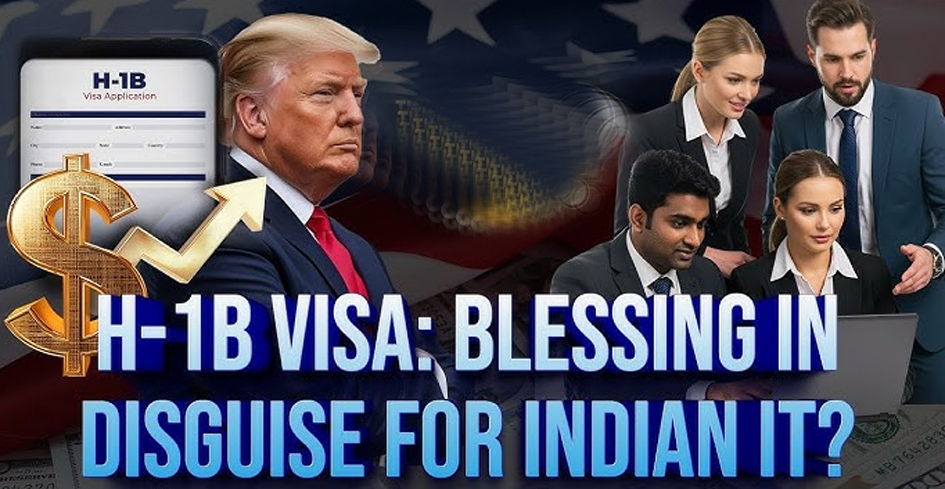
The recent announcement by the Trumph government in the United States to raise the H-1B visa fee to a staggering 100,000 dollars per year has sent shockwaves across the global IT industry. At first glance, this move appears to be a protectionist measure intended to discourage foreign workers, particularly from India, from entering the U.S. job market. On the surface, it looks like a setback for Indian tech professionals and companies who have long relied on the H-1B route for access to lucrative American opportunities. But if we look closely, this punitive measure could well be the spark that India needs to move from being the back-office of the world to becoming a genuine innovation hub.
For decades, the Indian IT sector has thrived by supplying highly skilled yet cost-effective manpower to the U.S. and other developed economies. Giants like Infosys, TCS, and Wipro built entire business models around offshore-onsite combinations, enabling American corporations to cut costs while getting top-notch technical expertise. However, this very success story has had a limitation: much of the focus has been on services rather than innovation. We became the coders and troubleshooters of the world but rarely the inventors of the next big technology.
Trumph’s steep visa fee hike, though painful in the short run, could push Indian companies to rethink this model. With H-1B visas becoming prohibitively expensive, firms may no longer be able to justify sending battalions of engineers abroad. Instead, they will be compelled to channel resources into research, product development, and intellectual property creation within India. Rather than just helping American corporations reduce costs, Indian IT will be forced to start building its own future-defining technologies.
For the crème de la crème of India’s technical talent, particularly IITians, this is hardly a roadblock. Those at the very top of the talent pyramid are in global demand and can command opportunities anywhere. For the mid-level and lesser-talented workforce, the message is clear: the jobs can still be done, but increasingly from offshore. If corporations cannot bring people to work, they will take work to the people. With modern collaboration tools, cloud computing, and high-speed connectivity, geography matters less than ever before.
In fact, the long-term consequence may be that more and more global corporations set up shop in India itself. Already, we see the likes of Microsoft, Google, Amazon, and Apple expanding their presence in Indian cities, not just for cost arbitrage but also to tap into India’s vast and growing consumer base. By making the H-1B route costlier, Trumph may inadvertently accelerate this trend, compelling big tech to invest in Indian campuses, R&D centers, and innovation hubs.
Another dimension often overlooked is India’s dual role in the technology ecosystem-not only as producers of tech talent but also as one of the largest consumers of technology worldwide. Whether it is Facebook, Google, WhatsApp, or Amazon, India has provided a massive user base that has honed, stress-tested, and scaled these platforms. Our sheer numbers and digital adoption have made global tech products sharper and more robust. With a more self-reliant approach, India now has the opportunity to leverage this consumer scale to nurture its own homegrown champions-companies that can rival global giants not only in services but in products and platforms.
The policy shift in the U.S. should therefore serve as a wake-up call for India’s policymakers as well. The time is ripe to double down on creating technology parks, high-tech incubation centers, and a thriving ecosystem for startups and entrepreneurs. We need to make it easier for innovators to access funding, protect intellectual property, and test their products at scale. India has the talent, the market, and the ambition-what it requires is the ecosystem to support breakthroughs.
In the final analysis, while Trumph may believe that raising H-1B visa fees will “Make America Great Again,” the reality could turn out differently. The immediate effect may indeed be disruptive, causing temporary pain for Indian professionals and IT exporters. But in the long run, this may become the very nudge that shifts Indian IT from being service-driven to innovation-led. Rather than supplying cheap labor to America, we could see a future where India becomes the crucible of new technologies, new products, and new ideas for the world.
Paradoxically, Trumph’s move might end up making India great-encouraging us to invest in ourselves, innovate boldly, and create a truly indigenous tech ecosystem. History often shows that adversity can sow the seeds of transformation. The H-1B visa hike could be India’s moment of reckoning, and if responded to wisely, a blessing in disguise.
 Follow our WhatsApp channel
