

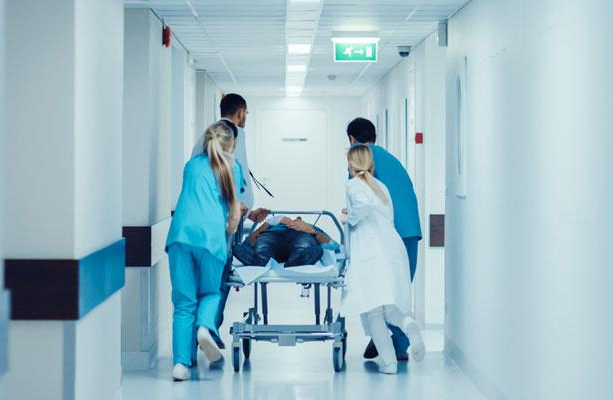
Disaster management Role of Prehospital retrieval
Dr Arvind Kohli
Disaster is any occurrence that causes damage, ecological disruption, loss of human life or deteriorationof health services on a scale sufficient to warrant an extra ordinary response from outside the affected community or area This is a consequence of accidents ,earthquakes, Battles and War floods. Train accidents etc
War is against human nature because it leads to casualties, destruction and spreads fear and unrest among all people. Hence, no matter the reasons or motives, wars remain an exceptional case for humans endangering mass injuries and Casualities
The World Health Organization defines mass casualty incidents as disasters and major incidents characterized by quantity, severity, and diversity of patients that can rapidly overwhelm the ability of local medical resources to deliver comprehensive and definitive medical care.
They have been occurring more frequently in recent decades and affect countries of all socioeconomic backgrounds. Preparedness and planning are vital, as these events can happen in any community at any given time.
Defined pre-hospital triage systems are essential in saving lives and optimizing the initiation of resource allocation when these disasters strike
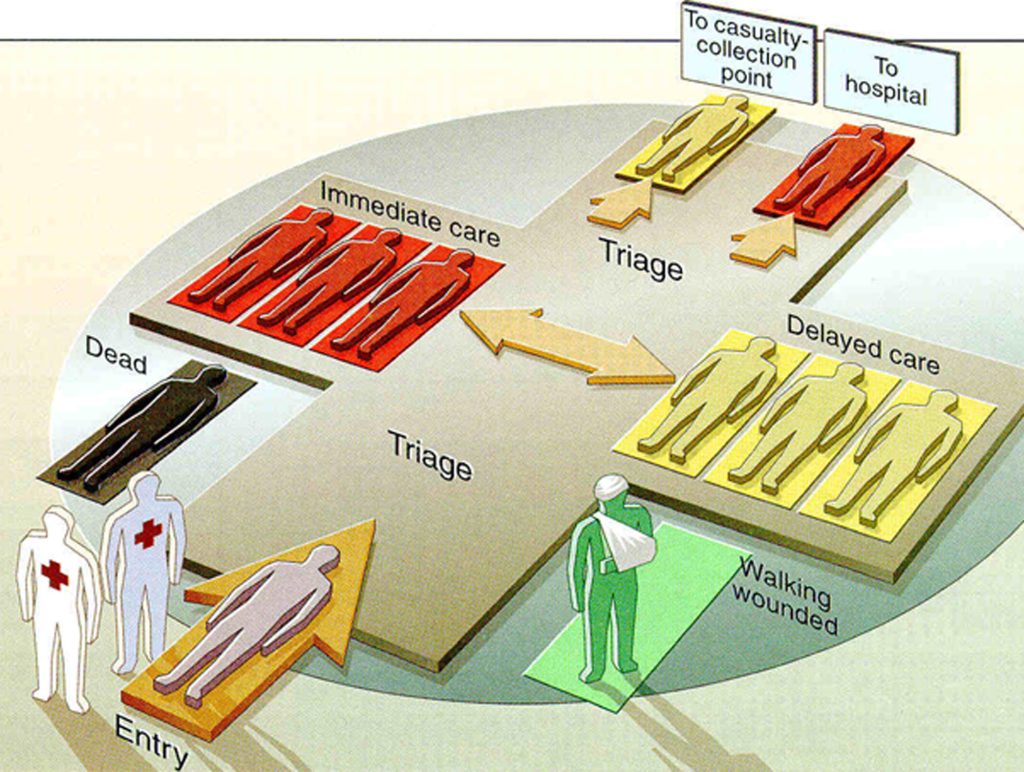
Triage is a process of rapidly sorting and classifying casualties according to their severity of injuries and need for medical attention, allowing for efficient allocation of limited resources.
Disaster management encompasses the broader scope of planning, preparation, and response to minimize the impact of disasters, including the use of triage as a key component
A prehospital evacuation plan outlines the procedures and strategies for safely removing individuals from a hazardous area of disaster before they reach a hospital or other medical facility. This includes rescue, first aid, triage, and transport of casualties, covering the initial phases of disaster response.
Key Components of a Prehospital Evacuation which is mentioned as star of life arescoop and run or stay and play so as to Preserve life,Prevent further injury and promote recovrey
* Risk Assessment:
Identifying potential hazards and vulnerabilities within the area.
* Warning and Alert Systems:
Establishing communication channels to inform residents and emergency responders of a potential threat.
* Rescue and Retrieval:
Deploying resources like search and rescue teams to locate and extract individuals from hazardous locations.
* First Aid and Initial Medical Care:
Providing basic medical assistance on-site, such as treating injuries and administering essential medications.
* Triage:
Prioritizing patients for transport based on the severity of their injuries and the availability of resources.
* Transportation:
Utilizing appropriate vehicles, such as ambulances or other emergency vehicles, to move patients to a designated location for further care.
* Communication and Coordination:
Establishing clear communication channels between emergency responders, medical facilities, and other relevant agencies.
* Evacuation Routes and Assembly Points:
Planning safe and efficient evacuation routes, and identifying designated gathering areas for people to wait for transport.
* Training and Exercises:
Conducting regular drills and training exercises to ensure that emergency responders are familiar with the evacuation plan and procedures.
* Resource Allocation:
Determining the resources needed, such as personnel, equipment, and supplies, and ensuring they are readily available.
Role of bystanders When a “sudden disaster” occurs, bystanders witness the event and are among the first to respond. During the critical time between the occurrence of the emergency incident and the arrival of professional trauma care team, those injured can deteriorate clinically and can die before the professional responders arrive. Bystanders often step forward, initiating evacuation, scene control, hemorrhage control with means available at that place, search and rescue, cardiopulmonary resuscitation (CPR) in some cases, and many other roles. Disaster managers and professional responders have recognized the value of bystanders, but concerns about liability and dependability have limited their utilization. Bystanders also have no accountability and limited health protection.However Bystanders should be included in all phases of the disaster management
Clinical Significance
Multiple triage systems are currently being implemented around the world. Some of the more well-known algorithms include START (simple triage and rapid treatment), SALT (sort, assess, life-saving interventions, treatment/triage), STM (Sacco triage method), Care Flight Triage, and SAVE (Secondary assessment of victim endpoint). There is limited data available to support one system over another. However, it is important to choose one and adhere to its algorithm to maintain an ordered approach.
START Triage
Simple triage and rapid treatment (START) is currently the most widely used triage system in the United States for mass casualty incidents. It was developed in 1983 by staff at Hoag Hospital and Newport Beach Fire Department in California for rescuers with basic first-aid skills. First responders delegate the movement of injured victims to a designated collection point as directed by using four main categories based on injury severity:
* BLACK: (Deceased/expectant) injuries incompatible with life or without spontaneous respiration; should not be moved forward to the collection point
* RED: (Immediate) severe injuries but high potential for survival with treatment; taken to collection point first
* YELLOW: (Delayed) serious injuries but not immediately life-threatening
* GREEN: (Walking wounded) minor injuries
SALT Triage
The sort, assess, life-saving interventions, and triage/treatment approach is similar to the START system; however, it is more comprehensive and adds simple life-saving techniques during the triage phase.
* SORT: sort the walking, waving, and still. This can be achieved by asking everyone at the scene to walk to a designated casualty collection point similar to the START method; however, this is followed by asking to wave an arm or leg if they need help. Those who cannot move or follow commands should be assessed first.
* ASSESSMENT: assessment and life-saving interventions go hand in hand. When you assess a victim and find life-threatening injuries, you should intervene.
* LIFE-SAVING INTERVENTIONS: simple techniques such as controlling major hemorrhage, opening airways, needle decompression, and auto-injector antidotes should be performed as long as it is not time intensive. Once performed, the provider should assign a color-coded tag similar to the START system and move onto the next patient to ensure the forward flow of patients.
TREATMENT AND TRANSPORT: Once tagged, patients will be moved to the designated casualty collection point for transport by emergency management services(EMS) to receiving facilities where a.Primary survey is initiated to Identify what is endangering the life of patient.and appropriate resuscitative measures should be taken up to treat what is likely catastophy affecting life of the patient In addition Secondary survey shall identify other associated injuries and a definite management plan is developed
What Is EMS?
Emergency Medical Services, more commonly known as EMS, is a system that responds to emergencies in need of highly skilled pre-hospital clinicians.
But EMS clinicians aren’t just the first healthcare practitioner on the scene; they’re often the first to identify a healthcare crisis in a community and act as a critical component of emergency management and, increasingly, a practitioner of community healthcare.
EMS is most recognizable by its vehicles, helicopters and workforce, which respond to emergency incidents. But far from being simply a ride to the emergency department (ED), this system of coordinated response and emergency medical care involves numerous people and agencies. A comprehensive EMS system is ready every day for every kind of emergency, whether or not that includes going to the hospital.
Despite a robust ecosystem of its own, EMS does not exist in isolation. It integrates with other services and systems intended to enhance the community’s health and safety. As seen in the graphic below, EMS operates at the crossroads of healthcare, public health, emergency management and public safety.
India has also developed a team of NDRF and SDRF(National and state disaster relief Management forces which are doing a wonderful job for managing the disasters occurring out of accidents earthquakes floods and battle /war related
Role of drills Hospitals, universities, fire departments, and other groups often participate inMOCK drills for responding to MCI(Mass causualityincidences)s, sometimes for regulatory purposes. The drills stage a scenario (for example, 300 victims of a derailed train) and staff practice triage and treatment.These drills allow personnel to practice how they should react in a catastrophe. They allow administrators to evaluate hospital needs (for equipment or materials)
(The author is CTV Surgeon)
 Follow our WhatsApp channel
