

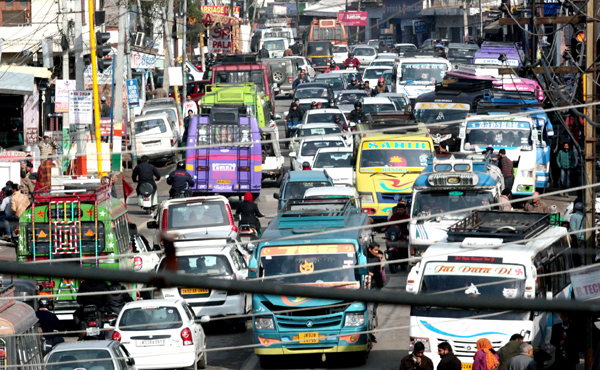
The Chief Secretary’s call for time-bound and result-oriented implementation of traffic management plans for Jammu and Srinagar is both timely and necessary. Years of discussions, master plans and committee reviews have yielded limited change on the ground. While planned projects, such as parking infrastructure, Intelligent Traffic Management Systems, and junction redesigns, are important, the core crisis lies elsewhere – the absence of mass transport, weak enforcement, unchecked encroachments, and uneven policing. Unless these structural gaps are addressed, congestion in both capital cities will continue to worsen.
The scale of the problem is evident from the data. Vehicle numbers across Jammu and Kashmir have nearly doubled over the past decade, crossing 25 lakh registered vehicles. Rapid motorisation without proportional road expansion has placed enormous stress on already narrow urban corridors. In historic cities like Srinagar and Jammu, built around old trade routes and dense neighbourhoods, road width cannot easily be expanded, making traffic management even more complex. Yet infrastructure expansion alone will not solve the crisis. The biggest missing link remains reliable mass public transport. Experts have repeatedly pointed out that people are willing to shift from private vehicles to mass transport like the metro. But except for the announcement, both metro projects at Srinagar and Jammu are right now deemed unfeasible. Currently, public transport supply is far below demand. Even modern initiatives like e-buses have struggled due to allocated routes and the absence of such services in the interiors of the cities. The result is predictable – people buy private vehicles because they cannot depend on public transport, further worsening congestion.
However, infrastructure and transport planning are only part of the story. The day-to-day collapse of traffic discipline is equally responsible. In both capitals, there is a visible contrast between VIP zones and ordinary city areas. Around Civil Secretariat complexes and key administrative corridors, traffic deployment is strong. But move a few metres away, and enforcement weakens drastically. No-entry violations, random parking, and illegal roadside occupation become routine. This selective policing creates resentment and encourages rule violations. Encroachment remains perhaps the most visible and damaging factor. Across markets and old city areas, footpaths are occupied by shop extensions, vendors, parked vehicles and informal activities. Reports highlight how footpath encroachments force pedestrians onto roads, directly reducing carriageway space and increasing accident risk. In congested zones like old Jammu City or downtown Srinagar, this becomes a daily survival challenge for residents. At peak hours there are genuine fears of stampede-like situations during festive or rush periods.
The winter capital faces an additional burden. Jammu must absorb seasonal administrative migration along with population inflow from Kashmir and Ladakh, leading to sudden spikes in traffic volume. Yet planning rarely reflects this seasonal reality. Traffic density nearly doubles, but management strategies remain static. Verbal assurances replace dynamic seasonal planning, leaving citizens to bear the consequences. Automation and surveillance-based traffic systems are useful tools, but they cannot substitute human enforcement in dense urban pockets. Many signals still function irregularly, requiring manual regulation during peak hours. In congested bazaars and old city stretches, only visible police presence can regulate movement, prevent illegal parking and control vendor spillover. Technology works best when supported by strong on-ground policing.
Equally concerning is the weak implementation of long-term planning frameworks. Master Plan 2032 clearly emphasised decongesting old city cores by shifting Government offices outward. Yet construction and administrative concentration continue in the same congested zones. Master plans lose credibility when they remain documents rather than action roadmaps. Municipal bodies also need urgent accountability reforms. Encroachment removal drives are often temporary and selective. Political pressure frequently dilutes enforcement, especially in market areas. But the rule of law cannot be constituency-specific. Traffic discipline, urban planning and public safety must operate uniformly across cities.
The emphasis on project completion is correct. But traffic reform cannot be engineering-driven alone. The real solution lies in four simultaneous actions: expanding reliable mass transport, enforcing anti-encroachment laws without political interference, ensuring uniform traffic policing beyond VIP zones, and implementing master plans in letter and spirit. Unless district administrations, municipal bodies and police act collectively and consistently, traffic chaos will remain the defining feature of daily life in Jammu and Srinagar.
 Follow our WhatsApp channel
