

Ashutosh Parashar
Nestled in the mountains, District Udhampur is often celebrated for its scenic beauty and strategic importance. But for those who pause and listen closely, the district hums with a different kind of energy-a literary energy that has been flowing for generations, as steadily as the “River Tawi”. It’s a place where the spoken word carries the weight of history, and the written word captures the very heartbeat of the land of Dogras.
Udhampur’s tryst with literature is not a recent affair. Its roots run deep into the soil of folk tradition. Long before the printing press made its way here, the soul of the district found its voice in the Geet sung by women at the village well, “Bakhs” recited around a winter fire, and in the witty banter of the countryside. This wasn’t just entertainment; it was the collective memory of a community, passed down through generations. This long tradition of folk literature created a fertile ground, a rich compost of stories, rhythms, and idioms, from which a magnificent tree of modern literature would eventually grow.
If folk literature was the seed, then the modern era saw Udhampur blossom into a veritable garden of letters. The district proudly holds the title of being a pioneer, a trailblazer for modern Dogri literature. The legendary Dinubhai Pant(born in village Painthal in erstwhile Udhampur district , presently in Reasi district) is a name that needs no introduction. He was not just a poet; he was a pied piper, who, armed with his wit and his pen, took Dogri from the drawing rooms of the elite to the every nook and corner of Duggar. With a twinkle in his eye and a humorous poem like “Shehar Pehlo Pehal Ge” on his lips, he made an entire region fall in love with its own mother tongue. He showed that literature could be both profound and playful, a mirror held up to the everyday life of the common man.
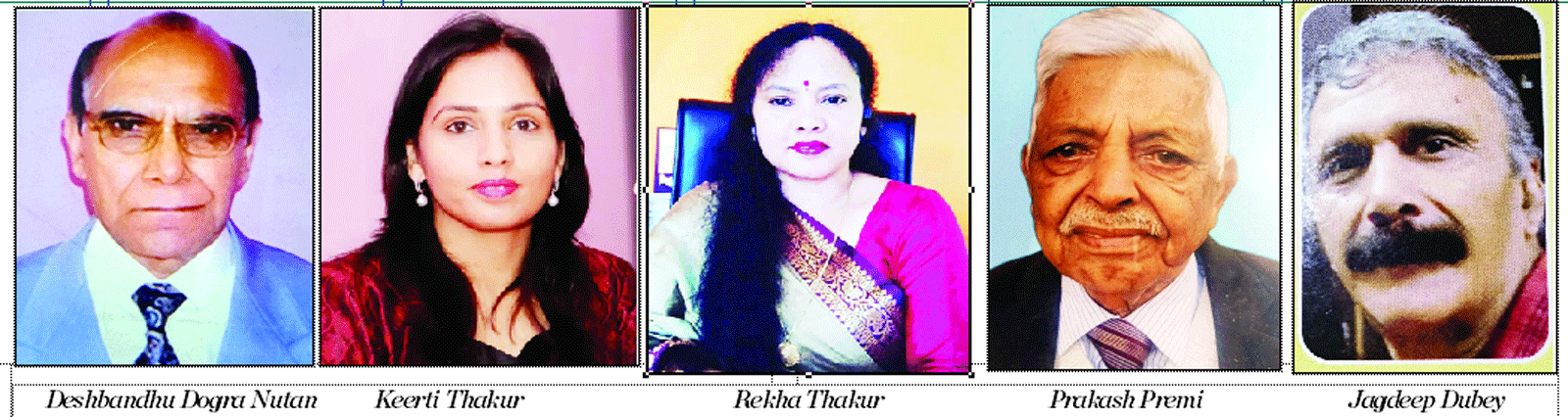
The path that Pant ji paved soon saw many travelers , and some of them became giants in their own right .The most remarkable proof of Udhampur’s literary prowess is the fact that district has produced seven Sahitya Akademi award winners- the highest literary honour in India. This is not a coincidence but a tradition of excellence . But the true beauty lies in breathtaking diversity in their work. . Prakash Premi built a monument with words, creating “Beddan Dharti Di” , the great epic in Dogri-a work of grand, mythological scope . Jitendra Udhampuri, Abhishap and Balkrishna Bhoura proves their master skills in poetry . . On the other hand, Desh Bandhu Dogra Nutan’s “Qaidi” and Vats Vikal’s “Phull bina Daali” showcased that Dogri has the potential to produce quality prose.
While the glitter of awards rightfully illuminates some deserving names, the true soul of Dogri literature in the district pulses far beyond the trophy cases. Its deepest strength lies in the quiet, relentless army of contributors- the passionate storytellers and poets, Most inspiring, is the vibrant surge of young, energetic writers and poets who refuse to let the language be a mere relic of the past. Armed with a profound respect for their roots but speaking in the urgent, contemporary idiom of their generation, they are fearlessly weaving modern anxieties and dreams, into the timeless fabric of Dogri. Jagdeep Dubey , Surjeet Hosh Badsali, Yash Raina, Sandeep Sufi ,are few such names who have enriched the literary landscape of the district . Perhaps the most beautiful and significant shift in recent times has been the rise of women’s voices. For too long, the literary world, like much of public life, was a male-dominated space. That has changed dramatically, and it is the ultimate expression of democratization. Udhampur district is no exception to this general trend, The women writers are bringing new sensitivities and new strengths to the literature. Women like Rekha Thakur, Kavita Dutt , Kalpana Dutt, Keerti Thakur and Ritu Singh are not only participating but reshaping the conversation.
All of this literary activity doesn’t happen in a vacuum. It is nurtured by the very soil of the district, and by the collective love for language. Organisations like “Meri Mitra Mandali” act as the lifeblood of this ecosystem. They are the modern-day chaupals where writers meet, debate, recite, and encourage one another. It is the result of these efforts that we have seen a surge of energetic and enthusiastic poets like Puran Dardi, Pratap kalas , Ajay Gunahgaar ,Vipan Upadhyay and many more .
Equally significant is the use of digital and social media platforms for the promotion of language and literature. Udhampur district is playing a pivotal role in leveraging these media through initiatives like “Apna Dogri Channel”. These efforts are instrumental in cultivating literary sensibility and tastes in younger generations ,
So , when we step back and look at this vast literary landscape, we see a district that is much more than a dot on the map., It is a living, breathing republic of letters, where the word is not a privilege for the few but a birthright for the many. And as long as there is story to tell and emotion to stir ,this literary soul of this remarkable district will never rest.
(The author is Principal Government Hr Sec School Ghordi Udhampur)
 Follow our WhatsApp channel
