

Pinaki Bakshi
pinakibakshi9@gmail.com
One of the rampant issues academic domains are still dealing with is the theoretical vs. practical implementation of knowledge. The concern is about the typical academic dynamics and also academic underpinnings that prioritize conventional rote learning and securing higher grades, while shunning the contemplative planes of imagination, critical thinking, and the well-being of students themselves. This results in extreme psychological as well as societal pressure being placed upon students. Today’s youth still faces pressure concerning memorization for studies instead of thought-provoking, conceptualized understanding and literal implementation of knowledge. Conventional teaching methodologies and mindsets need to be shunned in order to achieve the true implication of education.
Another concern is the captivation with grades and GPA, which hampers the critical thinking of youth by promoting a book-based culture. The panoptic theory of conflict actually focuses upon the grading system, where a “five-point-something GPA” supports the traditional belief that a student’s success and future can be judged solely on the basis of grades. Today’s dilemma lies in the immense obsession with marks, which is the outcome of a “blind rat race” and a panoptic, deceptive structure that controls and judges a student’s future performance merely on grades. Competition becomes so forceful and intense in some institutions that it creates immense pressure upon students.
Extreme academic pressure amid mental health concerns is also one of the issues that today’s youth is still dealing with. The laborious academic ambience and competitive spirit create an environment of psychological strain and anxiety for students, resulting in a gloomy thought process and a draining of positive energy. Incidents like suicides and mental harassment raise questions about the mental well-being of students and the failure of institutions to help them cope with these challenges. Totalitarianism and the dearth of students’ voices also stand as major forces affecting the bright future of the young generation. The educational system still delves into an adamant and authoritarian environment where traditional learning methods frequently obstruct groundbreaking thought processes. Students’ imaginative powers feel stifled and restricted by old, conventional study ideas and unnecessary rules and protocols.
Even today, longstanding conventional methodologies are used in classrooms, such as dictation, teaching from books, and providing notes, thereby hampering students’ actual creativity. Instead of practical knowledge, the focus remains on theoretical underpinnings, which leads to the suppression of authenticity and original thought. This piece of writing deconstructs the underlying factors that perpetuate this flawed system.
Societal expectations and family pressures force students into systems where they often have little interest. Getting into prestigious institutions becomes their sole target. After entering such systems, they are expected to achieve superior grades to secure financial stability. Such external pressure suppresses personal passions and creative interests, forcing students to abandon their internal desires.
In today’s epoch, parents need to care about their children’s choices, yet they are often influenced by societal norms that push children to follow the crowd. The educational system portrayed by Chetan Bhagat in his novel Five Point Someone resembles a factory producing “engineers.” The focus is on churning out graduates with limited creativity and skills merely for the job market. There is little concern for holistic growth, personal development, or creativity, as the emphasis remains on memorization and grades.
There is no need to continue with the dichotomy of the old conventional education system, which reflects a deep disparity between outdated, inflexible learning methods and progressive educators who value inventiveness and innovation. A significant change in the educational realm is urgently needed to stimulate the right ideas among the right people.
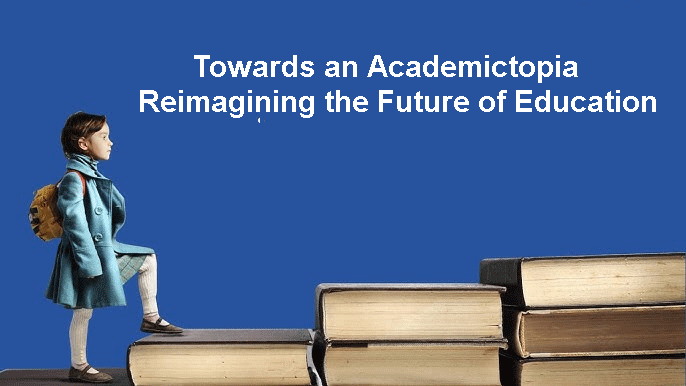
The old notion of success is being challenged by redefining it beyond salary, perks, and status. Today’s youth must explore success in terms of self-attainment, self-realization, meaningful relationships, and becoming the best version of themselves. Success achieved through negative means is temporary, whereas real success lies in character and personality. Success is incomplete without meaningful relationships and appreciation. The ultimate goal of education is to create an “academictopia”-an academic utopia where individuals strive for excellence while contributing positively to society.
Education that merely forces students to memorize without practical understanding must be condemned. The best education fosters lifelong learning and helps individuals become their best selves. Education should not be just a means of survival; it should be a way of life.
A change in the education system is the need of the hour. The Ministry of Human Resource Development (MHRD), Government of India, addressed this through the implementation of the National Education Policy (NEP) 2020, which focuses on lifelong learning skills and conceptual understanding rather than rote memorization. NEP emphasizes comprehensive, inclusive, and multidisciplinary education that enhances creativity and analytical thinking. It allows students to explore diverse subjects, including sciences, arts, and professional training, unlike the rigid traditional system. The policies under FYUGP NEP 2020 adopt a student-centric approach, offering flexibility in subject and career choices.
The focus of the educational system should be on preparing students to handle the complexities of the real world. It should advocate individual growth, originality, and the pursuit of personal aspirations over mere academic achievement and societal validation. Today’s generation needs a broader approach rather than mere transformation. Emerging issues among youth must be addressed with the right approach and guidance.
 Follow our WhatsApp channel
