

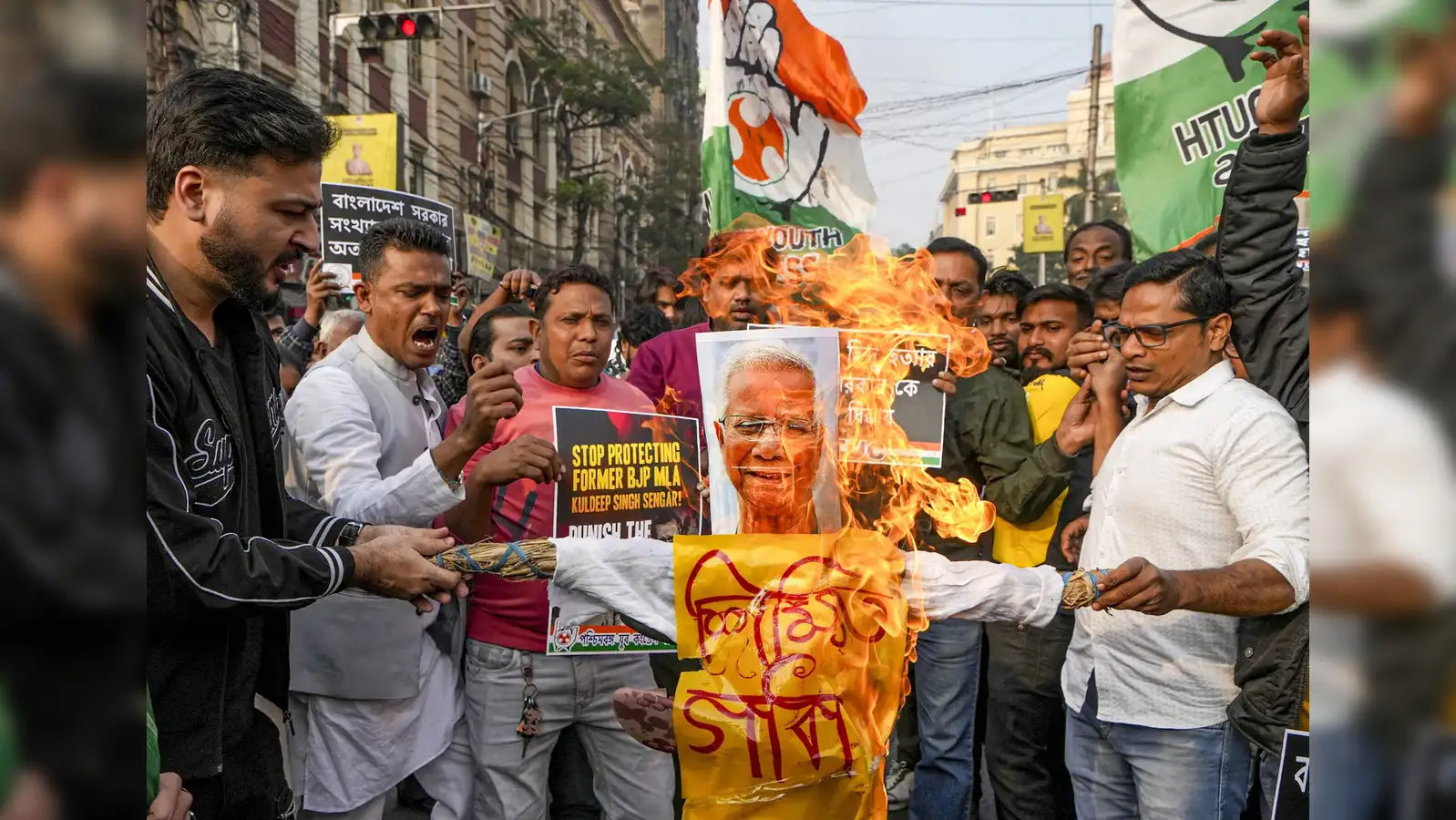
DHAKA, Dec 29: Bangladesh’s ties with India witnessed a downturn as it navigated a turbulent 2025 marked by political instability, economic strain and alleged persecution of minorities, leading to a diplomatic tussle between the two neighbours.
The relationship between India and Bangladesh hit a rough note after the ouster of Prime Minister Sheikh Hasina, who fled to India in August last year following anti-government protests.
She was sentenced to death in absentia by a tribunal this year for her alleged role in a deadly crackdown during the agitation.
Dhaka summoned Indian High Commissioner Pranay Verma five times over various issues, while India summoned Bangladesh’s High Commissioner Reaz Hamidullah once to express concerns over security in Bangladesh.
The transition, from what was widely regarded as an “India-friendly” Awami League government to Muhammad Yunus-led interim dispensation, significantly altered Bangladesh’s diplomatic posture.
Dhaka’s engagement with Islamabad to deepen ties further complicated the regional equation.
According to experts, Bangladesh’s crisis was worsened by a lack of interest from major global powers in engaging with the Yunus-led interim government, leaving Dhaka diplomatically adrift.
Analysts labelled 2025 as a “missing year” for Bangladesh due to the absence of an elected government. During this time, major embassies engaged more with political parties poised to form the next government rather than with the interim administration.
Former ambassador Mahfuzur Rahman told PTI that Bangladesh went through 2025 “with no clear foreign policy directive” and “no important country engaged Dhaka with any deep thought”.
He said, by contrast, “despite signs of softness and maturity on Delhi’s part to overcome the hostility in bilateral ties, Dhaka did not take the initiative or advantage to improve relations”.
“It (Dhaka) rather showed an immature attitude, visibly to appease a domestic constituency,” he said.
Rahman, who had served as the deputy high commissioner in Islamabad, said Pakistan pursued an active diplomacy with Bangladesh and Dhaka responded to it, “whether knowingly or unknowingly, the impact or the course it will lead to”.
The South Asian nation, with a population of around 175 million, has allegedly seen a growing shift toward religious conservatism amid a prolonged period of political instability.
The closing months of 2025 witnessed the rise of anti-India forces, raising concerns across the region.
Dhaka University international relations professor Imtiaz Ahmed told PTI that “state-complicity” played a crucial role in the rise of anti-India forces.
Security analyst and 1971 Liberation War veteran Nasir Uddin said the evolving situation exposed Bangladesh to a “dangerous” geopolitical phase, particularly in its ties with major regional and international powers.
“India is repeatedly expressing its concerns, but those in power in Bangladesh without any (electoral) mandate remain indifferent, much like the Pakistani rulers in 1971,” Uddin said.
The violent, student-led agitation known as the July Uprising, which ousted Hasina’s government in 2024, fundamentally altered Bangladesh’s political landscape.
However, analysts say, even over a year after the upheaval, Bangladesh showed a little improvement in stability, with political violence and economic crisis continuing to plague the nation.
Political violence has increased after the Election Commission declared February 12, 2026, as the date for general elections.
The killing of Sharif Osman Hadi, a leader of Inqilab Mancha known for his anti-India rhetoric, on December 18 triggered nationwide protests and violence.
A few days later, another student leader, Motaleb Shikder, was shot in the head.
Rehman Sobhan, who taught Chief Adviser Yunus at Dhaka University more than six decades ago, criticised the interim government, saying its failure had pushed Bangladesh into a “dangerous phase” where election candidates were becoming targets of violence.
The year also reportedly saw a rise in attacks on Hindus and Liberation War veterans. Media organisations and shrines of Sufi saints were also attacked.
Former prime minister and Bangladesh Nationalist Party (BNP) Chairman Khaleda Zia’s critical health also remained in the news in 2025.
With the 80-year-old BNP chief on a ventilator, attention increasingly shifted to her son, Tarique Rahman, who returned from London ahead of the polls after over 17 years in self-exile. Rahman’s arrival energised BNP supporters.
With the Awami League absent from the political scene, BNP has emerged as the principal political force, while Jamaat-e-Islami positioned itself as a key rival by forging alliances with other fringe groups. The Yunus-led government has banned the Awami League from contesting the elections.
Adding a new dimension to the electoral arena was the emergence of several student-led political parties, including NCP and Inqilab Mancha, born out of protest movements.
Yunus was appointed head of the interim administration, backed by the Students Against Discrimination (SAD) platform. In February, a major offshoot of SAD launched the National Citizen Party (NCP).
Senior journalist Mozammel Hossain Manju said the forces that ousted the previous regime could themselves face decline, referring to the NCP.
On the economic front, Bangladesh grappled with slower growth, high inflation, subdued investment and rising unemployment through 2025. Observers linked these challenges to political instability since 2024.
In December, National Board of Revenue Chairman Md Abdur Rahman Khan warned that Bangladesh has slipped into a “debt trap”, with debt servicing becoming the second-largest budget expense and the tax-to-GDP ratio falling to around seven per cent from 10 per cent.
Yunus had promised to establish a corruption-free state; however, in recent months, allegations of corruption within the interim administration have increasingly surfaced in public discourse.
As 2025 draws to a close, Bangladesh stands at a critical juncture, grappling with political uncertainty, economic crisis and strained ties with its closest neighbour. (PTI)
 Follow our WhatsApp channel
