

Prof D Mukherjee
The Shanghai Cooperation Organisation (SCO), founded in 2001 from the original “Shanghai Five,” has evolved from a regional security grouping into one of the world’s most influential multilateral platforms. Bringing together major Eurasian powers-China, Russia, India, Central Asian Nations and more recently Iran and Belarus-the SCO has steadily widened its mandate from counterterrorism and border management to economics, energy, digital cooperation, and global governance.The 15th SCO Summit, held in Tianjin, China, from August 31 to September 1, 2025, symbolized this evolution at its peak. It was the largest assembly in the group’s history, bringing together over twenty heads of state and leaders from more than ten international organizations. In many ways, Tianjin resembled the Bandung Conference of 1955: a historic moment when the Global South articulated an alternative vision of world order, challenging Western dominance and asserting a collective identity.
The summit adopted the theme ‘Upholding the Shanghai Spirit: SCO on the Move’, emphasizing mutual trust, equality, consultation, and shared growth. The leaders of all nine permanent member states attended, including Xi Jinping, Vladimir Putin, and Narendra Modi, alongside counterparts from Kazakhstan, Uzbekistan, Kyrgyzstan, Tajikistan, Pakistan, Iran, and Belarus. Observers and dialogue partners such as Mongolia, Turkey, Nepal, Myanmar, Malaysia, and Egypt were present, as were representatives from the United Nations and ASEAN.This unprecedented breadth of participation underscored the SCO’s expanding global appeal. The agenda stretched across pressing concerns: regional and international security, economic resilience, energy cooperation, counterterrorism, digital connectivity, artificial intelligence governance, and climate change. Far from being a closed Eurasian forum, Tianjin projected itself as a laboratory for multipolar governance-seeking to rival the G7 and NATO in scope if not yet in institutional maturity.
At the heart of the summit lay a collective determination to challenge the unilateral dominance of the United States. China’s President Xi Jinping framed the SCO as a platform for constructing a fairer multipolar order. He proposed institutional innovations such as an SCO Development Bank, a common energy platform, the extension of $1.4 billion in loans to member states, and the sharing of China’s BeiDou satellite navigation system. Such initiatives were designed to reduce reliance on U.S.-dominated institutions like the IMF, World Bank, and GPS. President Putin echoed this sentiment, portraying the SCO as an embodiment of ‘ genuine multilateralism’ and warning against the neocolonial use of financial instruments by Western powers. Against the backdrop of Trump’s escalating tariff wars-with new duties imposed on Chinese electric vehicles and Indian pharmaceuticals-the SCO leaders presented a united economic front. The strategic message was clear: Washington’s attempt to contain China, Russia, and India individually would face a coordinated pushback when these powers converged under the SCO framework.
Among all the leaders present, Narendra Modi’s role was particularly watched, both in Asia and in the West. India has increasingly styled itself as a voice of the Global South, a mantle it carried forward from the 2023 G20 Delhi Summit, where Modi championed the inclusion of the African Union. In Tianjin, he reiterated, in essence , India’s principle of ‘Grow and Let Grow’, positioning his country as a constructive rather than coercive power. PM Modi further reiterated that SCO must endeavour to coming out of the shell of double-standards and contrarily it should subscribe to the catalytic provider and creator of ‘Security, Connectivity and Opportunity’ not only for the SCO member nations but all nations across .
Modi was firm in condemning terrorism, calling for zero tolerance towards state sponsors and financiers of extremist networks. His statement was interpreted as a pointed message to Pakistan, but it also reinforced India’s credibility in Eurasian security cooperation. Simultaneously, Modi balanced this hard line with a broader narrative of inclusive growth, sovereignty, and connectivity without coercion. This twin message-strong against terror, soft in diplomacy-helped solidify India’s reputation as a responsible leader capable of bridging divides across East and West, North and South.
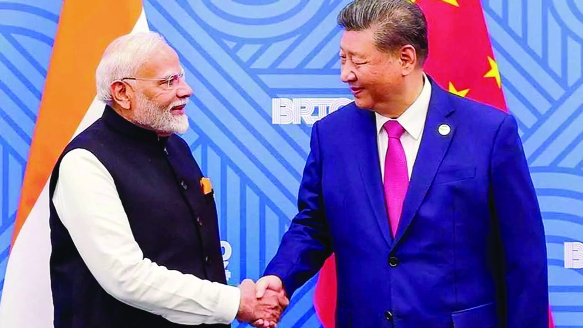
The visual spectacle of Modi seated alongside Xi Jinping and Vladimir Putin encapsulated a profound geopolitical recalibration. While India continues to partner with the United States through QUAD and Indo-Pacific initiatives, her willingness to engage at the highest levels with China and Russia signalled a commitment to strategic autonomy. This triangular moment-RIC unity-generated unease in Washington.For the Trump administration, already struggling with crises in Ukraine, West Asia, and its stalled Greenland and Panama policy narratives, the Tianjin summit was a reminder that American leverage was waning. Instead of isolating Russia and China, the U.S. found itself facing a trio of major powers projecting resilience and cooperation.
The anxiety in Washington was most vividly expressed through Peter Navarro, White House Trade Counsellor, who erupted in a Fox News interview shortly after the summit. On the one hand, Navarro called Modi a “great leader” and praised India as the world’s largest democracy. On the other, he attacked Modi for “getting into bed with Putin and Xi,” accusing India of acting as a “laundromat for Kremlin” by refining and reselling Russian oil to Western markets. His choice of words-particularly the reference to “Brahmins profiteering at the expense of the Indian people”-sparked widespread criticism, blending cultural stereotypes with economic frustration.
Navarro’s outburst betrayed more than anger at India’s independent foreign policy. It revealed the Trump administration’s frustration at its own unfulfilled promises: peace in West Asia, resolution in Ukraine, a stable South Asia after the April 2025 Pahalgam-Kashmir attack, and domestic economic revival. By misadventure of scapegoating India, Navarro inadvertently exposed the hollowness of Washington’s global leadership claims.Navarro went further in branding the Ukraine conflict as “Modi’s War,” suggesting that India’s oil trade enabled the Kremlin’s war machine. The Tianjin summit decisively countered this narrative. Putin and Xi asserted that the conflict was the consequence of NATO expansion and Western coercion, not Indian complicity. Modi himself avoided inflammatory rhetoric but reiterated India’s consistent position: dialogue, diplomacy, and respect for sovereignty.
By collectively framing the war as the responsibility of the U.S. and its European allies, SCO leaders undermined Washington’s attempt to globalize blame. The contrast between Navarro’s accusatory language and the SCO’s measured declarations highlighted the deepening divergence in narratives-an erosion of U.S. credibility and an affirmation of SCO as a platform for alternative perspectives.The Tianjin Declaration of 2025 mapped out a bold institutional future for the SCO. Plans to establish a Development Bank, intensify cooperation with BRICS+, and deepen partnerships in AI, fintech, and climate governance underscored the group’s ambition to rival Western-led systems. The growing acceptance of India’s “Grow and Let Grow” philosophy across Africa, Southeast Asia, and Latin America demonstrated that the Global South increasingly looks to New Delhi as a moral and strategic leader.
As the SCO expands its global footprint, the U.S. faces the prospect of losing its status as the uncontested superpower. A new world order, multipolar in structure and pluralistic in orientation, is emerging. India, with its blend of hard and soft power, stands at the heart of this transformation-neither beholden to Washington nor subsumed by Beijing, but charting its own path as a global pivot.The 15th SCO Summit in Tianjin was not merely another international gathering; it was a turning point in global affairs. By offering a platform where China, Russia, and India could converge, and where the Global South could articulate its aspirations, the SCO positioned itself as a genuine alternative to Western hegemony. The frustration of U.S. leadership, encapsulated in Navarro’s biting remarks, only amplified the symbolism of Tianjin.
The Tianjin SCO Summit of 2025 reaffirmed India’s stature as a pivotal voice in the emerging multipolar order, yet it also highlighted the dilemmas born of her geography and history. For her, the challenge lies in sustaining strategic autonomy while managing uneasy ties with immediate neighbours. Relations with China remain unsettled by border disputes and competing ambitions in the Indo-Pacific, while Pakistan continues to harbour and sponsor terrorism. Bangladesh, once a steady partner, has begun to test her bilateral patience, adding to the complexity of her regional environment.The key takeaway from Tianjin is that she must treat multilateral platforms like the SCO not merely as ends in themselves, but as instruments to reinforce stability, constrain hostile behaviour, and expand her leadership of the Global South. Balancing firmness with diplomacy, her strategy will depend on resilience against neighbours’ provocations while deepening global influence through inclusive engagement.Summarily, for India, the summit was significant. Modi’s projection of strength against terrorism alongside his emphasis on inclusive growth elevated her credibility as a global leader. In a world defined by multipolarity, her policy of ‘Grow and Let Grow’ resonates as both practical and aspirational.
(The columnist is a Bengaluru based educationist, a management scientist and an independent researcher)
 Follow our WhatsApp channel
