

Indu Pawar
Even after 75 years of independence, women in India continue to face immense challenges in gaining political representation. Despite their active participation in democratic processes, their role within political parties often remains confined to tokenism. Many parties give tickets to women candidates merely to satisfy internal quotas, while real power remains inaccessible.
There persists a misguided belief that women lack political awareness or leadership skills. This stereotype has led to their consistent underrepresentation in decision-making bodies. Such notions are not only unfair but also detrimental to the democratic fabric of the country.
For genuine transformation, women’s involvement must begin at the grassroots level. Their participation should go beyond symbolic gestures and extend to real leadership roles – in shaping policies, leading communities, and influencing national discourse. Equal rights must be matched with equal opportunities.
To achieve this, the government must adopt and enforce policies that ensure women’s full participation in governance. Women should receive fair constitutional representation at all levels – from local self-government bodies to state legislatures and Parliament. Furthermore, institutions must guarantee equal economic opportunities, as financial independence is essential to political empowerment. Only when women are empowered both socially and economically can they emerge as influential leaders and change-makers.
At the same time, women themselves must become more aware and assertive. They must actively claim their legal and constitutional rights. Laws alone cannot bring change unless women themselves take initiative to lead and participate in public life.
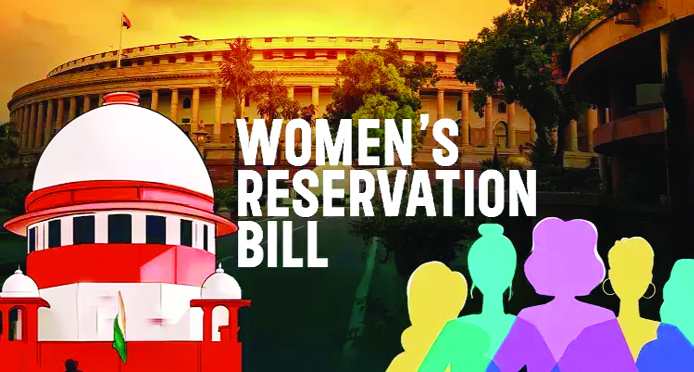
In this context, the Women’s Reservation Bill marks a significant step forward. The bill proposes 33% reservation for women in the Lok Sabha and State Assemblies, with one-third of these reserved seats allotted to women from Scheduled Castes (SC) and Scheduled Tribes (ST). The reservation is set for an initial period of 15 years and may be reviewed thereafter based on constitutional needs.
Importantly, while the bill has been passed by both houses of Parliament, its implementation is dependent on the completion of the delimitation process. It is estimated that the bill will take effect before the general elections of 2029. However, this delay has drawn criticism. Many experts question the bill’s immediate impact and express concern that without swift implementation, the spirit of the bill may be lost.
Another area of concern is the bill’s silence on reservation for women from the Other Backward Classes (OBC). Given the large population of OBC women, their exclusion from the bill’s provisions has sparked debate and demands for broader inclusion.
It is worth remembering that the Congress party had earlier introduced 33% reservation for women in Panchayats and Municipal Corporations. That historic move created hope for women’s increased participation in governance. Unfortunately, beyond that point, progress has stalled, leaving women’s political empowerment hanging in uncertainty.
The passage of the Women’s Reservation Bill is undoubtedly a landmark moment in Indian legislative history. But its true success will depend on timely implementation, inclusive policies, and a genuine shift in societal and political mindsets. Representation must not be reduced to symbolism – it should lead to real empowerment, leadership, and equity.If the government itself is committed and willing to act, then where does the gap lie?”
 Follow our WhatsApp channel
