

Professor Jasbir Singh
In the journey of nation-building, certain thinkers leave behind an enduring legacy that continues to guide generations. Pandit Deendayal Upadhyaya, a philosopher, politician, and nationalist, was one such towering leader. His vision of Integral Humanism and his advocacy of the Swadeshi ideology have had a profound influence on India’s political and economic discourse. In today’s rapidly changing world, his ideas are not only relevant but also crucial in shaping an independent, self-reliant, and morally grounded India.
Legacy of Leadership and National Service
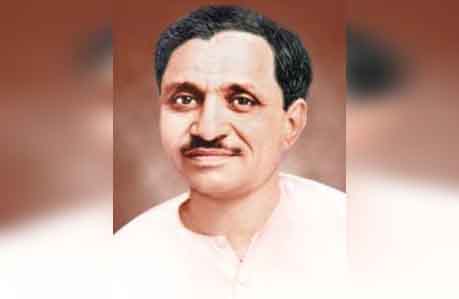
Today, we are celebrating the birth anniversary of Pandit Deendayal Upadhyaya, who was born on September 25, 1916 (Ashwin Krishna Trayodashi, Samvat 1973) in village Nagla Chandraban, now called Deendayal Dham, near the town of Farah in Mathura District in Uttar Pradesh. Every time one reads, speaks, listens, thinks, and discusses his thoughts, one experiences freshness, a new perspective, a novelty in his words and thoughts. His each thought and word make him a unique personality in the world. Pandit Deendayal Upadhyaya is an unparallel example of how a leader should be in social life, how to live up to the democratic values and imbibe the morals and ethos of this great country India.
Pandit Deendayal Upadhyaya is revered by all, irrespective of different ideologies. In his political career, he maintained cordial relations with everyone. He wrote his political diary, in which he openly criticized the Nehru government policies on security, food, and agriculture. But when he published his diary in the form of a book, he got its foreword written by Congress leader and the then UP Chief Minister Sh. Sampurnanand. In his foreword, Sh. Sampurnanand commented that this book is a “psychological glow” for future readers. Today, we are observing how this ‘glow’ of the thoughts of Pandit Deendayal Upadhyaya is spreading its shine in the whole of India. Based on this, India is marching toward modernization and taking on the reins of world leadership.
The Philosophical Foundation: Integral Humanism
Pandit Deendayal Upadhyaya’s most important contribution to Indian political thought is his philosophy of Integral Humanism. It is a unique ideological framework that integrates the physical, intellectual and spiritual aspects of human life. His philosophy goes with the objectives of humankind where, according to him, humankind has four attributes- body, mind, intellect, and soul which correspond to four universal objectives, Kama (desire or satisfaction), Artha (wealth), Dharma(moral duties), and Moksha (total liberation or salvation). For him, Dharma is the basic and Moksha the ultimate objective of humankind and society.His philosophy of Integral Humanism, a synthesis of the material and the spiritual, the individual and the collective, bears eloquent testimony to all this.
In the field of politics and economics, Pandit Deendayal Upadhyaya was realistic and down to earth. He visualized for India a decentralized polity and self-reliant economy with the village as the base.Unlike western ideologies that often prioritize economic growth over human well-being, Pandit Deendayal Upadhyaya placed human beings at the centre of development. For him, the true progress of a nation could not be measured by technological advancements alone, but by the well-being and dignity of its common citizens, especially those in rural India.
Critique of Western Economic Models
Pandit Deendayal Upadhyaya was critical of the western economic models adopted after independence. He opposed the mixed economy model, which he saw as a confused blend of capitalism and socialism, lacking any cultural or ideological coherence with Indian values.He warned against the blind imitation of the west, emphasizing that while western science could be helpful, thoughtless replication of its lifestyle and institutions would harm India’s socio-cultural identity. According to him, any model of development must be tailored to India’s unique conditions, traditions, and aspirations.
Swadeshi: The Path to Self-Reliance
Central to Pandit Deendayal Upadhyaya’s vision was the principle of Swadeshi-a concept that went beyond economic self-sufficiency. He defined Swadeshi as a way of life that promotes: Local production and consumption; Decentralized economic structures; Human dignity through meaningful employment; and Moral economy rooted in Dharma
Pandit Deendayal Upadhyaya believed that not only due to different ideals of life but also because of different conditions in terms of time and place the way of our economic development will have to be different from that of the west. Even those who realise that they are dependent upon certain systems are not able to step out of their orbits. In the past, the economic prosperity of the west had a blind belief in us about the western system of production. Western economists produced so much critical literature that we easily felt overwhelmed by it. We could not rise above it. It is possible that this science of economics may have some principles that do not depend upon time, place or system and can prove useful to all, but very few have the capacity to assess this quality. No doubt as Pandit Deendayal Upadhyaya himself pointed out that every economic action based on policy guidelines has to be undertaken based on socio-economic cost benefit analysis. The action has to be based on facts – data and analysis- that tells us that there is economic benefit to the society. Economic system of the nation has to be designed to provide all human necessities of the population and goods and services required to protect the nation from aggressors. In addition to these, there has to be objective of helping people of other nations also. And India during the last ten years stands tall in these contexts by imbibing the outlook and philosophy of Pandit Deendayal Upadhyaya for humanitarian progression.
For Pandit Deendayal Upadhyaya, economic democracy was just as important as political democracy. “Vote for all” must be accompanied by “Work for all.” He advocated for employment that is both meaningful and chosen, not forced. According to him, a person who works but is not given a fair share in national income is as good as unemployed.
Relevance in Contemporary India
Speaking at the Samudra se Samriddhi event Narendra Modi, Prime Minister of India said, “India is moving forward with the spirit of global brotherhood and India has no major enemy in the world today, but in true terms, Indian’s biggest adversary is dependence on other nations”. Today, the Swadeshi spirit finds renewed emphasis under the leadership of Prime Minister Narendra Modi, who has repeatedly stressed that dependence on foreign powers, is a national weakness. The government’s initiatives like Aatmanirbhar Bharat (Self-Reliant India), Make in India, and efforts towards defence indigenization are practical manifestations of Pandit Deendayal Upadhyaya’s ideals.
India has also shown resilience on the international stage-be it standing up to tariff pressures, defending the interests of Indian farmers and MSMEs, or withstanding geopolitical challenges. The country’s growing status as the third-largest economy by purchasing power parity (PPP) is a testament to its inner strength and strategic vision.
Conclusion
At a time when the world faces crises of identity, morality, and sustainability, Pandit Deendayal Upadhyaya’s philosophy presents a timeless blueprint for progress-where development is not just about GDP, but about the well-being of the last person in the last village. Truly, aligning India’s development with his ideology is not only a tribute to a great thinker but a step towards realizing the full potential of Bharat Mata.
The author is chair Professor at Pandit Deendayal Upadhyaya, University of Jammu
 Follow our WhatsApp channel
