

Lt Gen Narendra Kotwal (R), Dr Anil Mehta
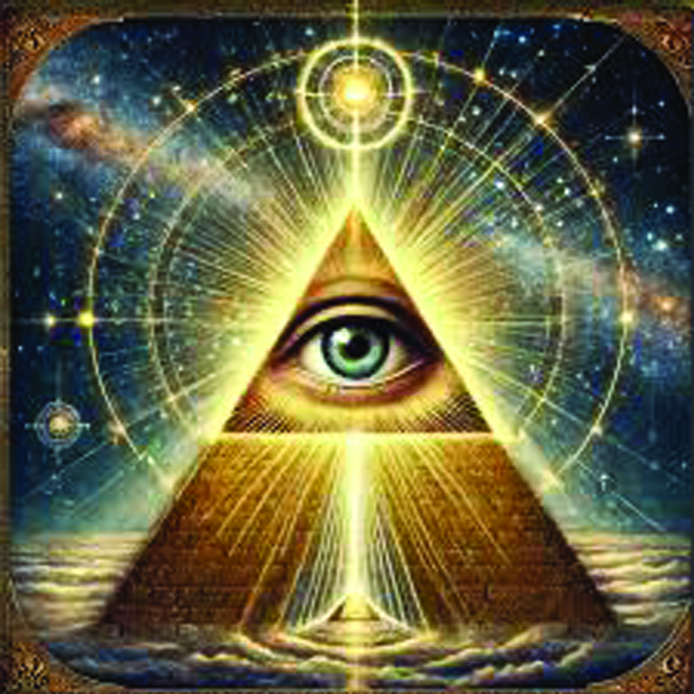
In daily life, our identity is often structured as a triangle of body, mind, and intellect mirroring the three vertices of form-bound existence. The body engages with the world, the mind processes perception and emotion, and the intellect exercises will and reason. This “Triangle of Existence” is a geometric metaphor for our empirical,limited reality. It defines us, but also confines us.
Even our physical posture in meditation seated with two knees and a head resembles a triangle. Yet, this triangle, though stable, is also finite. It reflects our structured effort to reach the infinite, but by itself, it doesn’t provide access to the boundless universe or our deepest origin. We sit as triangles, but we must awaken as circles. In fact, even before birth, we are shaped by the wisdom of this geometry. The child in the womb occupies the uterine cavity in a circular form through an attitude of universal flexion, where the fetal body curves naturally inwards, as if held by the arms of wholeness. This flexion is not just anatomical it is symbolic. It reflects a state of primal harmony, completeness, and sacred enclosure. Any deviation from this attitude is clinically considered abnormal, further affirming that our original design physiologically and spiritually is inherently circular.
Thus, the triangle, though a functional structure in our waking life, is a construct that arises later, shaped by separation, linear thought, and identity formation. Th journey of realization lies in tracing back from the angularity of effort to the effortless grace of the circle within.
The Inner Circle and the Universal Circle
Within this personal triangle lies a small circle of wisdom our buddhi, or inner intelligence. This circle is not merely cognitive; it is the silent knower, the intuitive witness. This inner circle, however, is embedded in a far greater circle ,the Circle of Universal Intelligence ,the field of consciousness that Krishna refers to when He says: I am the Self, O Gudakesha, seated in the hearts of all beings. (Bhagavad Gita 10.20).The small circle of self and the vast cosmic circle are not separate. There is a ripple effect, a quantum resonance. As our awareness expands, the inner circle begins to vibrate with the universal field. This merging is not linear but entangled, coherent, and infinite in potential just like the principles of quantum mechanics suggest. In this expanded geometry, we realize: the Self is not a point within a triangle; it is the centre of a circle that has no circumference. This is the mystical paradox: the Self is both the still point and the boundless totality.
Only the Baffled Human has a Triangle
In the natural world, there are no triangles. All other life forms plants, animals, rivers, galaxies exist in circular rhythms. They flow, they spiral, they pulse without edges. It is only the human being confused by ego, distracted by intellect, and seduced by desire that breaks the flow and develops angles. Ironically, we too were born as circles. Every newborn child is a being of wholeness pure awareness without divisions. The infant has no concept of self and other, no separation of mind and body. It exists in unity. Only with conditioning, fear, ambition, and intellectual over use do the sharp edges of the triangle emerge bringing disconnection and suffering.
The spiritual journey, therefore, is not one of acquiring, but of remembering. We are not trying to become something new we are returning to what we originally were: a circle complete, seamless, radiant.
Mathematics, Physics, and Theology Converge
Mathematically, as the sides of a triangle increase infinitely, it approaches the shape of a circle. (pi), which defines the circle, is infinite and irrational symbolizing the very nature of the Self, which cannot be fully grasped by intellect alone. In quantum terms, consciousness mirrors a wave function until observed, it remains undefined and interconnected. The triangle corresponds to the collapsed, limited self; the circle is the field of all possibilities. The observer effect in quantum physics reminds us that awareness shapes reality. When we align the inner circle of awareness with the outer field of cosmic intelligence, reality changes.
Theologically, this concept finds profound resonance. In Vedantic philosophy, the Self is Sat-Chit-Ananda being, consciousness, and bliss. In Christian mysticism, God is described as a circle whose centre is everywhere and circumference nowhere. In Sufism, the seeker spirals inward to the heart of the Beloved. The message is clear across traditions: the truth of existence is circular, not angular.
To move from the triangle to the circle is to move from ego to essence, from fragmentation to fullness, from striving to being. The Self is not a prisoner of the triangle, it is the silent centre of a sacred circle that extends to infinity. Let us visualize ourselves not as fixed angles between knees and head, but as inner circles of wisdom nested within the vast circle of the cosmos. In this sacred geometry, we are not isolated points, but pulsating centres of universal awareness.
To live in the circle is to live in peace, rhythm, and resonance to realize that we are the ripple and the ocean, the centre and the whole, the self and the Self.
 Follow our WhatsApp channel
