

Dr. Daisy Parihar
daisy.parihar@gmail.com
There are stories that make headlines for a day and then disappear. And then there are stories that never truly leave – they settle quietly into the heart, lingering long after the noise fades. Harish Rana’s story is one of those.
It is not just the story of a young man. It is the story of a dream that once shone brightly, of parents who refused to give up, of years filled with hope and helplessness, and of a goodbye that took thirteen long years to finally be spoken.
Born on 12 September 1993, Harish Rana was everything a family could hope for. Bright, disciplined, and deeply respectful, he carried within him a quiet determination that set him apart. He was not the loudest in the room, but he was always among the most focused. His teachers admired him, his friends respected him, and his parents saw in him a future they had long dreamed of.
For his mother, he was more than just a son – he was her world, her pride, her constant source of joy. For his father, he was hope made real, a promise that all their sacrifices would one day find meaning. Harish did not just dream of success; he worked for it, step by step, with patience and sincerity.
When he secured admission to Panjab University, it felt like the beginning of everything they had envisioned. A new chapter had opened, full of possibilities, aspirations, and quiet confidence. Life seemed to be moving exactly as it should.
And then, without warning, everything changed.
On 21 August 2013, a single moment altered the course of his life forever. A fall from the fourth floor of his paying guest accommodation left him critically injured. The damage to his brain was severe. The boy who once spoke with clarity and purpose was suddenly reduced to silence.
Doctors worked tirelessly. Machines were connected. Tubes were inserted to help him breathe and survive. But soon came the words that no parent is ever prepared to hear – there was very little hope of recovery.
Yet for parents, even the smallest possibility is enough to hold on to. And so, they did.
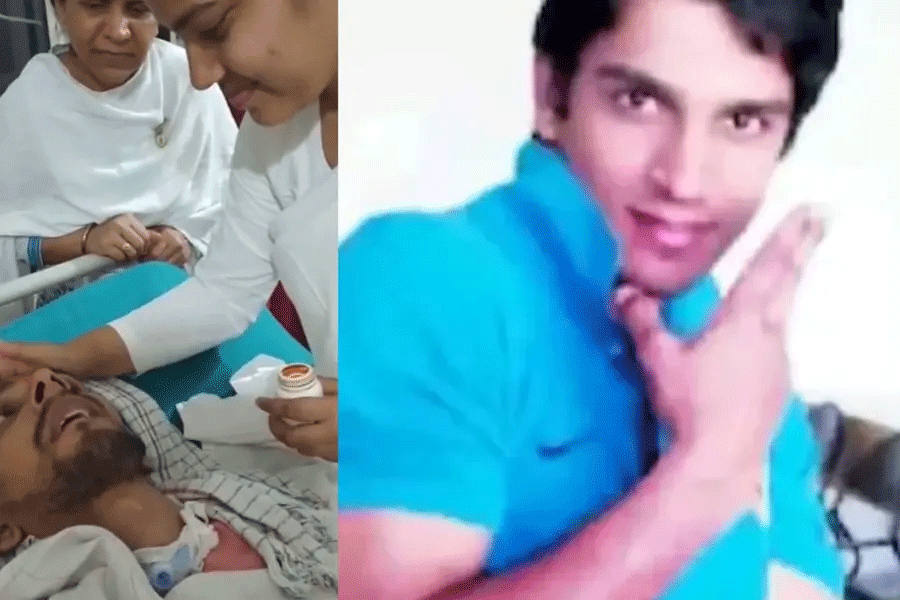
Days turned into weeks, weeks into months, and months into years. Harish slipped into a vegetative state – a condition where the body continues, but the person, as they once were, seems out of reach. He required constant medical support. A tracheostomy tube helped him breathe, and feeding tubes sustained his body. He lay confined to a bed, unmoving, unresponsive.
But to his parents, he was never just a patient. He was their son.
His mother refused to let silence take over. She spoke to him every day, as if he could hear her, as if he would respond. She would recall his childhood, the little moments that once filled their home with laughter. She would gently hold his hand and whisper, “Harish, do you remember how you used to hug me from behind?” Her voice carried hope, even when reality did not.
His father, though quieter, carried his own storm within. He took responsibility for everything – the treatments, the care, the endless routines – but more than that, he carried the unbearable weight of watching his son exist without truly living. Still, he remained strong, because he believed that strength was what his son needed.
Years passed, but nothing changed.
The world outside moved forward – people celebrated, seasons changed, life went on – but inside that room, time seemed frozen. Every day was the same, filled with routine, waiting, and a hope that refused to die.
But hope, no matter how powerful, cannot rewrite reality forever.
Doctors remained consistent in their assessment. There was no meaningful improvement. No sign that Harish would return to the life he once knew. Slowly, painfully, a truth began to settle into the hearts of his parents – the son they remembered was not coming back.
What remained was a body sustained by machines, a life held in place by medical intervention rather than natural existence.
And then came the most difficult question of all: were they holding on for him, or for themselves?
Love, they realized, is not always about holding on. Sometimes, it is about letting go.
With heavy hearts and unimaginable courage, his parents made a decision no parent should ever have to make. They approached the courts, seeking permission for passive euthanasia – the withdrawal of life support in a case where recovery was no longer possible.
This was not an act of giving up. It was an act of love.
The case reached the Supreme Court of India, where medical boards reviewed his condition in detail. The years of suffering, the lack of improvement, and the realities of his medical state were all carefully examined. After thorough consideration, permission was granted to withdraw life support, acknowledging that prolonging biological existence in such a condition was not in his best interest.
For the world, it was a legal decision.
For the family, it was the end of a long, painful journey.
In the final moments, the room was filled with silence – a silence that carried thirteen years of hope, pain, and unanswered prayers. His mother sat beside him, holding his hand, her heart heavy yet strangely calm.
With tears in her eyes, she whispered words that must have taken every ounce of strength she had, “Forgive everyone… it’s time to go now.”
His father stood nearby, his silence speaking more than words ever could. A man who had held himself together for years finally allowed himself to feel the depth of his loss.
There were no dramatic farewells. No final responses. Only a quiet acceptance, a release from years of suffering, and a love that remained unbroken till the very end.
And even in that moment of unbearable grief, the family made a choice that reflected extraordinary humanity. They decided to donate his organs, hoping that even in death, their son could give life to someone else.
In losing their own child, they chose to save another.
It was a decision born not out of obligation, but out of compassion – a final act of love that extended beyond their own pain.
Harish Rana’s story is not just about tragedy. It is about resilience, about the depth of parental love, and about the difficult balance between hope and acceptance. It is about understanding that sometimes, holding on can cause more pain than letting go.
More than anything, it is a reminder of how fragile life truly is.
We move through our days believing in certainty. We make plans, chase ambitions, and assume that tomorrow will come just like today. We delay conversations, postpone forgiveness, and take moments for granted, believing there will always be another chance.
But life does not always offer that luxury.
In a single moment, everything can change. A routine day can turn into a lifelong struggle. A future full of promise can pause without warning.
Harish’s story reminds us of a truth we often choose to ignore – life is unpredictable. No one knows what the next moment holds.
So perhaps the lesson is simple, yet profound. Hold your loved ones a little closer. Speak the words you have been keeping inside. Forgive more easily. Love more openly.
Because sometimes, there is no perfect time.
And sometimes, there is no next time.
Life is unpredictable, and no one knows what the next moment may bring.
 Follow our WhatsApp channel
