

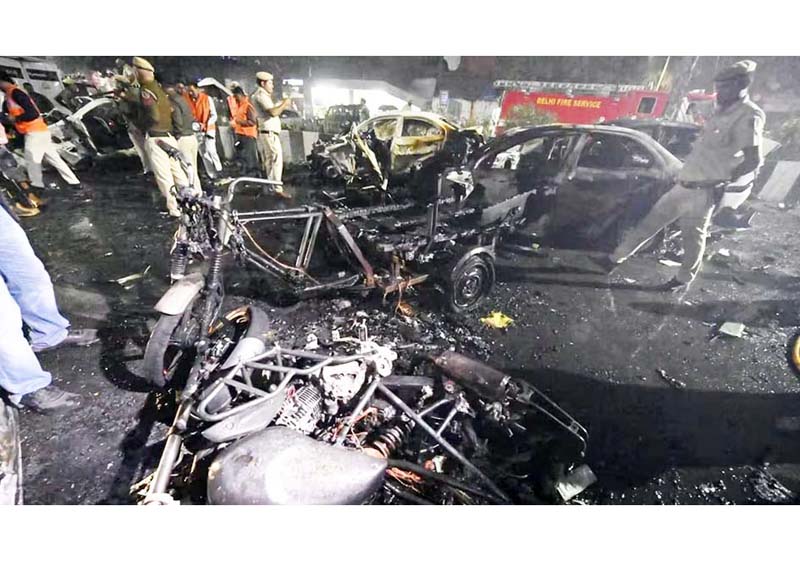
The deadly explosion near Delhi’s Red Fort on Monday evening has jolted the nation’s collective conscience and sent shockwaves throughout the nation. Twelve people have lost their lives, scores are injured, and several vehicles have been gutted in what appears to be one of the most serious terror incidents in the national capital in recent years. The intensity of the blast, which shattered windows several metres away and sparked panic across one of the most crowded parts of the city, underscores not just the scale of destruction but the grave vulnerability of urban India to terror networks that continue to evolve and infiltrate.
What lends this incident an even darker dimension is the disturbing backdrop of recent intelligence inputs and recoveries. Just hours before the explosion, authorities had seized nearly 2,900 kilograms of explosive material from multiple locations in and around Delhi. Even more alarming was the recovery of a large cache of arms and explosives from the residence of a Kashmiri doctor in Faridabad. Preliminary investigations now suggest that the driver of the car involved in the blast and one of his accomplices were also from Kashmir. In the chain of ownership of the Hyundai i20 used for the explosion, another Kashmiri name has surfaced. These links may not be mere coincidences. Investigators believe that the recovery of such a massive stockpile of explosives and subsequent arrests may have panicked the module, forcing them into a premature and desperate move. If true, this points to a much larger conspiracy-one that possibly spans multiple states and involves individuals who would otherwise have never come under the security radar.
The involvement of highly educated individuals, including doctors, in such nefarious acts is particularly chilling. It exposes how radicalisation has penetrated segments of society once thought to be immune from extremist ideologies. The recent case of an AK-47 rifle found in the locker of a doctor at a Government Medical College in Kashmir further underlines this disturbing trend. Terrorism today is not confined to the uneducated or economically deprived; rather, it has mutated into an insidious network that can lure or corrupt minds from all walks of life.
This evolution demands an urgent rethinking of our counter-terror strategies. The traditional focus on known suspects and fringe groups must now be supplemented with more nuanced intelligence-gathering that maps social, digital, and ideological networks. The digital ecosystem has become the new breeding ground for extremism-where recruiters operate anonymously, narratives are weaponised, and indoctrination occurs through encrypted platforms. The security apparatus must therefore invest heavily in cyber surveillance, data analytics, and digital forensics to stay ahead of such threats. At the same time, incidents such as the Red Fort blast highlight the need for a swift, professional crisis response.
From a broader perspective, this attack also serves as a sobering reminder that terrorism continues to mutate, exploiting every available loophole. Terror outfits are no longer limited by geography or ideology; they adapt, re-strategise, and strike when vigilance dips. In this context, complacency is the biggest enemy. Security agencies, including the NIA, NSG, and Intelligence Bureau, have proven their capabilities in the past by cracking complex terror cases. Yet, the new wave of hybrid terrorism-fuelled by technology, disinformation, and radicalisation of the educated-requires an equally adaptive and proactive response.
The government and security forces will undoubtedly bring the perpetrators and their handlers to justice. Still, the larger challenge lies in addressing the roots of radicalisation and ensuring that no educated, young, or professional individual falls prey to extremist propaganda. From shock to defiance, India stands united against those who seek to disturb its peace and divide its people. India has overcome countless terror challenges in the past, and it will do so again. But the message from this horrific incident is clear: the enemy is still lurking, recalibrating its methods, and probing for weaknesses. There is no room for laxity. The fight against terror must be relentless, intelligence-driven, and unified. Terrorism, whatever its form or face, will find no refuge in India, for the noose of law and the will of the people will always prevail.
 Follow our WhatsApp channel
