

shakir mustehsin
shakirmustehsin@gmail.com
The Cost of Curiosity
Before the internet became an affordable, omnipresent utility in India, its meaning to the average citizen, those who were not particularly “tech-savvy”, was charmingly limited. It lived within a few familiar domains such as Facebook, Wikipedia, and Google. In those days, downloading a modest 03 MB MP3 file could take an entire day, yet no one considered it an inconvenience; it was simply the cost of curiosity.
Life moved at a different rhythm since then. Elders spent their time diagnosing the perceived moral decline of the youth. Toddlers reigned over kingdoms built of plastic toys rather than pixels. Education was offline, structured and intellectually peaceful. Youngsters roamed alleyways as freely as leaves on a spring breeze.
The Scale of the Paradox
We haven’t entirely lost these scenes, but the scale has shifted. Today, nearly 120,000 apps are released every month. From college professors to fruit vendors, we all occupy the same digital platforms. The average smartphone now carries close to 80 apps and with them our habits have transformed
Songs are no longer downloaded; they are streamed and discarded. Elders have traded social critique for personalized feeds. Toddlers now resist breakfast unless accompanied by the hypnotic glow of high-contrast reels.
We celebrate this as “efficiency,” but it is a paradox that reduces human labor while simultaneously reducing human involvement. But beneath this celebration lies a far less glamorous concern, privacy.
The “Dull” Reality of Privacy
Privacy often sounds dull – Almost as dull as a prime time news anchor reciting rehearsed admiration for a political patron. Yet its significance is anything but trivial. As Edward Snowden wrote in Permanent Record:
“Ultimately, saying that you do not care about privacy because you have nothing to hide is no different from saying you do not care about freedom of speech because you have nothing to say.”
It often begins innocently, with a few taps on the familiar “Allow” button, typically positioned at the bottom right corner of a newly installed app or website. Allow location. Allow contacts. Allow storage. Allow, allow, allow.
That seemingly harmless sequence grants access to far more than one might imagine. GPS coordinates, contact lists, stored media, browsing patterns, usage habits, and a rich collection of metadata quietly come together to sketch a detailed portrait of your life. All of this in exchange for convenience, and hidden beneath terms and conditions long enough to qualify as short essays.
This data is the currency we pay for convenience, hidden beneath terms and conditions long enough to be essays.
The Dark Poetry of Code
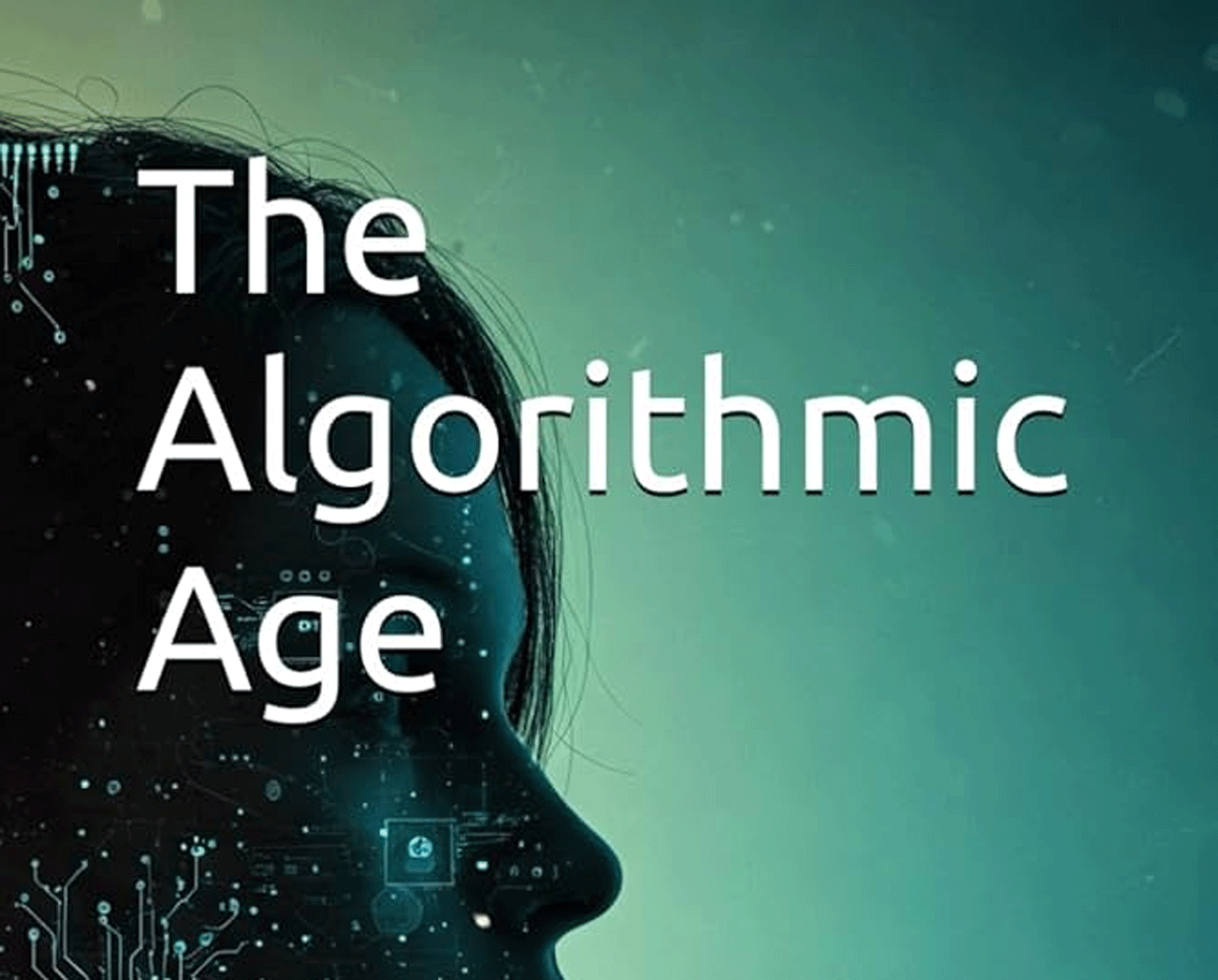
Beneath the screen, algorithms operate with binary certainty. They are disturbingly perceptive, anticipating your pauses, your swipes and even your moments of hesitation. It is a kind of dark poetry written in code rather than words.
The result is a universal lament: “I do not even realize where the time goes”. Time – the elusive fourth dimension – is no longer spent in contemplation, but in consumption.
The Solution: Uninstall. Remove. Disengage
The remedy is neither revolutionary nor complex, yet we often choose “more consumption” instead. To break the cycle, we must be not only Selective in identifying what genuinely benefits you but also disengage/delete what does not serve a purpose without ceremony as well as recognize limits to endless scrolling.
Despite the promises of the digital age, one rarely encounters a neurosurgeon, a scientist, or a scholar who attributes their mastery solely to endless scrolling. Technology can assist, certainly, but dependence is a different matter altogether. One would hope never to encounter a surgeon pausing mid operation because the internet failed and a tutorial refused to load.
As for your data, there is little room for illusion. It is collected, processed, analyzed, shared, and ultimately monetized. They sniff it all, they know it all, they collect it all, process it all, exploit it all, and partner it all, with an efficiency that would be admirable, if it were not so intrusive.The system is efficient. Relentlessly so.
You may not be able to stop your data from being collected entirely. That battle, for now, is uneven.
In an age designed to take everything, choosing to withhold is a quiet act of resistance.
Shakir Mustehsin
Computer Science Engineering Student, CU, Srinagar and can be reached at
 Follow our WhatsApp channel
